
How to Become a Phlebotomy Technician in 2026
Is Phlebotomy Technician Right for You?
The U.S. Department of Labor's O*NET profile for Phlebotomists (SOC 31-9097) describes the work this way: Draw blood for tests, transfusions, donations, or research. May explain the procedure to patients and assist in the recovery of patients with adverse reactions.
What the work involves
- Dispose of contaminated sharps, in accordance with applicable laws, standards, and policies.
- Organize or clean blood-drawing trays, ensuring that all instruments are sterile and all needles, syringes, or related items are of first-time use.
- Draw blood from veins by vacuum tube, syringe, or butterfly venipuncture methods.
- Match laboratory requisition forms to specimen tubes.
- Dispose of blood or other biohazard fluids or tissue, in accordance with applicable laws, standards, or policies.
Skills and knowledge that matter
Skills: Service Orientation, Social Perceptiveness, Speaking, Active Listening, Critical Thinking, Writing.
Knowledge: Customer and Personal Service, English Language, Administrative, Education and Training.
Tools and technology you may use
Tools: Aliquot tubes, Barcode scanners, Biohazard spill kits, Blood collection syringes, Blood culture bottles, Blood culture incubators.
Technology: Medical software, Web platform development software, Spreadsheet software, JavaScript, MEDITECH software, Microsoft Excel.
Typical preparation
O*NET Job Zone Three (Medium Preparation Needed). Most occupations in this zone require training in vocational schools, related on-the-job experience, or an associate's degree. Employees in these occupations usually need one or two years of training involving both on-the-job experience and informal training with experienced workers. A recognized apprenticeship program may be associated with these occupations.
Interest fit
O*NET interest profile: Realistic, Conventional, Investigative. People who enjoy hands-on, practical work with tools, machines, plants, or materials often find this occupation a good fit.
Source: O*NET 29.1 (updated 2026-06-13)
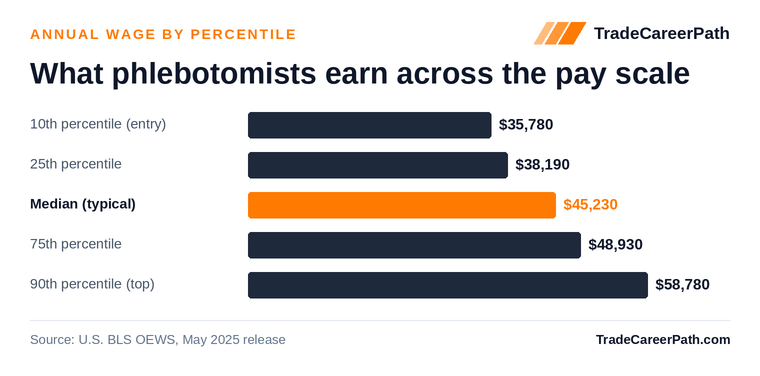
Quick answer: Training as a phlebotomy technician usually takes under a year, with many certificate programs running about 4 to 8 months. You finish a training program, complete supervised clinical hours drawing blood, and in most cases earn a certification such as the NHA Certified Phlebotomy Technician (CPT). No college degree is required, and certification is mandatory in only a few states, though most employers expect it. The median phlebotomist salary is $45,230 per year ($21.75/hour), and employers post about 18,400 openings nationwide each year (BLS, May 2025).
Phlebotomy technicians, also called phlebotomists, draw blood and collect specimen samples that labs use for testing and diagnosis. They work in hospitals, diagnostic labs, blood donation centers, and clinics. It is one of the fastest ways to start a hands-on healthcare career without a long degree.
How to Become a Phlebotomy Technician
Most people enter the field in under a year. There is no single national license to earn. Instead, you build the career through a short training program, supervised clinical hours, and a certification that employers recognize.
1. Earn a high school diploma or GED
A high school diploma or GED is the minimum requirement for nearly every phlebotomy program and almost every entry-level lab job. Before you enroll, it helps to build the foundation the work depends on. High school biology and anatomy give you a head start on the human body and the circulatory system, and basic math helps with labeling, measurement, and sample tracking. Comfort with computers matters too, since labs run on electronic health records and specimen-tracking software. If you are changing careers and already hold a diploma or a degree in another field, you can move straight to the next step. Many strong phlebotomists come from unrelated backgrounds and bring useful skills in customer service, organization, and staying calm with nervous patients. Soft skills count here as much as science, because you will work face to face with people who are often anxious about needles.
2. Complete a phlebotomy training program
This is the core credential, and most students earn it through a certificate program at a trade or technical school or a community college. These programs often run about 4 to 8 months, and some accelerated options run shorter. Associate degree paths exist too, but they are not required for entry-level work. Costs vary by program and school, so compare current tuition with the schools you are considering rather than assuming a single price. Typical coursework covers human anatomy and physiology, venipuncture and finger-stick technique, specimen collection and labeling, bloodborne pathogen and infection-control safety, and basic medical terminology. Look for a program that includes a supervised clinical or externship component, because hands-on blood-draw practice is what employers and certifying bodies want to see. Online and hybrid formats let you handle the classroom theory remotely, but the clinical hours must be completed in person at a partnering lab or clinic.
3. Complete your clinical hours
Classroom learning prepares you, but you cannot work as a phlebotomist without sticking real veins. Most certification exams and employers expect a minimum number of successful venipunctures and capillary (finger-stick) draws logged under supervision. Good programs build this into an externship at a hospital, clinic, or diagnostic lab, where you practice on actual patients while an experienced phlebotomist or instructor checks your technique. Use this time to get comfortable with the full routine: verifying patient identity, choosing a vein, labeling tubes at the bedside, and easing patients who are afraid of needles. If your program does not place you, ask local labs and blood donation centers about clinical or volunteer opportunities. The hours you log here work as the evidence on your application that you can draw blood cleanly and safely, which matters far more to a hiring manager than a grade on a written test.
4. Earn a phlebotomy certification
In most states certification is strongly preferred by employers, and a few states, such as California, require it by law before you can draw blood. Several recognized national credentials exist, and they are largely interchangeable to employers:
- Certified Phlebotomy Technician (CPT) from the National Healthcareer Association (NHA)
- Registered Phlebotomy Technician (RPT) from American Medical Technologists (AMT)
- Phlebotomy Technician (PBT) from the American Society for Clinical Pathology (ASCP) Board of Certification
Eligibility usually depends on completing an approved training program and documenting a set number of supervised blood draws. Each exam tests anatomy, collection technique, safety, and specimen handling, and each certifying body charges its own exam fee. Pick the credential your target employers ask for, and check your state’s rules and your school’s exam pass rate before you commit.
5. Apply for phlebotomy jobs
Hospitals, diagnostic and reference labs, blood donation centers, physician offices, and outpatient clinics all hire phlebotomists. On your resume, lead with your certification and the number of clinical draws you have logged, since that is the first thing a lab supervisor looks for. Many new phlebotomists start with mobile draw teams or busy outpatient labs, which build speed and confidence fast. Once you have experience, you can move into lead phlebotomist, specimen-processing, or donor-center roles, and the job is a common stepping stone toward training as a medical laboratory technician, medical assistant, or nurse.
What Does a Phlebotomy Technician Do?
Phlebotomy technicians collect blood and other specimen samples that labs use to diagnose and monitor disease. They are often the only clinical staff a patient meets during a lab visit, so accuracy and a calm bedside manner both matter. Most of the day is spent drawing blood, labeling samples correctly, and getting them to the lab without error.
Typical duties include:
- Drawing blood using venipuncture or finger sticks
- Verifying patient identity and labeling samples at the bedside
- Maintaining sterile, safe equipment and following infection-control rules
- Reassuring patients and easing discomfort during draws
- Transporting and logging specimens for analysis
Skills That Make a Great Phlebotomist
- Steady hands and close attention to detail
- Compassion and patience with anxious patients
- Clear communication and a professional manner
- Solid knowledge of safety and infection control
- The ability to stay calm in a fast-paced setting
Work Settings for Phlebotomists
Phlebotomy technicians work in many environments, including:
- Hospitals and emergency departments
- Diagnostic and reference laboratories
- Blood donation and plasma centers
- Physician offices and outpatient clinics
- Mobile draw teams and community health drives
Education and Certification Paths
| Pathway | Typical Duration | Outcome |
|---|---|---|
| Certificate program | About 4 to 8 months | Most common entry credential |
| Associate degree | About 2 years | Broader healthcare foundation |
| Clinical externship | Built into training | Required supervised blood-draw hours |
| Certification exam | After training | CPT, RPT, or PBT credential |
Career Growth and Advancement
With experience, phlebotomy technicians often move into roles such as:
- Lead or Senior Phlebotomist who trains newer staff
- Medical Laboratory Technician
- Medical Assistant
- Nurse (LPN or RN) with further schooling
- Clinical Research Coordinator
Cost and Duration of Training
- Program cost: varies by program and school, so confirm current tuition with each school you consider
- Time to complete: many certificate programs run about 4 to 8 months, with some shorter
- Certification exam fees: set separately by the certifying body
Many programs offer online or hybrid classroom theory, but the required clinical hours must be completed in person.
Pros and Cons of Being a Phlebotomy Technician
Pros
- Short training, often under a year
- Steady demand in hospitals and labs
- A direct entry point into healthcare
- Rewarding patient interaction
Cons
- Regular exposure to blood and needles
- Repetitive, on-your-feet tasks
- Strict safety standards to follow
Quick Facts: Phlebotomy Salary, Education, and Outlook

Industry Organizations & Certifying Bodies
These are the recognized national organizations, unions, certifying bodies, and regulatory authorities that shape this trade. They issue the credentials, sponsor the apprenticeships, publish the codes, and represent workers and employers.
- American Society for Clinical Pathology (ASCP) Board of Certification Issues the Phlebotomy Technician (PBT) certification.
- National Healthcareer Association (NHA) Issues the Certified Phlebotomy Technician (CPT) credential.
- American Medical Technologists (AMT) Issues the Registered Phlebotomy Technician (RPT) credential.
Wage and Employment Charts
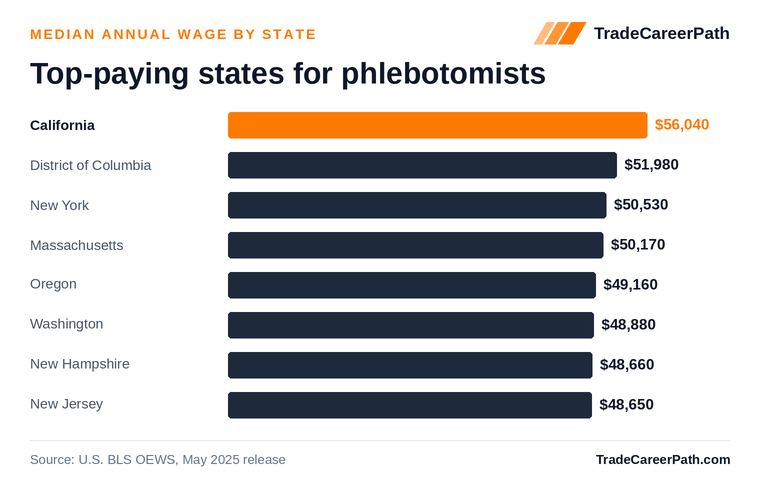
Phlebotomy Technician Salary and Requirements by State
Select your state for local wage data, training options, and requirements:
Alabama · Alaska · Arizona · Arkansas · California · Colorado · Connecticut · Delaware · District of Columbia · Florida · Georgia · Hawaii · Idaho · Illinois · Indiana · Iowa · Kansas · Kentucky · Louisiana · Maine · Maryland · Massachusetts · Michigan · Minnesota · Mississippi · Missouri · Montana · Nebraska · Nevada · New Hampshire · New Jersey · New Mexico · New York · North Carolina · North Dakota · Ohio · Oklahoma · Oregon · Pennsylvania · Rhode Island · South Carolina · South Dakota · Tennessee · Texas · Utah · Vermont · Virginia · Washington · West Virginia · Wisconsin · Wyoming
Workplace Safety Snapshot
BLS Survey of Occupational Injuries and Illnesses data (2023-2024) report approximately 243.9 days-away, restricted, or transfer cases per 10,000 full-time-equivalent workers in phlebotomists (about 2.44 per 100 FTE). Source: BLS Survey of Occupational Injuries and Illnesses, Table R98.
Frequently Asked Questions
How long does phlebotomy technician training take?
Most people finish in under a year. Many certificate programs run about 4 to 8 months, and some run shorter. A high school diploma or GED is generally required to start, and you will also need supervised clinical hours before you can work independently.
Do you need a college degree to work as a phlebotomy technician?
No. A college degree is not required. Most people enter the field through a certificate program at a trade school or community college, though associate degree options exist. A high school diploma or GED is typically the only educational prerequisite.
How much does phlebotomy training cost?
Costs vary by program and school, so check current tuition with the schools you are considering. Certificate programs at trade schools and community colleges are generally more affordable than degree programs, and certification exams charge a separate fee set by the certifying body.
Is phlebotomy certification required?
Requirements vary by state and employer. A few states, such as California, require certification to draw blood, while many others do not mandate it by law. Even where it is optional, most employers prefer or expect a credential such as the NHA Certified Phlebotomy Technician (CPT), the AMT Registered Phlebotomy Technician (RPT), or the ASCP Phlebotomy Technician (PBT). Always confirm your state's rules before enrolling.
Is it hard to train as a phlebotomy technician?
Entry is relatively accessible because there is no degree requirement and most people finish training in under a year. The work itself takes a steady hand, attention to detail, and comfort around blood and needles. Drawing blood cleanly and keeping patients calm are skills you build through supervised practice.
Can you train for phlebotomy online?
Partly. You can complete the classroom theory online or in a hybrid format, but blood draws require hands-on clinical hours that must be done in person, often arranged at a local lab or clinic. Confirm how a program handles its clinical component before you enroll.
How much do phlebotomy technicians make?
The median wage for phlebotomists is $45,230 per year, or about $21.75 per hour (BLS, May 2025). The lowest tenth earned around $35,780 and the highest tenth earned around $58,780, with pay varying by employer, location, and experience.
How Phlebotomy Technician Pay Compares to Similar Trades
Side-by-side comparison of Phlebotomy Technician and the closest related careers, based on U.S. Bureau of Labor Statistics data (May 2025 OEWS + 2024-2034 Employment Projections).
| Career | Median Pay | 10-Year Growth | Annual Openings |
|---|---|---|---|
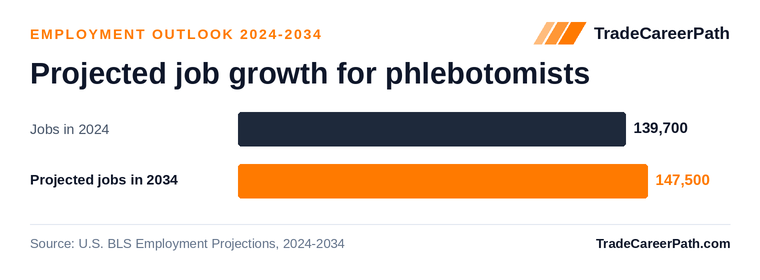
| Phlebotomy Technician this guide | $45,230 | +5.6% | 18,400 |
| Medical Assistant | $45,690 | +12.5% | 112,300 |
| Patient Care Technician | $42,260 | +2.3% | 204,100 |
| Certified Nursing Assistant (CNA) | $42,260 | +2.3% | 204,100 |
| EKG Technician | $74,310 | +3.0% | 3,800 |
Source: BLS Occupational Employment and Wage Statistics + BLS Employment Projections.
Sources
- U.S. Bureau of Labor Statistics, Occupational Employment and Wage Statistics (May 2025)
- U.S. Bureau of Labor Statistics, Employment Projections 2024-2034
- U.S. Bureau of Labor Statistics, Survey of Occupational Injuries and Illnesses (2023-2024, Table R98)
- U.S. Department of Labor, Wage and Hour Division, Davis-Bacon General Wage Determinations (2026)
Phlebotomy Technician Salary by State
About this guide: Researched and written by the TradeCareerPath Editorial Team. Our editorial team researches and sources every trade school and career guide using federal labor and education data, including BLS OEWS and Employment Projections, DOL apprenticeship records, IPEDS, College Scorecard, and state licensing boards. We follow the editorial standards documented at /editorial-policy/.
Data sources
Figures on this page are sourced from the federal and state datasets below. Methodology: how we rank and source data.
| Data | Provider | Vintage |
|---|---|---|
| Occupational Employment and Wage Statistics (OEWS) | U.S. Bureau of Labor Statistics | May 2025 |
| Employment Projections | U.S. Bureau of Labor Statistics | 2024-2034 |
| Integrated Postsecondary Education Data System | National Center for Education Statistics (IPEDS) | 2024 |
| College Scorecard (school-level outcomes) | U.S. Department of Education | latest release |
| College Scorecard (field-of-study earnings) | U.S. Department of Education | latest release (updated 2026-06-12) |
| Occupational licensing requirements | CareerOneStop (U.S. Department of Labor) | latest release (updated 2026-02-22) |
| Registered apprenticeship programs | CareerOneStop / Apprenticeship.gov (U.S. Department of Labor) | latest release (updated 2025-10-25) |
| O*NET occupation profiles (skills, tasks, tools, job zones) | U.S. Department of Labor (O*NET / Employment & Training Admin.) | O*NET 29.1 (updated 2026-06-13) |