
How to Become a Pilot: Training and Licensing
Is Pilot Right for You?
The U.S. Department of Labor's O*NET profile for Airline Pilots, Copilots, and Flight Engineers (SOC 53-2011) describes the work this way: Pilot and navigate the flight of fixed-wing aircraft, usually on scheduled air carrier routes, for the transport of passengers and cargo. Requires Federal Air Transport certificate and rating for specific aircraft type used. Includes regional, national, and international airline pilots and flight instructors of airline pilots.
What the work involves
- Use instrumentation to guide flights when visibility is poor.
- Start engines, operate controls, and pilot airplanes to transport passengers, mail, or freight, adhering to flight plans, regulations, and procedures.
- Work as part of a flight team with other crew members, especially during takeoffs and landings.
- Respond to and report in-flight emergencies and malfunctions.
- Inspect aircraft for defects and malfunctions, according to pre-flight checklists.
Skills and knowledge that matter
Skills: Operation and Control, Operations Monitoring, Monitoring, Critical Thinking, Active Listening, Judgment and Decision Making.
Knowledge: Transportation, English Language, Public Safety and Security, Mechanical.
Tools and technology you may use
Tools: Aileron trim switches, Airborne collision avoidance systems ACAS, Aircraft data loaders, Anti-skid control systems, Attitude heading reference systems AHRS, Autobrakes.
Technology: Information retrieval or search software, Data base user interface and query software, Object or component oriented development software, Microsoft Excel, Microsoft Office software, Microsoft Outlook.
Typical preparation
O*NET Job Zone Four (Considerable Preparation Needed). Most of these occupations require a four-year bachelor's degree, but some do not. Employees in these occupations usually need several years of work-related experience, on-the-job training, and/or vocational training.
Interest fit
O*NET interest profile: Realistic, Conventional, Enterprising. People who enjoy hands-on, practical work with tools, machines, plants, or materials often find this occupation a good fit.
Source: O*NET 29.1 (updated 2026-06-13)
Dreaming of flying for a living?
Pilots operate aircraft for travel, transport, and emergency services, combining skill, responsibility, and freedom.
Pilots control airplanes, helicopters, and other aircraft to transport passengers and cargo or perform specialized missions such as firefighting or rescue operations.
The aviation industry offers a variety of career paths, from private and commercial flying to instructional or corporate aviation.
If you’re passionate about technology, precision, and travel, training as a pilot offers a challenging and highly skilled profession.
Quick answers
At a glance
- Typical work: operate and navigate aircraft for passenger or cargo transport, or specialized missions.
- Entry credential: Private Pilot License (PPL).
- Training options: Part 61 (flexible) or Part 141 (structured) flight schools.
- Cost: varies enormously by path - flight hours are the main driver, and airline-pathway programs cost far more than a private certificate alone.
- Timeline: 6-12 months for a PPL; 1-4 years depending on training intensity and license type.
Q: What does a pilot do?
A: Pilots operate aircraft to transport passengers and cargo or perform specialized missions such as firefighting or rescue operations. They also plan flights, communicate with air traffic control, and follow FAA regulations.
Q: What license do you start with?
A: The Private Pilot License (PPL) is the foundation for all pilot certifications. It requires a minimum of 40 flight hours plus written and practical exams.
Q: What comes after the PPL to fly professionally?
A: Many pilots add an Instrument Rating (IR), Commercial Pilot License (CPL), and possibly a Multi-Engine Rating or Airline Transport Pilot (ATP) certificate.
Q: How long does pilot training take?
A: Timelines vary by program and goals. This page outlines 6-12 months for a PPL and 1-4 years depending on training intensity and license type.
Q: How much does pilot training cost?
A: It varies enormously by school, aircraft type, and program level - flight hours are the main cost driver, so airline-pathway programs run far higher than a private certificate alone. FAA fees vary for exams and certifications; request current pricing in writing from any school you consider.
Q: What skills help pilots succeed?
A: Strong communication, situational awareness, and attention to detail matter, along with staying calm under pressure. Mechanical and technical aptitude and good vision are also important.
Quick Facts: Pilot Training and Licensing Overview
What Pilots Do
Pilots navigate and operate aircraft under a variety of conditions and missions.
Their responsibilities extend beyond flight control, requiring strong judgment, planning, and communication.
Typical Responsibilities
- Conduct pre-flight inspections and flight planning
- Operate aircraft controls and navigation systems
- Communicate with air traffic control
- Monitor weather and adjust routes for safety
- Maintain flight logs and adhere to FAA regulations
Pilots balance technical skill and responsibility to ensure every flight operates safely and efficiently.
Key Skills and Traits for Success
- Strong communication and situational awareness
- Mechanical and technical aptitude
- Ability to stay calm under pressure
- Attention to detail and focus
- Physical fitness and good vision
Work Settings for Pilots
Pilots work in various roles across the aviation field:
- Commercial airlines
- Cargo and freight carriers
- Charter and private jet services
- Agricultural or aerial survey operations
- Emergency medical, firefighting, or law enforcement aviation
How to Become a Pilot (5 Steps)
Training as a pilot requires formal flight training and certification through the FAA (Federal Aviation Administration).
1. Meet Basic Eligibility Requirements
You must be at least 17 years old for a private pilot license and able to read, write, and speak English. You'll also need to pass a medical exam from an FAA-authorized examiner.
2. Enroll in a Flight School or Aviation Program
Choose between a Part 61 (flexible) or Part 141 (structured) flight school. Both follow FAA-set aeronautical knowledge requirements - aerodynamics, navigation, weather, and safety - while logging flight hours with an instructor.
3. Earn a Private Pilot License (PPL)
The PPL is the foundation for all pilot certifications. It requires a minimum of 40 flight hours, written and practical exams, and demonstration of flying proficiency.
4. Obtain Advanced Ratings or Licenses
To fly professionally, you'll need additional credentials such as an Instrument Rating (IR), Commercial Pilot License (CPL), and possibly a Multi-Engine Rating or ATP (Airline Transport Pilot) certificate.
5. Gain Experience and Specialize
After certification, pilots can build flight hours as flight instructors, corporate pilots, or entry-level co-pilots before advancing to larger commercial or airline positions.
Education and Training Paths
| Pathway | Typical Duration | Outcome |
|---|---|---|
| Flight School (Private Pilot License) | 6-12 months | Basic flight proficiency and PPL |
| Aviation College or Degree Program | 2-4 years | Flight training combined with aviation studies |
| Commercial License and Ratings | 1-2 years | Qualified for paid flight operations |
| Airline Transport Pilot (ATP) | Variable | Meets FAA requirements for airline captains |
Career Growth and Specialization
With experience, pilots can advance into specialized or leadership roles:
- Flight Instructor - trains new pilots and builds flight hours
- Charter or Corporate Pilot - operates private aircraft for companies or clients
- Airline Pilot - flies regional or major airline routes
- Test Pilot or Examiner - evaluates aircraft or pilot performance
Cost and Duration of Training
- Program Cost: varies by school, format and location depending on school, aircraft type, and program level
- Duration: 1-4 years depending on training intensity and license type
- FAA Fees: vary for exams and certifications
Aviation requires significant commitment and training. For those passionate about flying, it offers unmatched career variety and adventure.
Pros and Cons
✅ Pros
- Exciting and dynamic career
- Opportunity to travel and see the world
- Variety of roles and aircraft types
- Strong demand for skilled pilots
⚠️ Cons
- Lengthy and expensive training process
- Irregular schedules and time away from home
- Strict health and licensing standards
Industry Organizations & Certifying Bodies
These are the recognized national organizations, unions, certifying bodies, and regulatory authorities that shape this trade. They issue the credentials, sponsor the apprenticeships, publish the codes, and represent workers and employers.
- U.S. Federal Aviation Administration (FAA) Issues all pilot certificates and ratings (Private, Commercial, ATP, etc.).
- Air Line Pilots Association International (ALPA) Largest U.S. airline pilots union.
- Aircraft Owners and Pilots Association (AOPA) General aviation pilot association and training resources.
Wage and Employment Charts
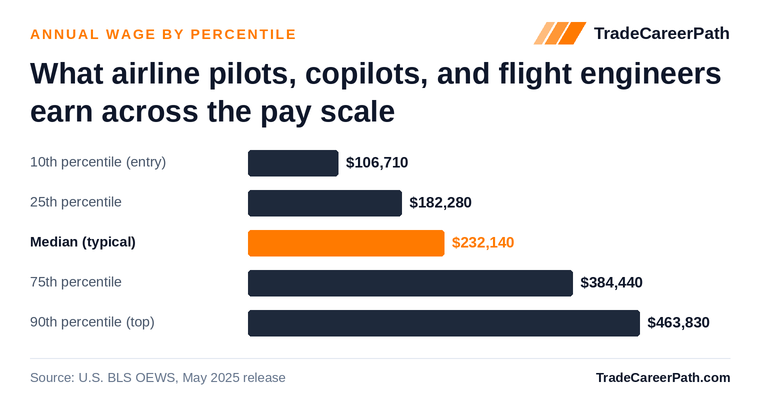
| Percentile | Annual wage |
|---|---|
| 10th | $106,710 |
| 25th | $182,280 |
| 50th (median) | $232,140 |
| 75th | $384,440 |
| 90th | $463,830 |
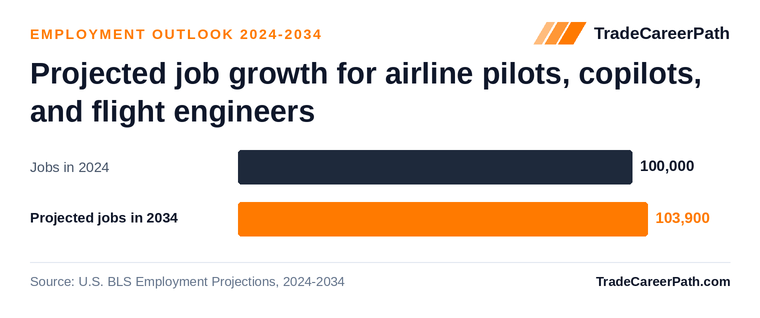
| Year | Employment |
|---|---|
| 2024 | 100,000 |
| 2034 projected | 103,900 |
| Percent change | +3.9% |
Pilot Salary and Requirements by State
Select your state for local wage data, training options, and requirements:
Alabama · Alaska · Arizona · Arkansas · California · Colorado · Connecticut · Delaware · District of Columbia · Florida · Georgia · Hawaii · Idaho · Illinois · Indiana · Iowa · Kansas · Kentucky · Louisiana · Maine · Maryland · Massachusetts · Michigan · Minnesota · Mississippi · Missouri · Montana · Nebraska · Nevada · New Hampshire · New Jersey · New Mexico · New York · North Carolina · North Dakota · Ohio · Oklahoma · Oregon · Pennsylvania · Rhode Island · South Carolina · South Dakota · Tennessee · Texas · Utah · Vermont · Virginia · Washington · West Virginia · Wisconsin · Wyoming
Workplace Safety Snapshot
BLS Survey of Occupational Injuries and Illnesses data (2023-2024) report approximately 41.5 days-away, restricted, or transfer cases per 10,000 full-time-equivalent workers in airline pilots, copilots, and flight engineers (about 0.41 per 100 FTE). Source: BLS Survey of Occupational Injuries and Illnesses, Table R98.
Frequently Asked Questions
How long does pilot training take?
It typically takes typically 6 months to 2 years of training. The most common entry path is through a certificate or associate degree program. A high school diploma or GED is generally required to get started.
How much do pilots make?
The median annual salary for pilots is $123,220 according to the Bureau of Labor Statistics (May 2025). Pay varies by state, experience, and specialization.
What is the job outlook for pilots?
The Bureau of Labor Statistics projects 5.1% employment growth for this occupation from 2024 to 2034, which is about as fast as average. Approximately 6,600 job openings are expected each year due to growth, retirements, and workers leaving the field.
Do you need a college degree to work as a pilot?
No. A college degree is not required to work as a pilot. Most people enter the field through a certificate or associate degree program. A high school diploma or GED is typically the only educational prerequisite.
Which states pay pilots the most?
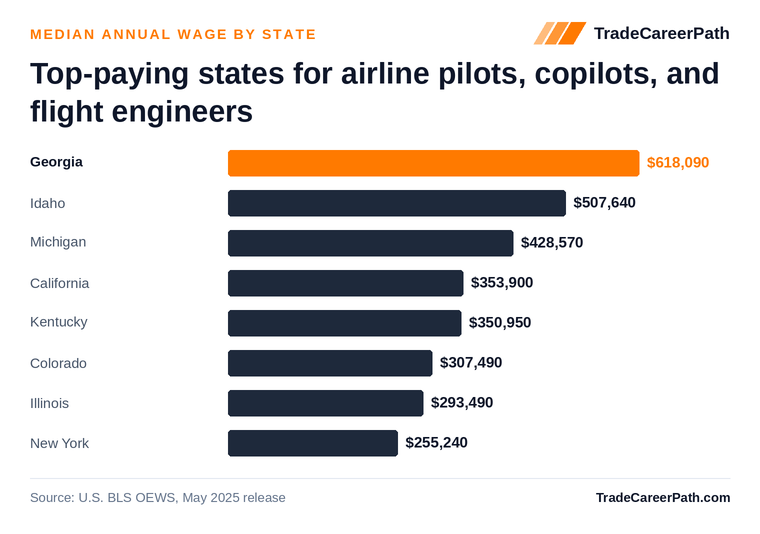
According to the U.S. Bureau of Labor Statistics (May 2025 OEWS), the highest-paying states for commercial pilots are Connecticut, New Jersey, and New York. Median annual wages: Connecticut ($232,160); New Jersey ($226,710); New York ($177,430).
Which states employ the most pilots?
BLS reports the largest concentrations of pilots in Texas, California, and Georgia. Employment levels: Texas (10,930 workers); California (10,670 workers); Georgia (8,770 workers) (May 2025).
What is entry-level pay for pilots?
BLS reports the bottom 10% of pilots earn under $58,850 per year. New workers often start near this level and see pay rise as they accumulate experience and credentials.
How many pilots work in the United States?
BLS reports approximately 103,560 pilots employed nationwide as of May 2025.
How many job openings are expected for pilots each year?
BLS projects approximately 11,700 openings per year for pilots from 2024 through 2034, including new positions, retirements, and workers transitioning out. The occupation is projected to grow 3.9% from 2024 to 2034, classified as about as fast as average growth.
How Pilot Pay Compares to Similar Trades
Side-by-side comparison of Pilot and the closest related careers, based on U.S. Bureau of Labor Statistics data (May 2025 OEWS + 2024-2034 Employment Projections).
| Career | Median Pay | 10-Year Growth | Annual Openings |
|---|---|---|---|
| Pilot this guide | $232,140 | +3.9% | 11,700 |
| Mechanic & Engine Technician | $79,870 | +4.0% | 11,300 |
| Mechanic & Engine Technician | $50,620 | +4.2% | 70,000 |
| CDL & Truck Driver Training | $58,640 | +4.0% | 237,600 |
Source: BLS Occupational Employment and Wage Statistics + BLS Employment Projections.
Sources
- U.S. Bureau of Labor Statistics, Occupational Employment and Wage Statistics (May 2025)
- U.S. Bureau of Labor Statistics, Employment Projections 2024-2034
- U.S. Bureau of Labor Statistics, Survey of Occupational Injuries and Illnesses (2023-2024, Table R98)
- U.S. Department of Labor, Wage and Hour Division, Davis-Bacon General Wage Determinations (2026)
Pilot Salary by State
About this guide: Researched and written by the TradeCareerPath Editorial Team. Our editorial team researches and sources every trade school and career guide using federal labor and education data, including BLS OEWS and Employment Projections, DOL apprenticeship records, IPEDS, College Scorecard, and state licensing boards. We follow the editorial standards documented at /editorial-policy/.
Data sources
Figures on this page are sourced from the federal and state datasets below. Methodology: how we rank and source data.
| Data | Provider | Vintage |
|---|---|---|
| Occupational Employment and Wage Statistics (OEWS) | U.S. Bureau of Labor Statistics | May 2025 |
| Employment Projections | U.S. Bureau of Labor Statistics | 2024-2034 |
| Integrated Postsecondary Education Data System | National Center for Education Statistics (IPEDS) | 2024 |
| College Scorecard (school-level outcomes) | U.S. Department of Education | latest release |
| College Scorecard (field-of-study earnings) | U.S. Department of Education | latest release (updated 2026-06-12) |
| Occupational licensing requirements | CareerOneStop (U.S. Department of Labor) | latest release (updated 2026-02-22) |
| Registered apprenticeship programs | CareerOneStop / Apprenticeship.gov (U.S. Department of Labor) | latest release (updated 2025-10-25) |
| O*NET occupation profiles (skills, tasks, tools, job zones) | U.S. Department of Labor (O*NET / Employment & Training Admin.) | O*NET 29.1 (updated 2026-06-13) |