
How to Become a Radiologic Technologist in 2026
Is Radiologic Technologist Right for You?
The U.S. Department of Labor's O*NET profile for Radiologic Technologists and Technicians (SOC 29-2034) describes the work this way: Take x-rays and CAT scans or administer nonradioactive materials into patient's bloodstream for diagnostic or research purposes. Includes radiologic technologists and technicians who specialize in other scanning modalities.
What the work involves
- Position imaging equipment and adjust controls to set exposure time and distance, according to specification of examination.
- Position patient on examining table and set up and adjust equipment to obtain optimum view of specific body area as requested by physician.
- Monitor patients' conditions and reactions, reporting abnormal signs to physician.
- Explain procedures and observe patients to ensure safety and comfort during scan.
- Use radiation safety measures and protection devices to comply with government regulations and to ensure safety of patients and staff.
Skills and knowledge that matter
Skills: Active Listening, Social Perceptiveness, Speaking, Service Orientation, Reading Comprehension, Monitoring.
Knowledge: Medicine and Dentistry, Customer and Personal Service, English Language, Computers and Electronics.
Tools and technology you may use
Tools: Automated defibrillators, Automatic x ray film processors, Collimators, Compression bands, Computed tomography CT audio and visual intercommunication systems, Computed tomography CT scanners.
Technology: Categorization or classification software, Medical software, Information retrieval or search software, eClinicalWorks EHR software, MEDITECH software, Microsoft Excel.
Typical preparation
O*NET Job Zone Three (Medium Preparation Needed). Most occupations in this zone require training in vocational schools, related on-the-job experience, or an associate's degree. Employees in these occupations usually need one or two years of training involving both on-the-job experience and informal training with experienced workers. A recognized apprenticeship program may be associated with these occupations.
Interest fit
O*NET interest profile: Realistic, Conventional, Investigative. People who enjoy hands-on, practical work with tools, machines, plants, or materials often find this occupation a good fit.
Source: O*NET 29.1 (updated 2026-06-13)
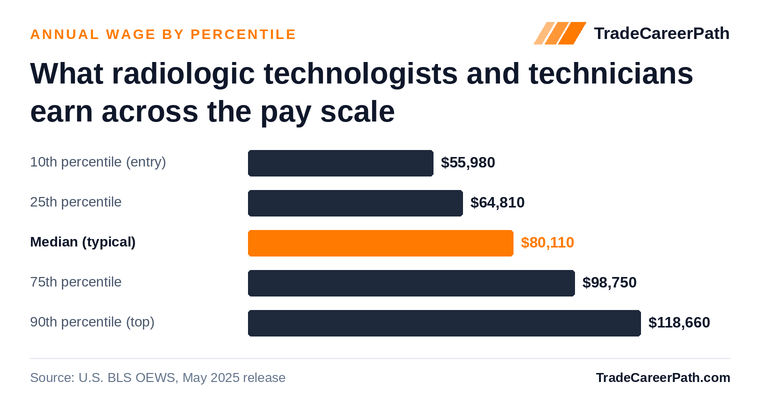
Quick answer: Training as a radiologic technologist usually takes 18 to 24 months in an accredited certificate or associate degree program. You complete supervised clinical rotations, earn certification through the American Registry of Radiologic Technologists (ARRT) by passing its exam, and apply for a state license, which most states require. The median radiologic technologist salary is $80,110 per year ($38.52/hour), and employers post about 12,900 openings nationwide each year (BLS, May 2025).
Radiologic technologists, often called X-ray techs, operate the imaging equipment doctors rely on to diagnose and treat patients. It is a hands-on healthcare role you can enter in about two years, without a four-year degree.
How to Become a Radiologic Technologist
Most people enter the field in about 18 to 24 months, depending on the program they choose. The path runs through accredited education, supervised clinical hours, national certification, and a state license in the states that require one.
1. Earn a high school diploma or GED
A high school diploma or GED is the minimum requirement for every accredited radiologic technology program. The coursework leans heavily on science, so it helps to take biology, chemistry, physics, anatomy, and as much math as you can fit in. Strong reading and note-taking habits matter too, because you will memorize a lot of anatomy and radiation-safety material. If you are changing careers and already hold a diploma or a degree in another field, you can move straight to the next step; many programs welcome students who bring patient-care, customer-service, or technical experience from other jobs. Comfort with computers also pays off later, since modern imaging runs on digital systems and electronic health records. Before you commit, it is worth shadowing or talking to a working technologist so you understand the physical and emotional demands of the job.
2. Complete an accredited radiologic technology program
This is the core credential, and you have a few formats to choose from. Certificate or diploma programs can run on the shorter end of the 18 to 24 month range and suit people who already hold a degree. Associate degree programs are the most common route and take about two years, combining general-education credits with radiography-specific coursework. Bachelor’s degree programs take longer and can help with advanced or supervisory roles. When comparing schools, prioritize accreditation through the Joint Review Committee on Education in Radiologic Technology (JRCERT), because graduating from a recognized program is what makes you eligible for ARRT certification and most state licenses. Expect coursework in human anatomy and physiology, radiation physics and biology, patient positioning, image evaluation, equipment operation, and radiation protection. Some programs offer online or hybrid lecture formats, but clinical hours must be completed in person.
3. Get clinical experience
Classroom work prepares you, but employers want to see that you can perform under real conditions. Accredited programs build clinical rotations into the curriculum, placing you in hospitals, clinics, or imaging centers where you position patients, operate X-ray and CT equipment, and produce diagnostic images under the supervision of licensed technologists. These hours are where the textbook material clicks into practice: you learn how to adjust for different body types, keep patients calm and still, and follow strict radiation-safety procedures every time. Treat clinicals as an extended job interview. The technologists and supervisors you work with often work as references, and some students receive job offers from the sites where they trained. Keep track of the procedures and modalities you have practiced, since that record helps when you apply for your first role.
4. Earn ARRT certification
For most jobs, the key credential is certification from the American Registry of Radiologic Technologists (ARRT). To qualify, you generally must graduate from an accredited program and meet ARRT’s ethics requirements, then pass the ARRT exam, which tests patient care, safety, image production, and procedures. Once certified, you maintain the credential through continuing education, with requirements that renew on a two-year cycle. Joining the American Society of Radiologic Technologists (ASRT), the largest professional association in the field, is a good way to access continuing-education resources, practice guidelines, and a professional network. ARRT also offers post-primary certifications in specialties such as CT, MRI, and mammography, which you can pursue later to expand what you are qualified to do and increase your pay.
5. Apply for state licensure and jobs
Many states require a license to work as a radiologic technologist, and most of those states accept ARRT certification as the basis for licensing eligibility. Requirements vary, so check the rules with your state before you apply, and budget time for the paperwork. With certification and any required license in hand, start applying to hospitals, outpatient clinics, physicians’ offices, and dedicated imaging centers, which are the largest employers. Tailor your resume to the modalities and procedures you trained on, lean on the references you built during clinicals, and be open to night, weekend, or on-call shifts early in your career. As you gain experience, advanced certifications in CT, MRI, or mammography open the door to higher-paying specialty roles and to lead or supervisory positions over time.
What Does a Radiologic Technologist Do?
Radiologic technologists operate diagnostic imaging equipment such as X-rays and CT scanners. They work alongside physicians and nurses to capture clear, accurate images while protecting patients from unnecessary radiation exposure.
Typical duties
- Positioning patients for imaging procedures
- Operating X-ray and CT equipment
- Maintaining patient safety and comfort
- Adjusting imaging settings for clear results
- Recording images and sharing them with the care team
Radiologic technologists sit at the meeting point of technology, anatomy, and patient care, and accurate imaging starts with them.
Skills That Make a Great Radiologic Technologist
- Strong technical and mechanical aptitude
- Compassion and clear patient communication
- Attention to detail and safety procedures
- Stamina for long shifts and patient lifting
- Professionalism and teamwork in clinical settings
Work Settings for Radiologic Technologists
Radiologic technologists work in a range of healthcare environments, including:
- Hospitals and emergency departments
- Outpatient clinics and physicians’ offices
- Dedicated diagnostic imaging centers
- Urgent care facilities
- Mobile imaging services
Education and Certification Paths
| Pathway | Typical Duration | Outcome |
|---|---|---|
| Certificate or Diploma | Roughly 18 to 24 months | Entry into the field, often for degree holders |
| Associate Degree | About 2 years | Most common credential |
| Bachelor’s Degree | About 4 years | Helpful for advanced or supervisory roles |
| ARRT Certification | After accredited program | National credential required by most employers |
Career Growth and Advancement

With experience and post-primary ARRT certifications, radiologic technologists can move into specialties and leadership roles, including:
- CT Technologist
- MRI Technologist
- Mammography Technologist
- Radiology Supervisor or Program Instructor
Cost and Duration of Training
- Time to complete: about 18 to 24 months for most certificate and associate degree programs
- Program cost: varies by program format and school, so compare tuition, fees, and clinical requirements before enrolling
- Certification: national certification through ARRT, renewed with continuing education every two years
Some programs offer online or hybrid lecture formats, though clinical hours are completed in person.
Pros and Cons
Pros
- Strong, steady salary in healthcare
- In demand across hospitals and clinics
- Meaningful, hands-on patient care role
- Clear pathways to specialize in CT, MRI, or mammography
Cons
- Radiation exposure, managed through strict safety measures
- Physically demanding work with patient lifting
- Continuing education and certification renewals required
Certification and Licensing
To work as a radiologic technologist, you generally need national certification and, in most states, a state license.
National certification
- American Registry of Radiologic Technologists (ARRT), the industry-standard certifying body
State licensing
- Requirements vary by state, and most states that require a license accept ARRT certification for eligibility.
Always verify your state’s requirements before applying.
Quick Facts: Radiologic Technologist Salary, Education, and Outlook

Industry Organizations & Certifying Bodies
These are the recognized national organizations, unions, certifying bodies, and regulatory authorities that shape this trade. They issue the credentials, sponsor the apprenticeships, publish the codes, and represent workers and employers.
- American Registry of Radiologic Technologists (ARRT) Industry-standard radiologic technologist certification.
- American Society of Radiologic Technologists (ASRT) Largest professional association for radiologic technologists.
- Joint Review Committee on Education in Radiologic Technology (JRCERT) Accredits radiography programs.
Wage and Employment Charts
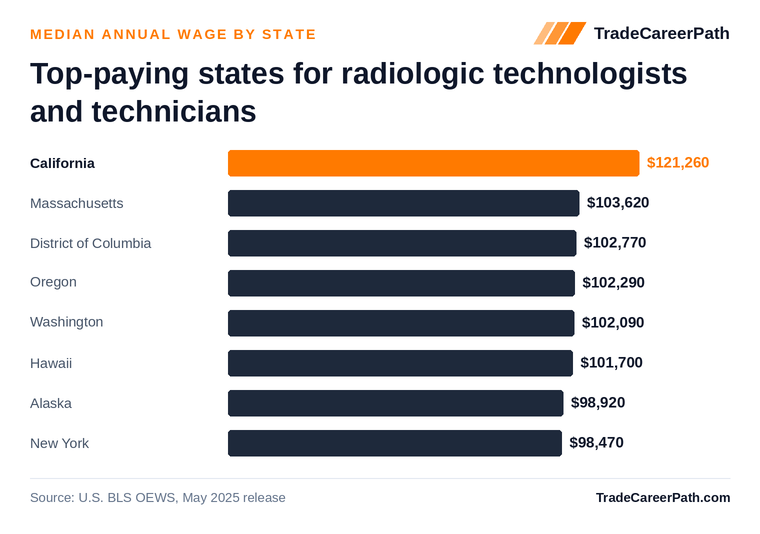
Radiology Technician Salary and Requirements by State
Select your state for local wage data, training options, and requirements:
Alabama · Alaska · Arizona · Arkansas · California · Colorado · Connecticut · Delaware · District of Columbia · Florida · Georgia · Hawaii · Idaho · Illinois · Indiana · Iowa · Kansas · Kentucky · Louisiana · Maine · Maryland · Massachusetts · Michigan · Minnesota · Mississippi · Missouri · Montana · Nebraska · Nevada · New Hampshire · New Jersey · New Mexico · New York · North Carolina · North Dakota · Ohio · Oklahoma · Oregon · Pennsylvania · Rhode Island · South Carolina · South Dakota · Tennessee · Texas · Utah · Vermont · Virginia · Washington · West Virginia · Wisconsin · Wyoming
Workplace Safety Snapshot
BLS Survey of Occupational Injuries and Illnesses data (2023-2024) report approximately 165.4 days-away, restricted, or transfer cases per 10,000 full-time-equivalent workers in radiologic technologists and technicians (about 1.65 per 100 FTE). Source: BLS Survey of Occupational Injuries and Illnesses, Table R98.
Frequently Asked Questions
How long does radiologic technologist training take?
Most accredited radiologic technology programs take 18 to 24 months, combining classroom, lab, and clinical training. A high school diploma or GED is generally required before you enroll.
Do you need a college degree to work as a radiologic technologist?
You do not need a bachelor's degree. Most people enter the field through an accredited certificate or associate degree program. A high school diploma or GED is the usual educational prerequisite to get started.
Is ARRT certification required to work as an X-ray tech?
Most employers and most states expect certification through the American Registry of Radiologic Technologists (ARRT). You earn it by graduating from an accredited program and passing the ARRT exam, then keep it active with continuing education every two years.
Do radiologic technologists need a state license?
Many states require a license to practice, and most of those states accept ARRT certification as the basis for licensing eligibility. Requirements vary, so confirm the rules with your state before you apply.
How much do radiologic technologists make?
The median radiologic technologist salary is $80,110 per year, or about $38.52 per hour (BLS, May 2025). Pay varies by state, employer, and specialty such as CT, MRI, or mammography.
Is it hard to train as a radiologic technologist?
The path is accessible because no four-year degree is required and most people finish training in about two years. The coursework is demanding, with heavy anatomy, physics, and radiation-safety content, plus hands-on clinical hours under supervision.
Can you study radiologic technology online?
Some programs offer online or hybrid classroom instruction, but the clinical hours must be completed in person at a hospital or imaging center. Confirm a program is accredited, ideally through JRCERT, before you enroll.
How Radiology Technician Pay Compares to Similar Trades
Side-by-side comparison of Radiologic Technologist (X-Ray Tech) and the closest related careers, based on U.S. Bureau of Labor Statistics data (May 2025 OEWS + 2024-2034 Employment Projections).
| Career | Median Pay | 10-Year Growth | Annual Openings |
|---|---|---|---|
| Radiologic Technologist (X-Ray Tech) this guide | $80,110 | +4.3% | 12,900 |
| Diagnostic Medical Sonographer (Ultrasound Tech) | $96,590 | +13.0% | 5,800 |
| EKG Technician | $74,310 | +3.0% | 3,800 |
| Medical Assistant | $45,690 | +12.5% | 112,300 |
Source: BLS Occupational Employment and Wage Statistics + BLS Employment Projections.
Advance Your Career with a Degree
Experienced Radiology Technician professionals often step up into degree-track careers where field experience is a hiring advantage:
- Medical Dosimetrist - median pay $147,470 (BLS OEWS, May 2025); requires a 4-year degree
See all trade careers that require a 4-year degree.
Degree and Program Guides
- Online Radiologic Technology Degrees - ARRT certification and the modality ladder
Sources
- U.S. Bureau of Labor Statistics, Occupational Employment and Wage Statistics (May 2025)
- U.S. Bureau of Labor Statistics, Employment Projections 2024-2034
- U.S. Bureau of Labor Statistics, Survey of Occupational Injuries and Illnesses (2023-2024, Table R98)
- U.S. Department of Labor, Wage and Hour Division, Davis-Bacon General Wage Determinations (2026)
Radiology Technician Salary by State
About this guide: Researched and written by the TradeCareerPath Editorial Team. Our editorial team researches and sources every trade school and career guide using federal labor and education data, including BLS OEWS and Employment Projections, DOL apprenticeship records, IPEDS, College Scorecard, and state licensing boards. We follow the editorial standards documented at /editorial-policy/.
Data sources
Figures on this page are sourced from the federal and state datasets below. Methodology: how we rank and source data.
| Data | Provider | Vintage |
|---|---|---|
| Occupational Employment and Wage Statistics (OEWS) | U.S. Bureau of Labor Statistics | May 2025 |
| Employment Projections | U.S. Bureau of Labor Statistics | 2024-2034 |
| Integrated Postsecondary Education Data System | National Center for Education Statistics (IPEDS) | 2024 |
| College Scorecard (school-level outcomes) | U.S. Department of Education | latest release |
| College Scorecard (field-of-study earnings) | U.S. Department of Education | latest release (updated 2026-06-12) |
| Occupational licensing requirements | CareerOneStop (U.S. Department of Labor) | latest release (updated 2026-02-22) |
| Registered apprenticeship programs | CareerOneStop / Apprenticeship.gov (U.S. Department of Labor) | latest release (updated 2025-10-25) |
| O*NET occupation profiles (skills, tasks, tools, job zones) | U.S. Department of Labor (O*NET / Employment & Training Admin.) | O*NET 29.1 (updated 2026-06-13) |