
How to Become a Registered Nurse (RN) in 2026
Is Registered Nurse (RN) Right for You?
The U.S. Department of Labor's O*NET profile for Registered Nurses (SOC 29-1141) describes the work this way: Assess patient health problems and needs, develop and implement nursing care plans, and maintain medical records. Administer nursing care to ill, injured, convalescent, or disabled patients. May advise patients on health maintenance and disease prevention or provide case management. Licensing or registration required.
What the work involves
- Record patients' medical information and vital signs.
- Administer medications to patients and monitor patients for reactions or side effects.
- Maintain accurate, detailed reports and records.
- Monitor, record, and report symptoms or changes in patients' conditions.
- Provide health care, first aid, immunizations, or assistance in convalescence or rehabilitation in locations such as schools, hospitals, or industry.
Skills and knowledge that matter
Skills: Social Perceptiveness, Active Listening, Speaking, Critical Thinking, Coordination, Service Orientation.
Knowledge: Psychology, Customer and Personal Service, Medicine and Dentistry, English Language.
Tools and technology you may use
Technology: Medical software, Business intelligence and data analysis software, Data base user interface and query software, Apache Spark, eClinicalWorks EHR software, Epic Systems.
Typical preparation
O*NET Job Zone Four (Considerable Preparation Needed). Most of these occupations require a four-year bachelor's degree, but some do not. Employees in these occupations usually need several years of work-related experience, on-the-job training, and/or vocational training.
Interest fit
O*NET interest profile: Social, Conventional, Investigative. People who enjoy working with, helping, and teaching other people often find this occupation a good fit.
Source: O*NET 31.0 (updated 2026-10-14)
Quick answer: Training as a registered nurse requires a 4-year degree - typically a Bachelor of Science in Nursing (BSN); ADN accepted by some employers. The national median pay is $97,550 per year, and BLS projects +5.6% employment change from 2025 to 2035 (BLS OEWS, May 2025; BLS Employment Projections, 2025-35).
Registered Nurse (RN) at a Glance
| Metric | Detail | Source |
|---|---|---|
| Median annual wage | $97,550 | BLS OEWS, May 2025 |
| Typical wage range | $68,940 (10th pct) - $137,470 (90th pct) | BLS OEWS, May 2025 |
| Employment | 3,379,720 nationwide | BLS OEWS, May 2025 |
| Projected growth (2025-35) | +5.6%, about 180,800 openings per year | BLS Employment Projections, 2025-35 |
| Typical education | Bachelor of Science in Nursing (BSN); ADN accepted by some employers | BLS Occupational Outlook Handbook |
| License / certification | NCLEX-RN exam + state board of nursing license (required in every state) | State licensing boards |
What Does a Registered Nurse (RN) Do?
Registered nurses assess patients, administer medications and treatments, coordinate care with physicians, operate medical equipment, and educate patients and families - and they carry the legal authority and accountability for that care. The RN is the person who catches the deteriorating patient at 3 a.m., questions the order that does not look right, and signs the chart that says what actually happened.
The day-to-day varies enormously by setting. A med-surg floor nurse manages five or six patients at once: assessments, timed medications, wound care, discharge teaching, and constant charting in the EHR. An ICU nurse runs one or two critically ill patients on ventilators and drips, titrating medications minute to minute. An ER nurse triages whoever walks in. Outside the hospital, home-health RNs work solo with full responsibility for each visit, OR nurses run the surgical field, and case-management or informatics nurses work the systems side of care. Twelve-hour hospital shifts are the norm - three days on, four off - a schedule many tradespeople actually prefer.
If you are coming up from a CNA, LPN, medical assistant, or paramedic role, the shortest way to describe the jump: right now you carry out the plan of care; as an RN you build it, adjust it, and answer for it. The vitals you take, the meds an LPN passes, the field interventions a paramedic performs - the RN is the one who ties all of it together, decides what it means, and escalates to the physician. That is why the license, the pay, and the responsibility all step up together.
Skills That Make a Great Registered Nurse (RN)
- Clinical assessment and triage - spotting the patient who is about to crash
- Medication administration and safety checks
- Patient and family education in plain language
- EHR charting and documentation (Epic, Cerner)
- Delegation and coordination with CNAs, LPNs, and techs
- Staying calm and precise under pressure
- Physical stamina - 12-hour shifts on your feet, lifting and repositioning patients
Registered Nurse (RN) Salary
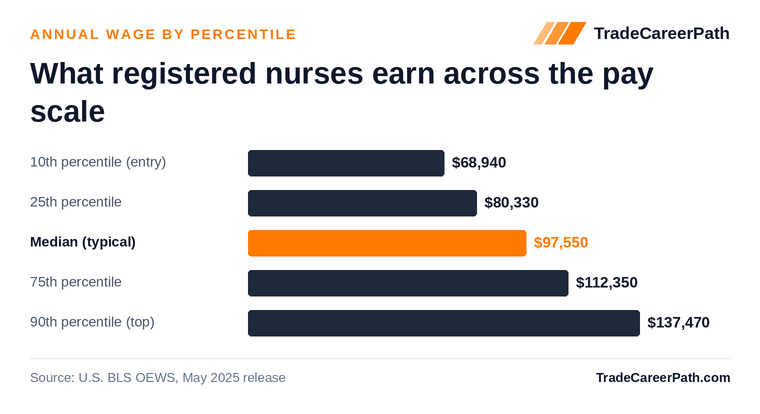
Nursing pays like a licensed trade at the top of its game. The national median is $97,550 per year, the 10th percentile - roughly where new graduates start - is $68,940, and the 25th percentile is $80,330, which many RNs reach within a couple of years. The 75th percentile is $112,350 and the 90th reaches $137,470 (BLS OEWS, May 2025). Shift differentials for nights and weekends, overtime, and travel contracts routinely push actual take-home above the base-wage figures shown here.
Where the Jobs and the Money Are
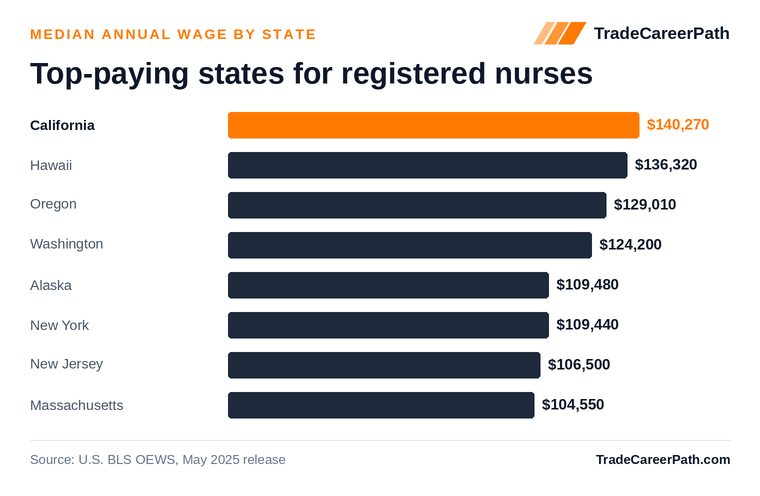
Unlike aerospace or tech, nursing has no single hub - the location quotients for every top state sit close to 1.0, meaning RNs are needed at roughly the same density everywhere people live. That is a structural advantage: you can chase pay without leaving the profession behind, and the license travels with you under the Nurse Licensure Compact.
| State | Median annual wage | Employment |
|---|---|---|
| California | $140,270 | 338,940 |
| Hawaii | $136,320 | 12,940 |
| Oregon | $129,010 | 39,730 |
| Washington | $124,200 | 69,260 |
| Alaska | $109,480 | 7,510 |
The West Coast dominates on pay - California’s median of $140,270 is far above the national figure, helped by the state’s nurse-to-patient ratio laws, and it also employs the most RNs of any state at 338,940. For sheer volume, Texas (271,380 RNs at a $95,970 median) and Florida (229,940 RNs at $84,190) are the other giant markets; Florida’s location quotient of 1.07 makes it one of the more nurse-dense states in the country, driven by its retiree population.
How to Become a Registered Nurse (RN)
1. Earn a nursing degree
Complete an ADN (2 years) or BSN (4 years) from an accredited program - look for ACEN or CCNE accreditation, because unaccredited coursework will not qualify you for the NCLEX-RN or transfer anywhere. Hospitals increasingly prefer or require the BSN, but the ADN is still the working adult’s fast lane: it gets you licensed, earning RN wages, and eligible for employer-funded RN-to-BSN completion later. If you already hold an LPN license or paramedic certification, bridge programs credit that training and shorten the degree.
2. Pass the NCLEX-RN
Every state requires the National Council Licensure Examination for registered nurses. It is a computer-adaptive exam covering safe care, pharmacology, and clinical judgment - the single gate between your degree and your license. Most programs publish first-time NCLEX pass rates; treat that number as the most honest quality metric a school offers, and be suspicious of any program that hides it.
3. Get your state license
Apply to your state board of nursing with your transcripts, NCLEX results, and a background check. Most states participate in the Nurse Licensure Compact, so one multistate license covers practice in every member state - a real asset for travel contracts or living near a state line. California and some other high-paying states license separately.
4. Start in a staff RN role
Hospitals, clinics, and home-health agencies hire new grads into residency or preceptorship programs - typically 6-12 months of paired, supervised practice before you carry a full assignment alone. Med-surg is the traditional first stop and the best generalist foundation. Career changers from EMS or LPN work often move into telemetry or emergency roles faster because they already function under pressure.
5. Specialize or advance
Experienced RNs move into ICU, ER, operating room, informatics, or case management - each with its own certification (CCRN, CEN, CNOR) that bumps both pay and marketability. The bigger forks are the RN-to-BSN completion if you started with an ADN, and the MSN track toward nurse practitioner, nurse educator, or leadership roles. The career ladder below maps what each stage realistically pays.
Career Ladder: Titles and Realistic Pay
The BLS wage percentiles line up well with how hospital nursing careers actually progress. Use this as a sanity check on offers, not a guarantee:
| Stage | Typical titles | Years in | Realistic pay (BLS OEWS, May 2025) |
|---|---|---|---|
| Entry level | New-grad resident, staff RN (med-surg, nights) | 0-2 | ~$68,940-$80,330 (10th-25th pct) |
| Mid-career | Staff RN in a specialty (ICU, ER, OR), preceptor | 2-8 | ~$97,550 (median) |
| Senior | Charge nurse, case manager, unit educator, travel RN | 8-15 | ~$112,350 (75th pct) |
| Leadership / high-cost markets | Nurse manager, house supervisor, informatics RN, West Coast staff RN | 15+ | $137,470+ (90th pct) |
Two notes for career changers. First, prior patient-care experience compresses this ladder: former LPNs, paramedics, and experienced CNAs are routinely trusted with specialty units and charge duties earlier because they already know how a floor runs. Second, the base-wage data understates real earnings at the top - night and weekend differentials, overtime, and travel contracts are standard in this field, and a staff RN in California starts near the 90th-percentile figure shown here simply because of geography.
Licensing: NCLEX-RN and Your State Board
There is no unlicensed path into this career - registered nursing is licensed in all 50 states. The sequence is fixed everywhere: graduate from a board-approved ADN or BSN program, pass the NCLEX-RN, and receive your license from the state board of nursing, which also runs the background check and sets continuing-education requirements for renewal.
Two details matter for planning:
- Nurse Licensure Compact (NLC): most states participate, so a multistate license from your home state covers practice in every member state without re-licensing.
- Non-Compact states: several of the highest-paying states, including California, license separately. Budget a few months of processing time - many nurses apply for licensure by endorsement while still working in their home state.
Specialty certifications (CCRN for critical care, CEN for emergency, CNOR for the OR) are voluntary but function like advanced trade cards: they signal competence, and many hospitals pay a differential for them.
Why an Online Degree Works for This Career
Nursing is one of the most established online degree paths. RN-to-BSN completion programs are offered almost entirely online because working nurses already have clinical experience, and pre-licensure BSN programs pair online coursework with clinical placements arranged near you. If you already hold a CNA, LPN, or ADN credential, an online BSN is the standard next rung on the ladder - and hospital tuition-assistance programs frequently cover most of it. See the dedicated guides: CNA to RN, LPN to RN, medical assistant to RN, paramedic to RN, and RN to BSN online.
Job Outlook for 2026 and Beyond
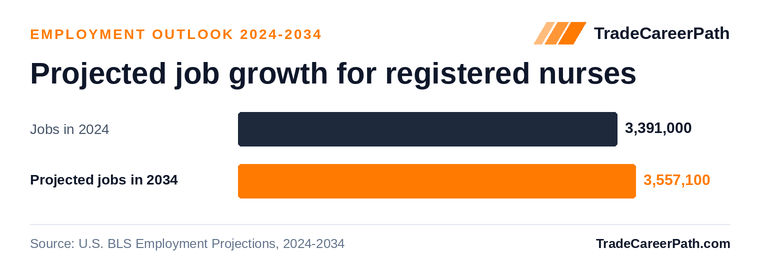
BLS projects registered nursing employment to grow +5.6% from 2025 to 2035 - from 3,465,400 to 3,660,100 jobs - with about 180,800 openings per year once retirements and occupation changes are counted (BLS Employment Projections, 2025-35). That openings number is the headline: nursing generates more annual openings than almost any other licensed occupation in the country, which is why new grads with a license rarely stay unemployed long.
Pay is moving too. The projections dataset put the 2024 median at $93,600; the May 2025 OEWS median is $97,550 - a meaningful year-over-year rise as hospitals compete to retain experienced nurses. The demand drivers are demographic and durable: an aging population needs more care, a large cohort of working RNs is itself nearing retirement, and care keeps expanding into outpatient, home-health, and telehealth settings.
Cost and Time to Complete the Degree
For registered nurses, the credential is: Bachelor of Science in Nursing (BSN); ADN accepted by some employers. The ADN route reaches the RN license in about 2 years and the BSN in 4; bridge formats (LPN to RN, paramedic to RN, RN to BSN) credit prior licenses and routinely shorten the total. Transfer credit is the other lever: prior college, military medic training, and healthcare certifications can be worth meaningful credit at transfer-friendly schools, so get a written transfer evaluation before enrolling anywhere. Costs vary widely by school type; in-state public and community-college ADN programs are usually the value benchmark, and hospital tuition assistance for the RN-to-BSN step is among the most generous of any industry - many nurses finish the bachelor’s while earning the $97,550 median RN wage.
Pros and Cons of Training as a Registered Nurse (RN)
Pros
- Median pay of $97,550 nationally (BLS OEWS, May 2025)
- About 180,800 openings per year - among the deepest job markets of any licensed occupation
- The ADN route reaches the license in about 2 years, and bridge programs credit CNA/LPN/paramedic experience
- Compact license travels across most states; demand exists in every county, not just hubs
Cons
- Hospitals increasingly prefer the 4-year BSN, so many ADN nurses complete it later
- Entry-level pay starts near $68,940 at the 10th percentile
- Licensing hurdle: NCLEX-RN exam + state board of nursing license (required in every state)
- Physically and emotionally demanding shift work - nights, weekends, and holidays are part of the deal
Frequently Asked Questions
Do I need a BSN to work as an RN?
No - an associate degree in nursing (ADN) qualifies you to sit for the NCLEX-RN. However, many hospitals prefer or require a BSN, and BLS data shows bachelor's-prepared nurses have broader advancement options. RN-to-BSN bridge programs let working ADN nurses finish the bachelor's online.
Can you train as an RN fully online?
Coursework can be completed online, but every accredited program includes in-person clinical hours. Online programs arrange clinical placements at healthcare facilities near you.
How much do registered nurses make?
The national median annual wage for registered nurses is $97,550 (BLS OEWS, May 2025). The top 10% earn $137,470 or more, while entry-level pay starts around $68,940.
What is the job outlook for registered nurses?
BLS projects employment of registered nurses to change by +5.6% from 2025 to 2035 (BLS Employment Projections, 2025-35).
How long does registered nurse training take?
The ADN route takes about 2 years; the BSN takes 4 years full-time. Bridge programs credit prior credentials - LPN-to-RN and paramedic-to-RN paths routinely shorten the path, and an RN-to-BSN completion program typically takes 12-24 months part-time while working.
Is nursing school hard?
It is demanding - anatomy, pharmacology, and pathophysiology are memorization-heavy, and clinical rotations run on top of coursework. Career changers coming from healthcare support roles usually find the hands-on portions easier than the classroom science, and the pass-or-fail gate at the end is the NCLEX-RN exam, not the coursework.
ADN vs BSN - which should I choose?
The ADN is the fastest, most affordable route to the RN license and the same NCLEX-RN exam. The BSN opens more hospital jobs, leadership tracks, and graduate-school doors. A common strategy for working adults: earn the ADN, start working as an RN, then finish an online RN-to-BSN with employer tuition assistance.
Can you train as an RN without a degree?
No. Every state requires graduation from an approved nursing program (ADN or BSN at minimum) plus passing the NCLEX-RN before the state board of nursing issues an RN license. Experience as a CNA, LPN, or paramedic shortens the degree through bridge programs, but it cannot replace it.
Registered Nurse (RN) Salary and Requirements by State
Alabama · Alaska · Arizona · Arkansas · California · Colorado · Connecticut · Delaware · District of Columbia · Florida · Georgia · Hawaii · Idaho · Illinois · Indiana · Iowa · Kansas · Kentucky · Louisiana · Maine · Maryland · Massachusetts · Michigan · Minnesota · Mississippi · Missouri · Montana · Nebraska · Nevada · New Hampshire · New Jersey · New Mexico · New York · North Carolina · North Dakota · Ohio · Oklahoma · Oregon · Pennsylvania · Rhode Island · South Carolina · South Dakota · Tennessee · Texas · Utah · Vermont · Virginia · Washington · West Virginia · Wisconsin · Wyoming
Related Careers and Degree Paths
- Licensed Practical Nurse (LPN) - the 1-year licensed nursing role, and the most common stepping stone to the RN
- Paramedic - emergency field medicine, with dedicated paramedic-to-RN bridge programs
- Respiratory Therapist - a 2-year licensed hospital role working alongside RNs in critical care
- Surgical Tech - the OR-focused alternative that skips the nursing license
- RN to BSN Online - the standard completion path once you hold the ADN and license
Degree and Program Guides
- Online Nursing Degrees - every route onto the RN ladder compared
- BSN vs ADN - which nursing degree to start with
Degree and Program Guides
- Online Nurse Practitioner Programs - the graduate step above the RN, 41.0% projected growth
Sources
- U.S. Bureau of Labor Statistics, Occupational Employment and Wage Statistics (OEWS), May 2025 - Registered Nurses (SOC 29-1141)
- U.S. Bureau of Labor Statistics, Employment Projections, 2025-35
- U.S. Bureau of Labor Statistics, Occupational Outlook Handbook - education and licensing requirements
Registered Nurse Salary by State
About this guide: Researched and written by the TradeCareerPath Editorial Team. Our editorial team researches and sources every trade school and career guide using federal labor and education data, including BLS OEWS and Employment Projections, DOL apprenticeship records, IPEDS, College Scorecard, and state licensing boards. We follow the editorial standards documented at /editorial-policy/.
Data sources
Figures on this page are sourced from the federal and state datasets below. Methodology: how we rank and source data.
| Data | Provider | Vintage |
|---|---|---|
| Occupational Employment and Wage Statistics (OEWS) | U.S. Bureau of Labor Statistics | May 2025 |
| Employment Projections | U.S. Bureau of Labor Statistics | 2025-2035 |
| Integrated Postsecondary Education Data System | National Center for Education Statistics (IPEDS) | 2024 |
| College Scorecard (school-level outcomes) | U.S. Department of Education | latest release |
| College Scorecard (field-of-study earnings) | U.S. Department of Education | latest release (updated 2026-06-12) |
| Occupational licensing requirements | CareerOneStop (U.S. Department of Labor) | latest release (updated 2026-02-22) |
| Registered apprenticeship programs | CareerOneStop / Apprenticeship.gov (U.S. Department of Labor) | latest release (updated 2025-10-25) |
| O*NET occupation profiles (skills, tasks, tools, job zones) | U.S. Department of Labor (O*NET / Employment & Training Admin.) | O*NET 31.0 (updated 2026-10-14) |