
RN to BSN Online: Is the Bachelor's Worth It for Working Nurses? (2026)
Quick answer: The RN to BSN is a 12-to-24-month online completion degree for licensed RNs. It does not change your license; it changes what you are eligible for: charge and management roles, specialty units, Magnet hospitals, and the graduate tracks (MSN, NP) that all require the bachelor’s first. RN median pay is $97,550 (BLS OEWS, May 2025).
What the BSN Actually Changes
Your ADN got you the same RN license a BSN grad holds. What the bachelor’s changes is the ceiling:
- Hiring eligibility. Many hospital systems, especially Magnet-designated ones, require the BSN for new hires or require completion within 2 to 5 years of hire.
- Advancement. Charge nurse, unit educator, case management, and nurse-manager postings routinely list the BSN as minimum education.
- Graduate school. Every MSN, nurse practitioner, and CRNA program starts from the BSN.
- Mobility. When staffing tightens, BSN-preferred becomes BSN-required; the credential is insurance against that cycle.
None of that is theoretical for a working ADN nurse. You have probably already watched a BSN colleague with less bedside time get the charge assignment, or seen a posting for the exact job you already do informally - with “BSN required” in the second line. The degree does not make you a better nurse at the bedside. It makes the system count the nursing you already do.
What the Work Is Like on the Other Side
The honest version first: for many nurses, the day after graduation looks exactly like the day before. Same unit, same patients, same twelve hours. The BSN is a key, not a teleporter - what changes is which doors you can open next, and those doors lead to genuinely different work.
Charge and resource nurse. You still take report, but your shift becomes assignments, admissions flow, staffing calls, and being the first stop for every problem on the unit. It is running the floor instead of running your four or five rooms - more phone, more judgment calls, fewer med passes.
Case management and utilization review. Largely a desk-and-phone job: discharge planning, insurance authorization, coordinating post-acute placement. Nurses burned out on lifting and night shifts move here deliberately; the clinical judgment is the same, the body wear is not. Many of these roles are Monday-through-Friday, and some are remote.
Unit educator and quality roles. Precepting formalized into a job: onboarding new grads, running competency checks, chasing infection and fall metrics, translating policy changes into practice at the bedside. The BSN research and evidence-based-practice coursework is aimed squarely at this work.
Nurse manager. Budgets, scheduling, hiring, HR conversations, and accountability for the unit’s numbers. It is the clearest pay-band jump and the clearest lifestyle change - you trade the shift-work rhythm for a pager that does not fully turn off.
Specialty and public-health roles. Community health, school nursing, public-health departments, and many outpatient specialty clinics list the BSN because the job involves population-level thinking, not just task-level care.
The common thread: BSN-gated roles trade physical load for cognitive and organizational load. If what you like about nursing is the hands-on patient care, you can keep it and simply work as promotable. If your back, your sleep, or your patience for short-staffed nights is telling you something, the roles above are the realistic exits that keep your license and your seniority working for you.
Registered Nurse Salary and the Career Ladder
BLS reports one wage distribution for all 3,379,720 registered nurses and does not split it by degree. The honest way to read the numbers: the BSN does not move the median for the occupation, it moves you along the distribution, because the roles that pay in the upper bands are the ones that screen for the bachelor’s. The national median is $97,550, the mean is $101,420, and the spread runs from $68,940 at the 10th percentile to $137,470 at the 90th (BLS OEWS, May 2025).
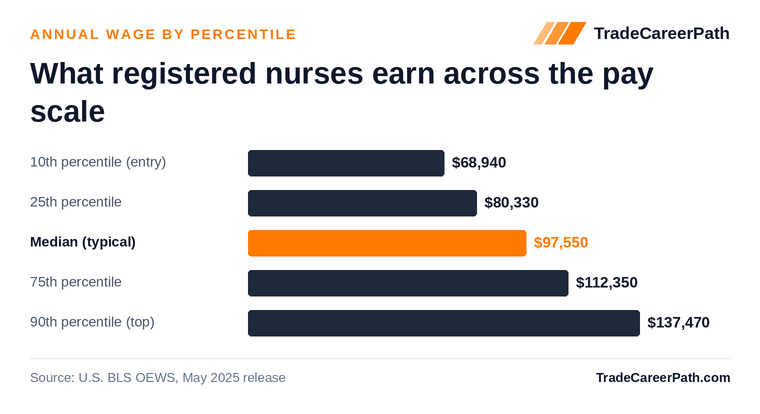
Here is how the percentile bands map onto the titles the BSN unlocks. Treat it as a sanity check on offers, not a guarantee - geography moves these numbers hard, as the state table below shows:
| Stage | Typical titles | Where the BSN fits | Realistic pay (BLS OEWS, May 2025) |
|---|---|---|---|
| Early career | Staff RN, floor nurse (ADN or BSN) | Not required for the license | ~$68,940-$80,330 (10th-25th pct) |
| Established | Experienced staff RN, specialty unit RN | BSN increasingly screened for | ~$97,550 (median) |
| Advancing | Charge nurse, case manager, unit educator | BSN typically required | ~$112,350 (75th pct) |
| Leadership / high-cost markets | Nurse manager, house supervisor, senior specialty roles | BSN required; MSN often preferred | $137,470+ (90th pct) |
Two notes. First, your bedside years count: an ADN nurse with a decade of ICU time who finishes the BSN does not start over at the bottom band - the degree stacks on top of the experience. Second, the top band is heavily a geography story. In the highest-paying states, ordinary staff positions pay above the national 75th percentile, which is the next table.
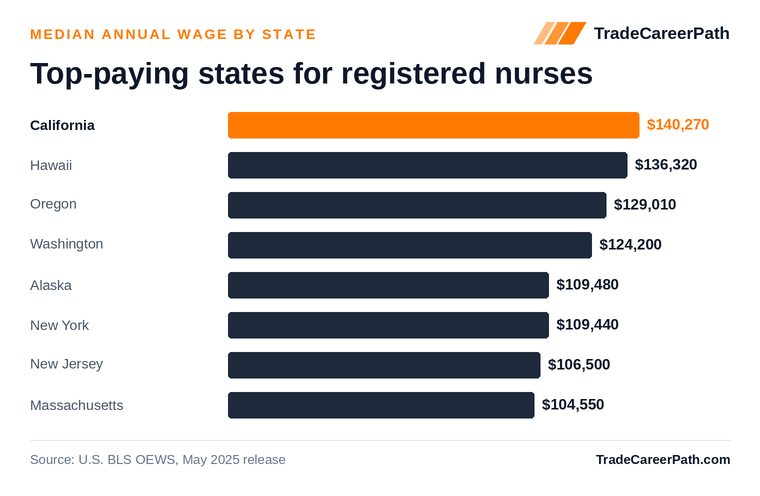
Top-Paying States for Registered Nurses
| State | Median annual wage | RN employment |
|---|---|---|
| California | $140,270 | 338,940 |
| Hawaii | $136,320 | 12,940 |
| Oregon | $129,010 | 39,730 |
| Washington | $124,200 | 69,260 |
| Alaska | $109,480 | 7,510 |
California is the outlier that distorts every national nursing conversation: a median of $140,270 - above the 90th percentile nationally - across 338,940 RNs, driven by mandated staffing ratios and strong union contracts. The rest of the top five is the West Coast plus Alaska. For contrast, the two other giant RN markets pay near or below the national median: Texas at $95,970 across 271,380 nurses, and Florida at $84,190 across 229,940 (BLS OEWS, May 2025). If you hold a compact-state license and are BSN-prepared, the arbitrage between those markets is real and travel nursing is built on it.
Choosing a Program
- Accreditation first. CCNE or ACEN accreditation is non-negotiable; it is what employers and graduate schools check.
- Confirm 100% online delivery. RN to BSN is the rare nursing credential that is genuinely online; any practicum should be arranged in your own community.
- Check credit transfer. Good programs award 60+ credits for your ADN and license, leaving roughly 30 to 40 credits of BSN coursework.
- Match the pace to your shifts. Programs are built for working nurses: one or two courses at a time, multiple start dates per year.
- Ask your employer about tuition assistance. Hospital tuition-reimbursement programs commonly cover RN to BSN costs, particularly where the system requires the degree.
Job Outlook for RNs Through 2034
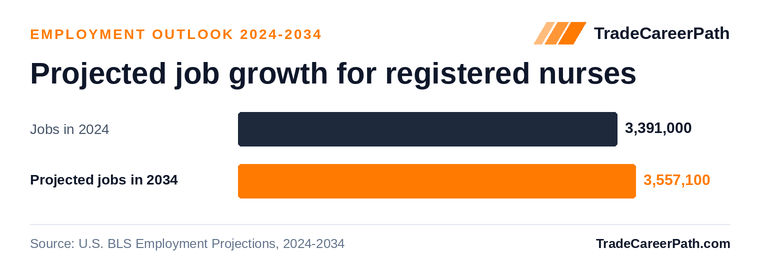
BLS projects registered nursing to grow 5.6% from 2025 to 2035 - from 3,465,400 to 3,660,100 jobs (BLS Employment Projections, 2025-35). That percentage looks modest until you notice the base: in an occupation this large, 5.6% is 166,100 net new positions, and the figure that actually matters to a working nurse is 180,800 openings per year once retirements and nurses leaving the field are counted.
For an ADN nurse weighing the bridge, the openings number cuts both ways. Demand for RNs broadly is not in question - an aging population and a large retirement wave guarantee the seats. But steady demand is exactly what lets hospital systems raise the education bar: when they can fill floors either way, “BSN preferred” hardens into “BSN required,” starting with the desirable units and the Magnet systems. The projections also show the wage floor rising - the occupation’s median annual wage stood at $93,600 in the 2024 projections base year against $97,550 in the May 2025 OEWS data - so the degree is compounding on top of a pay level that is already moving.
Licensing: Your RN License Does Not Change
Worth stating plainly, because it is the most common misconception about this bridge: the RN to BSN involves no new license and no new exam.
Registered nursing is a mandatory-licensure occupation. Every RN - ADN or BSN - got the license the same way: graduate from a state-approved nursing program, pass the NCLEX-RN, and register with the state board of nursing, then keep the license active through renewal and any continuing-education requirements the state sets. You have already cleared every one of those gates. The BSN is an academic credential layered on top of the license you hold; your license number, your scope of practice, and your renewal cycle are untouched the day you graduate.
Three licensing-adjacent points that do matter:
- The Nurse Licensure Compact. A majority of states participate in the multistate compact, which lets an RN with a compact home-state license practice in other compact states without relicensing. Compact status follows your state of residence, not your degree - but if the BSN opens a move or a travel contract, the compact is what makes the license portable.
- Certifications stack on the BSN. Specialty certifications (critical care, emergency, case management, and others) are voluntary credentials from professional bodies, not licenses. Many of the BSN-gated roles above expect one; the degree plus the certification is the standard package for specialty and leadership postings.
- Advanced practice is a separate license. If the BSN is your on-ramp to nurse practitioner or CRNA work, know that those roles require a graduate degree, national certification, and a separate APRN license from the state board. The BSN does not grant any advanced-practice authority - it is the prerequisite that makes the graduate application possible.
Frequently Asked Questions
How long does an RN to BSN program take?
Most online RN to BSN programs take 12 to 24 months part-time. Accelerated tracks finish in as little as 9 to 12 months for nurses who can carry a heavier course load.
Is the RN to BSN fully online?
Yes, almost universally. Because you already hold the RN license and clinical experience, RN to BSN completion programs are among the few nursing credentials offered 100% online, with any practicum arranged at your own workplace or community.
Does a BSN increase salary?
BLS reports one median for all registered nurses ($97,550, OEWS May 2025) and does not split by degree. The BSN's financial value shows up in eligibility: charge, specialty, management, and Magnet-hospital roles that list the BSN as a requirement.
Why do hospitals push the BSN?
Magnet designation and quality initiatives favor bachelor's-prepared nursing staff, so many systems require new hires to hold or complete a BSN within a set window. An RN to BSN enrollment satisfies those clauses.
Is an RN to BSN program hard?
It is easier than nursing school was. There is no new clinical licensure content - the coursework is leadership, research, community health, and writing. The real difficulty is time management: one or two courses at a time around 12-hour shifts is the workload most programs are built for.
What is the difference between an ADN and a BSN?
Both lead to the same RN license and the same NCLEX-RN exam. The ADN is a two-year associate degree; the BSN adds roughly 30 to 40 credits of leadership, research, and community-health coursework, and it is the credential that management, specialty, and Magnet-hospital postings screen for.
Do you need a new license or NCLEX after finishing the BSN?
No. Your RN license comes from passing the NCLEX-RN and registering with your state board of nursing, and you already did both. The BSN is an academic credential layered on top of the license you hold - no new exam, no new license.
What is the job outlook for registered nurses?
BLS projects RN employment to grow 5.6% from 2025 to 2035, from 3,465,400 to 3,660,100 jobs, with about 180,800 openings per year once retirements and occupation changes are counted (BLS Employment Projections, 2025-35).
Keep Climbing
- How to Become a Registered Nurse: the full guide
- LPN to RN bridge programs
- All trade careers that require a 4-year degree
Degree and Program Guides
- BSN vs ADN - why the BSN matters even though both sit the same exam
- Online Nursing Degrees - all nursing routes compared
Degree and Program Guides
- Online Nurse Practitioner Programs - where the BSN leads next
Sources
- U.S. Bureau of Labor Statistics, Occupational Employment and Wage Statistics (OEWS), May 2025 - Registered Nurses (SOC 29-1141)
- U.S. Bureau of Labor Statistics, Employment Projections, 2025-35
- U.S. Bureau of Labor Statistics, Occupational Outlook Handbook - registered nurses, education, licensure, and advancement
Rn to Bsn Salary by State
About this guide: Researched and written by the TradeCareerPath Editorial Team. Our editorial team researches and sources every trade school and career guide using federal labor and education data, including BLS OEWS and Employment Projections, DOL apprenticeship records, IPEDS, College Scorecard, and state licensing boards. We follow the editorial standards documented at /editorial-policy/.
Data sources
Figures on this page are sourced from the federal and state datasets below. Methodology: how we rank and source data.
| Data | Provider | Vintage |
|---|---|---|
| Occupational Employment and Wage Statistics (OEWS) | U.S. Bureau of Labor Statistics | May 2025 |
| Employment Projections | U.S. Bureau of Labor Statistics | 2025-2035 |
| Integrated Postsecondary Education Data System | National Center for Education Statistics (IPEDS) | 2024 |
| College Scorecard (school-level outcomes) | U.S. Department of Education | latest release |
| College Scorecard (field-of-study earnings) | U.S. Department of Education | latest release (updated 2026-06-12) |
| Occupational licensing requirements | CareerOneStop (U.S. Department of Labor) | latest release (updated 2026-02-22) |
| Registered apprenticeship programs | CareerOneStop / Apprenticeship.gov (U.S. Department of Labor) | latest release (updated 2025-10-25) |
| O*NET occupation profiles (skills, tasks, tools, job zones) | U.S. Department of Labor (O*NET / Employment & Training Admin.) | O*NET 31.0 (updated 2026-10-14) |