
How to Become a Roofer: Training and Steps
Is Roofer Right for You?
The U.S. Department of Labor's O*NET profile for Roofers (SOC 47-2181) describes the work this way: Cover roofs of structures with shingles, slate, asphalt, aluminum, wood, or related materials. May spray roofs, sidings, and walls with material to bind, seal, insulate, or soundproof sections of structures.
What the work involves
- Inspect problem roofs to determine the best repair procedures.
- Remove snow, water, or debris from roofs prior to applying roofing materials.
- Set up scaffolding to provide safe access to roofs.
- Estimate materials and labor required to complete roofing jobs.
- Cement or nail flashing strips of metal or shingle over joints to make them watertight.
Skills and knowledge that matter
Skills: Coordination, Critical Thinking, Active Listening, Time Management, Speaking, Operations Monitoring.
Knowledge: Building and Construction, Customer and Personal Service, English Language, Public Safety and Security.
Tools and technology you may use
Tools: Adjustable roof brackets, Air compressors, Angle knives, Axes, Bench-mount hand brakes, Bitumen applicators.
Technology: Computer aided design CAD software, Data base user interface and query software, Analytical or scientific software, Microsoft Excel, Microsoft Office software, Microsoft Windows.
Typical preparation
O*NET Job Zone Two (Some Preparation Needed). These occupations usually require a high school diploma. Employees in these occupations need anywhere from a few months to one year of working with experienced employees. A recognized apprenticeship program may be associated with these occupations.
Interest fit
O*NET interest profile: Realistic, Conventional, Enterprising. People who enjoy hands-on, practical work with tools, machines, plants, or materials often find this occupation a good fit.
Source: O*NET 29.1 (updated 2026-06-13)
Ever wondered who installs and maintains the roofs that protect homes and businesses?
Roofers are skilled tradespeople who make sure every structure stays dry, safe, and durable.
Roofers work with a range of materials including shingles, metal, tile, and membranes to cover and waterproof buildings.
If you enjoy outdoor work, have good balance, and like seeing your results at the end of each day, roofing offers a practical and rewarding trade path.
Quick answers
At a glance
- Roofers install, repair, and replace roofs on residential, commercial, and industrial buildings.
- Materials often include shingles, metal, tile, and membranes.
- Training paths commonly include on-the-job training, apprenticeships, and optional trade programs.
- Success often depends on balance, coordination, attention to detail, and following safety procedures.
- With experience, roofers may advance into leadership, inspection, estimating, or business ownership.
What does a roofer do?
Roofers install, repair, and replace roofs on residential, commercial, and industrial buildings. They measure, cut, and secure materials to provide waterproof protection and proper drainage.
What materials do roofers work with?
Roofers work with materials including shingles, metal, tile, and membranes to cover and waterproof buildings.
Where do roofers work?
Roofers work in residential home construction and repairs, commercial and industrial roofing projects, and storm restoration and emergency repair services. Some work for specialty contractors or as independent contractors.
What skills and traits help roofers succeed?
Strong balance and physical coordination matter, along with attention to detail. Roofers also need to follow plans and safety regulations and solve problems when repairing complex roof systems.
What are common training paths for roofers?
Common pathways include certificate or trade programs (6-12 months), on-the-job training (6-12 months), and apprenticeship programs (2-3 years).
How can roofers advance in their careers?
With experience, roofers may move into foreman or crew supervisor roles, inspection or estimating, or project management. Some work as independent contractors or small business owners.
What Roofers Do
Roofers install, repair, and replace roofs on residential, commercial, and industrial buildings. They measure, cut, and secure materials to provide waterproof protection and proper drainage.
Typical Tasks
- Inspect roofs to determine repair or replacement needs
- Measure, cut, and fit roofing materials
- Apply shingles, metal panels, or membranes securely
- Seal joints and flashing to prevent leaks
- Follow safety procedures when working at heights
Key Skills and Traits for Success
- Strong sense of balance and physical coordination
- Comfort working outdoors and in varied weather
- Ability to follow plans and safety regulations
- Problem-solving skills for repairing complex roof systems
- Attention to detail for accurate installation
Work Settings for Roofers
Roofers are employed across many settings including:
- Residential home construction and repairs
- Commercial and industrial roofing projects
- Storm restoration and emergency repair services
- Specialty contractors installing green or metal roofs
- Independent contractors or small business operations
How to Become a Roofer (5 Steps)
Here’s a common path into the roofing trade.
1. Earn a High School Diploma or Equivalent
Take courses in mathematics, shop, and building trades. These help you develop measurement and tool-use skills.
2. Enroll in a Trade or Technical Program (Optional)
Some schools offer short construction or roofing courses. These can teach safety, material handling, and roof system basics.
3. Gain On-the-Job Experience or Enter an Apprenticeship
Many roofers start as helpers, learning alongside experienced crews. Apprenticeships combine training with practical work.
4. Obtain Safety or Manufacturer Certifications
Roofing often involves OSHA safety training, fall protection, and product-specific certifications offered by material manufacturers.
5. Build Experience and Advance
With experience, roofers can move into crew leadership, inspection, or project management. Some start their own roofing businesses.
Education and Training Paths
| Pathway | Typical Duration | Outcome |
|---|---|---|
| Certificate or Trade Program | 6-12 months | Basic knowledge of materials, safety, and installation |
| On-the-Job Training | 6-12 months | Practical roofing experience under supervision |
| Apprenticeship Program | 2-3 years | Combination of classroom learning and field training |
Career Growth and Advancement
Roofers with experience may move into roles such as:
- Foreman or crew supervisor
- Roof inspector or estimator
- Specialty installer for green, metal, or solar-integrated roofs
- Independent contractor or small business owner
Pros and Cons
Pros
- Visible results and hands-on satisfaction
- Opportunities for steady construction work
- Variety of projects from homes to large facilities
Cons
- Physically demanding and weather-dependent
- Work at heights requires safety awareness
- Seasonal slowdowns in certain regions
Quick Facts: Roofer Training and Outlook
Industry Organizations & Certifying Bodies
These are the recognized national organizations, unions, certifying bodies, and regulatory authorities that shape this trade. They issue the credentials, sponsor the apprenticeships, publish the codes, and represent workers and employers.
- United Union of Roofers, Waterproofers and Allied Workers Primary roofers union; sponsors registered apprenticeships.
- National Roofing Contractors Association (NRCA) Roofing contractor trade association; offers ProCertification credentials.
Federal Prevailing Wages by State
The U.S. Department of Labor sets Davis-Bacon prevailing wages that contractors must pay on federally funded construction projects. These are minimum hourly rates, not averages - actual market pay can be higher. Across 42 states with active 2026 determinations, the average total compensation (base + fringe) for roofers is $38.00/hour. Rhode Island pays the highest rate ($78.93/hr total), while Florida reports the lowest active determination ($12.00/hr total).
| State | Base Hourly | Fringe Hourly | Total Hourly | Annualized* |
|---|---|---|---|---|
| Rhode Island | $47.49 | $31.44 | $78.93 | $164,174 |
| Alaska | $52.07 | $19.62 | $71.69 | $149,115 |
| Connecticut | $45.15 | $23.53 | $68.68 | $142,854 |
| Maryland | $52.21 | $14.91 | $67.12 | $139,610 |
| Michigan | $42.67 | $21.62 | $64.29 | $133,723 |
| Pennsylvania | $41.21 | $21.46 | $62.67 | $130,354 |
| Illinois | $36.00 | $26.36 | $62.36 | $129,709 |
| New York | $34.10 | $28.20 | $62.30 | $129,584 |
| Ohio | $40.15 | $21.28 | $61.43 | $127,774 |
| New Jersey | $35.95 | $21.85 | $57.80 | $120,224 |
| Delaware | $27.98 | $27.90 | $55.88 | $116,230 |
| Indiana | $34.55 | $21.04 | $55.59 | $115,627 |
| California | $42.80 | $12.64 | $55.44 | $115,315 |
| Kentucky | $34.38 | $19.94 | $54.32 | $112,986 |
| Minnesota | $35.55 | $18.77 | $54.32 | $112,986 |
| Missouri | $33.60 | $19.99 | $53.59 | $111,467 |
| District of Columbia | $36.26 | $14.91 | $51.17 | $106,434 |
| Washington | $35.64 | $14.89 | $50.53 | $105,102 |
| Nevada | $37.76 | $12.42 | $50.18 | $104,374 |
| Colorado | $32.90 | $6.18 | $39.08 | $81,286 |
| West Virginia | $24.28 | $9.32 | $33.60 | $69,888 |
| Louisiana | $23.04 | $9.34 | $32.38 | $67,350 |
| Oregon | $27.49 | $0.00 | $27.49 | $57,179 |
| North Carolina | $18.26 | $4.38 | $22.64 | $47,091 |
| Arizona | $17.46 | $4.47 | $21.93 | $45,614 |
| Wisconsin | $18.01 | $3.28 | $21.29 | $44,283 |
| Montana | $15.48 | $5.28 | $20.76 | $43,181 |
| North Dakota | $17.17 | $2.66 | $19.83 | $41,246 |
| New Hampshire | $18.87 | $0.00 | $18.87 | $39,250 |
| Virginia | $15.56 | $3.06 | $18.62 | $38,730 |
| Iowa | $15.02 | $1.88 | $16.90 | $35,152 |
| Kansas | $14.33 | $2.48 | $16.81 | $34,965 |
| Vermont | $16.80 | $0.00 | $16.80 | $34,944 |
| South Dakota | $14.35 | $2.14 | $16.49 | $34,299 |
| Idaho | $16.00 | $0.00 | $16.00 | $33,280 |
| Texas | $13.64 | $1.80 | $15.44 | $32,115 |
| Oklahoma | $15.00 | $0.29 | $15.29 | $31,803 |
| Nebraska | $13.57 | $0.77 | $14.34 | $29,827 |
| New Mexico | $13.24 | $0.50 | $13.74 | $28,579 |
| Alabama | $13.66 | $0.00 | $13.66 | $28,413 |
| Georgia | $13.62 | $0.00 | $13.62 | $28,330 |
| Florida | $12.00 | $0.00 | $12.00 | $24,960 |
* Annualized total = total hourly × 2,080 hours (40-hour week, 52 weeks). Actual annual pay varies with overtime, project length, and benefits utilization.
Source: U.S. Department of Labor, Wage and Hour Division - Davis-Bacon General Wage Determinations, 2026. Rates reflect the lowest base rate within each statewide determination for roofer classifications.
Wage and Employment Charts
| Percentile | Annual wage |
|---|---|
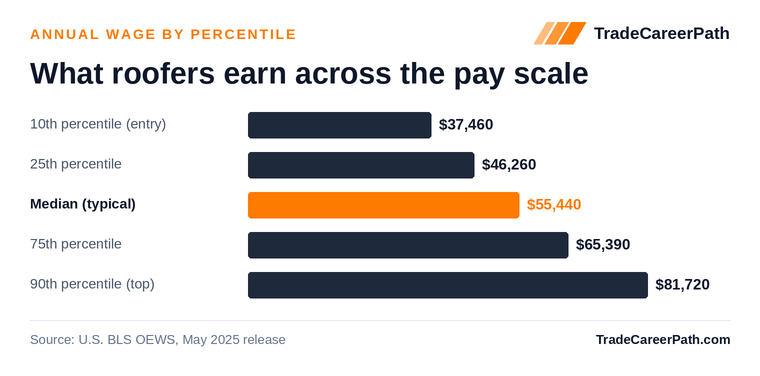
| 10th | $37,460 |
| 25th | $46,260 |
| 50th (median) | $55,440 |
| 75th | $65,390 |
| 90th | $81,720 |
| Year | Employment |
|---|---|
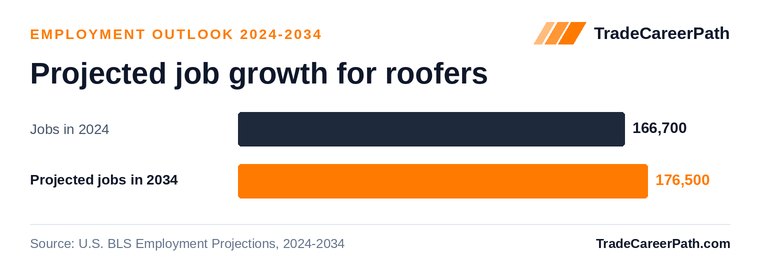
| 2024 | 166,700 |
| 2034 projected | 176,500 |
| Percent change | +5.9% |
Roofer Salary and Requirements by State
Select your state for local wage data, training options, and requirements:
Alabama · Alaska · Arizona · Arkansas · California · Colorado · Connecticut · Delaware · District of Columbia · Florida · Georgia · Hawaii · Idaho · Illinois · Indiana · Iowa · Kansas · Kentucky · Louisiana · Maine · Maryland · Massachusetts · Michigan · Minnesota · Mississippi · Missouri · Montana · Nebraska · Nevada · New Hampshire · New Jersey · New Mexico · New York · North Carolina · North Dakota · Ohio · Oklahoma · Oregon · Pennsylvania · Rhode Island · South Carolina · South Dakota · Tennessee · Texas · Utah · Vermont · Virginia · Washington · West Virginia · Wisconsin · Wyoming
Workplace Safety Snapshot
BLS Survey of Occupational Injuries and Illnesses data (2023-2024) report approximately 240.3 days-away, restricted, or transfer cases per 10,000 full-time-equivalent workers in roofers (about 2.40 per 100 FTE). Source: BLS Survey of Occupational Injuries and Illnesses, Table R98.
Frequently Asked Questions
How long does roofer training take?
It typically takes typically 6 months to 2 years of training. The most common entry path is through a certificate or associate degree program. A high school diploma or GED is generally required to get started.
How much do roofers make?
The median annual salary for roofers is $55,440 according to the Bureau of Labor Statistics (May 2025). Entry-level workers earn around $37,460, while those in the 90th percentile earn over $81,720. Pay varies by state, experience, and specialization.
What is the job outlook for roofers?
The Bureau of Labor Statistics projects 5.9% employment growth for this occupation from 2024 to 2034, which is about as fast as average. Approximately 12,700 job openings are expected each year due to growth, retirements, and workers leaving the field.
Do you need a college degree to work as a roofer?
No. A college degree is not required to work as a roofer. Most people enter the field through a certificate or associate degree program. A high school diploma or GED is typically the only educational prerequisite.
Which states pay roofers the most?
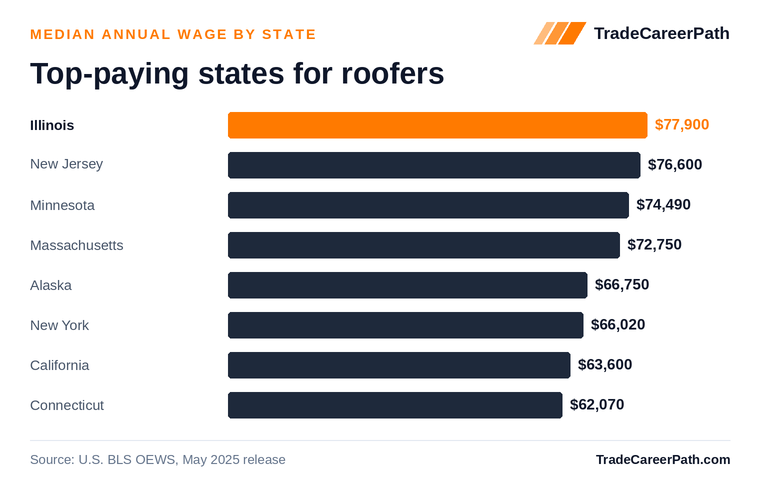
According to the U.S. Bureau of Labor Statistics (May 2025 OEWS), the highest-paying states for roofers are Illinois, New Jersey, and Minnesota. Median annual wages: Illinois ($77,900); New Jersey ($76,600); Minnesota ($74,490).
Which states employ the most roofers?
BLS reports the largest concentrations of roofers in Florida, California, and Washington. Employment levels: Florida (23,550 workers); California (21,190 workers); Washington (5,890 workers) (May 2025).
How much do experienced roofers earn?
The top 10% of roofers earn more than $81,720 per year, according to BLS Occupational Employment and Wage Statistics (May 2025). Experienced workers in this band typically hold senior credentials, supervisory roles, or specialty certifications.
What is entry-level pay for roofers?
BLS reports the bottom 10% of roofers earn under $37,460 per year. New workers often start near this level and see pay rise as they accumulate experience and credentials.
How many roofers work in the United States?
BLS reports approximately 135,490 roofers employed nationwide as of May 2025.
How many job openings are expected for roofers each year?
BLS projects approximately 12,700 openings per year for roofers from 2024 through 2034, including new positions, retirements, and workers transitioning out. The occupation is projected to grow 5.9% from 2024 to 2034, classified as faster than average growth.
Is roofer a growing career?
Yes. BLS projects 5.9% employment growth for roofers between 2024 and 2034, classified as faster than average. Employment is projected to rise from approximately 166,700 jobs in 2024 to 176,500 in 2034.
How much do roofers make per hour?
The median hourly wage for roofers is $26.65, according to BLS (May 2025). Hourly pay ranges from about $18.01 (bottom 10%) to $39.29 (top 10%).
How Roofer Pay Compares to Similar Trades
Side-by-side comparison of Roofer and the closest related careers, based on U.S. Bureau of Labor Statistics data (May 2025 OEWS + 2024-2034 Employment Projections).
| Career | Median Pay | 10-Year Growth | Annual Openings |
|---|---|---|---|
| Roofer this guide | $55,440 | +5.9% | 12,700 |
| Carpentry | $60,580 | +4.5% | 74,100 |
| Sheet Metal Worker | $61,800 | +2.4% | 10,600 |
| Construction Worker | $47,120 | +7.3% | 129,400 |
| Floor Installing Listings | $55,690 | +10.1% | 4,200 |
Source: BLS Occupational Employment and Wage Statistics + BLS Employment Projections.
Sources
- U.S. Bureau of Labor Statistics, Occupational Employment and Wage Statistics (May 2025)
- U.S. Bureau of Labor Statistics, Employment Projections 2024-2034
- U.S. Bureau of Labor Statistics, Survey of Occupational Injuries and Illnesses (2023-2024, Table R98)
- U.S. Department of Labor, Wage and Hour Division, Davis-Bacon General Wage Determinations (2026)
Roofer Salary by State
About this guide: Researched and written by the TradeCareerPath Editorial Team. Our editorial team researches and sources every trade school and career guide using federal labor and education data, including BLS OEWS and Employment Projections, DOL apprenticeship records, IPEDS, College Scorecard, and state licensing boards. We follow the editorial standards documented at /editorial-policy/.
Data sources
Figures on this page are sourced from the federal and state datasets below. Methodology: how we rank and source data.
| Data | Provider | Vintage |
|---|---|---|
| Occupational Employment and Wage Statistics (OEWS) | U.S. Bureau of Labor Statistics | May 2025 |
| Employment Projections | U.S. Bureau of Labor Statistics | 2024-2034 |
| Integrated Postsecondary Education Data System | National Center for Education Statistics (IPEDS) | 2024 |
| College Scorecard (school-level outcomes) | U.S. Department of Education | latest release |
| College Scorecard (field-of-study earnings) | U.S. Department of Education | latest release (updated 2026-06-12) |
| Occupational licensing requirements | CareerOneStop (U.S. Department of Labor) | latest release (updated 2026-02-22) |
| Registered apprenticeship programs | CareerOneStop / Apprenticeship.gov (U.S. Department of Labor) | latest release (updated 2025-10-25) |
| O*NET occupation profiles (skills, tasks, tools, job zones) | U.S. Department of Labor (O*NET / Employment & Training Admin.) | O*NET 29.1 (updated 2026-06-13) |