
How to Become a Merchant Marine Officer in 2026
Is Merchant Marine Officer Right for You?
The U.S. Department of Labor's O*NET profile for Captains, Mates, and Pilots of Water Vessels (SOC 53-5021) describes the work this way: Command or supervise operations of ships and water vessels, such as tugboats and ferryboats. Required to hold license issued by U.S. Coast Guard.
What the work involves
- Direct courses and speeds of ships, based on specialized knowledge of local winds, weather, water depths, tides, currents, and hazards.
- Prevent ships under navigational control from engaging in unsafe operations.
- Serve as a vessel's docking master upon arrival at a port or at a berth.
- Consult maps, charts, weather reports, or navigation equipment to determine and direct ship movements.
- Steer and operate vessels, using radios, depth finders, radars, lights, buoys, or lighthouses.
Skills and knowledge that matter
Skills: Operation and Control, Speaking, Monitoring, Active Listening, Critical Thinking, Operations Monitoring.
Knowledge: Transportation, Public Safety and Security, Mechanical, Law and Government.
Tools and technology you may use
Technology: Operating system software, Computer aided design CAD software, Facilities management software, Apple macOS, Autodesk Revit, Microsoft Excel.
Typical preparation
O*NET Job Zone Three (Medium Preparation Needed). Most occupations in this zone require training in vocational schools, related on-the-job experience, or an associate's degree. Employees in these occupations usually need one or two years of training involving both on-the-job experience and informal training with experienced workers. A recognized apprenticeship program may be associated with these occupations.
Interest fit
O*NET interest profile: Realistic, Conventional, Enterprising. People who enjoy hands-on, practical work with tools, machines, plants, or materials often find this occupation a good fit.
Source: O*NET 31.0 (updated 2026-10-14)
Quick answer: Training as a merchant marine officer requires a 4-year degree - typically a Bachelor’s from a maritime academy (deck or engine license track). The national median pay is $92,460 per year, and BLS projects +4.0% employment change from 2025 to 2035 (BLS OEWS, May 2025; BLS Employment Projections, 2025-35).
Merchant Marine Officer at a Glance
| Metric | Detail | Source |
|---|---|---|
| Median annual wage | $92,460 | BLS OEWS, May 2025 |
| Typical wage range | $47,420 (10th pct) - $170,640 (90th pct) | BLS OEWS, May 2025 |
| Employment | 36,850 nationwide | BLS OEWS, May 2025 |
| Projected growth (2025-35) | +4.0%, about 3,800 openings per year | BLS Employment Projections, 2025-35 |
| Typical education | Bachelor’s from a maritime academy (deck or engine license track) | BLS Occupational Outlook Handbook |
| License / certification | USCG Merchant Mariner Credential with officer endorsement (required) | Federal (USCG) |
What Does a Merchant Marine Officer Do?
Merchant marine officers command and run commercial vessels - tankers, container ships, offshore supply vessels, towboats, harbor tugs, and ferries. The occupation splits into two license tracks. Deck officers (mates) stand navigation watches, plan passages, run cargo loading and discharge, and manage the vessel’s stability paperwork; the master (captain) carries final responsibility for the ship, crew, and cargo. Engine officers keep the plant running: main propulsion, generators, fuel and ballast systems, hydraulics, refrigeration, and the maintenance program that keeps a vessel out of the shipyard.
Day to day the work depends heavily on the trade you sail in. A third mate on a deep-sea container ship stands a four-on, eight-off bridge watch, checks cargo lashings, and maintains safety and firefighting gear. A mate on a Gulf of Mexico supply boat spends the watch station-keeping next to a drilling rig. A towboat pilot on the inland rivers threads 30-plus barges through locks and bridges. Engineers on all of them live in a world familiar to anyone from the mechanical trades - diesels, pumps, welding repairs, and troubleshooting under time pressure - except the plant is floating and there is no calling in a contractor at sea. Everything runs on watch rotations, and deep-sea work typically means weeks or months aboard followed by comparable time off.
If you are an able seaman, tankerman, or marine-trades worker now, the shortest way to say it: the unlicensed crew executes the work; the officer owns the watch. The mate decides the course alteration; the engineer on watch decides whether the main engine keeps turning with that bearing running hot. You already know the vessel side of the job - the license track converts that deck-plate knowledge into legal authority, and officers who came up through the crew are consistently better watchstanders for it.
Skills That Make a Great Merchant Marine Officer
- Navigation, COLREGS, and collision avoidance
- Cargo operations, stability, and trim calculations
- Diesel propulsion, electrical, and auxiliary engine-room systems
- Maritime law, SOLAS, and pollution-prevention (MARPOL) compliance
- Watchstanding leadership and bridge/engine-room resource management
- Emergency response: firefighting, damage control, and lifesaving drills
- Paperwork discipline: logbooks, cargo documents, and inspection records carry legal weight
Merchant Marine Officer Salary
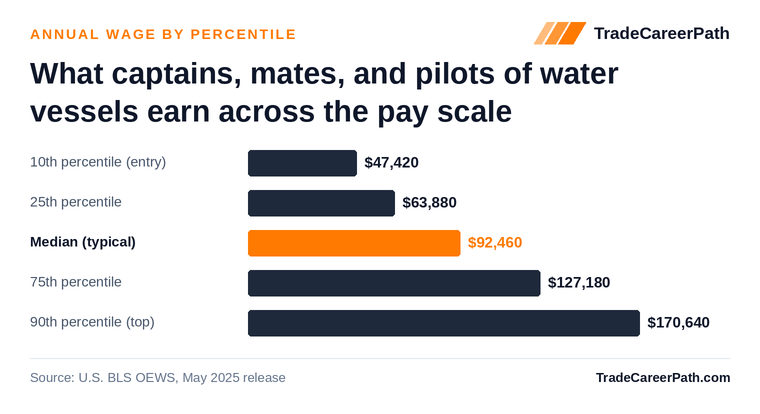
Ship officers are among the better-paid careers open to a trades background, and pay scales sharply with license grade. The national median is $92,460 per year. The spread is wide: the 10th percentile - small inland and harbor vessels, junior licenses - is $47,420, while the 90th percentile reaches $170,640, where masters, chief engineers, and harbor pilots sit (BLS OEWS, May 2025). The mean of $103,720 running above the median tells you the top of this occupation pulls hard on the average.
Where the Jobs and the Money Are
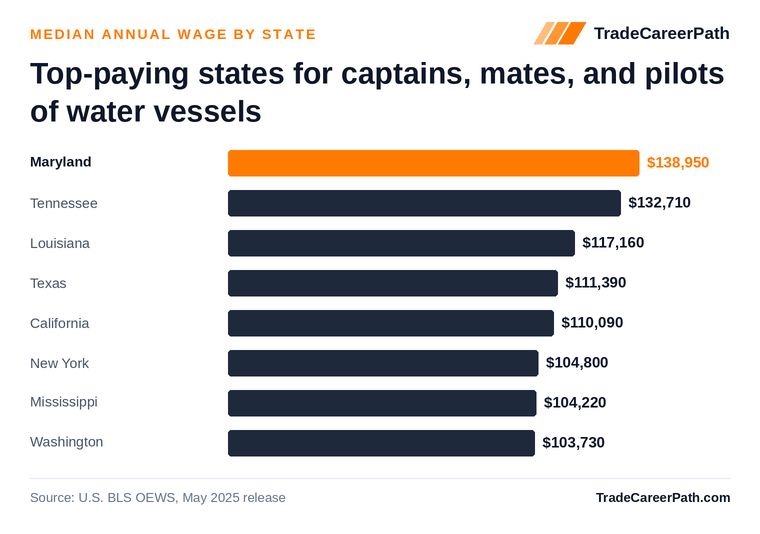
This is a coastline-and-river occupation, and one state dominates it: Louisiana employs 6,830 ship officers - the offshore oil-and-gas fleet plus the Mississippi River towing industry - with Florida (5,040) and Texas (3,400) next (BLS OEWS, May 2025).
| State | Median annual wage | Employment |
|---|---|---|
| Maryland | $138,950 | 450 |
| Tennessee | $132,710 | 940 |
| Louisiana | $117,160 | 6,830 |
| Texas | $111,390 | 3,400 |
| California | $110,090 | 2,420 |
Louisiana is the standout on both axes: ship officers are nearly fifteen times as concentrated there as in the average state labor market (location quotient 14.89), which means a deep job market where you can change companies without moving. Maryland and Tennessee pay more at the median but employ far fewer officers - thin markets built around pilotage and river towing. Florida’s concentration (2.14) is double the national norm, though its passenger-vessel and small-craft sector pulls the median down to $76,040.
How to Become a Merchant Marine Officer
1. Choose deck or engine
Mates navigate and run cargo; engineers run propulsion and ship systems. This choice is made before you enroll, because the curriculum and the USCG license exam differ from the first year. Coming from the mechanical trades - diesel, welding, industrial maintenance - the engine track is the natural fit; if you have deck time as an AB or tankerman, the deck track builds on what you already stand watch around.
2. Attend a maritime academy
Six state maritime academies plus the federal U.S. Merchant Marine Academy grant the bachelor’s and the license track together - four years including sea terms aboard a training ship and commercial cadet shipping. This is the most direct route: you graduate with both the degree and the exam prep done. The alternative is the hawsepipe: accumulating sea time in the unlicensed crew and sitting the USCG exams without the degree - cheaper but slower, and without the bachelor’s that shoreside jobs later want.
3. Earn your USCG credential
Academy graduates sit the Third Mate or Third Assistant Engineer license exams at graduation. The license rides inside your Merchant Mariner Credential, alongside the supporting pieces every officer needs: STCW certification, a USCG medical certificate, a TWIC card, and drug-testing enrollment. Keep every sea-service letter from day one - documented sea time is the currency of this entire career.
4. Sail and build sea time
License upgrades - Second, Chief Mate, and Master on deck; Second, First, and Chief on the engine side - follow documented sea service in grade plus additional exams and coursework. Each upgrade is a real pay jump, so officers who sail consistently climb faster. Rotations vary by sector: roughly even time-on/time-off is common deep-sea, while inland and offshore work runs shorter hitches - pick the trade that fits the life you want.
5. Advance
The top of the seagoing ladder is chief engineer or ship’s master; harbor pilotage - a separate, competitive state-regulated track - sits at the very top of the pay scale. The other direction is ashore: port captain, fleet manager, marine surveyor, vessel superintendent - where the academy bachelor’s earns its keep a second time.
Career Ladder: Titles and Realistic Pay
The BLS wage percentiles line up well with license grades. Use this as a sanity check on offers, not a guarantee - sector matters enormously:
| Stage | Typical titles | Years in | Realistic pay (BLS OEWS, May 2025) |
|---|---|---|---|
| Entry level | Third Mate, Third Assistant Engineer, small-vessel mate | 0-3 | ~$47,420-$63,880 (10th-25th pct) |
| Mid-career | Second Mate, Second Assistant Engineer | 3-8 | ~$92,460 (median) |
| Senior | Chief Mate, First Assistant Engineer | 8-15 | ~$127,180 (75th pct) |
| Master / Chief | Ship’s master, chief engineer, harbor pilot | 15+ | $170,640+ (90th pct) |
Two notes for career changers. First, documented sea time from your trade years counts: ABs, tankermen, and QMEDs who go the academy or hawsepipe route often upgrade faster because their service record is already thick. Second, the wage data understates seagoing take-home - many deep-sea jobs pay day rates with substantial overtime, earned while working roughly half the year aboard.
Do You Need a License? Yes - Here Is the Real Path
This career is fully licensed - there is no informal route to the officer’s chair. Sailing as a mate or engineer on a commercial vessel requires a U.S. Coast Guard Merchant Mariner Credential (MMC) with the appropriate officer endorsement, and larger or internationally trading vessels also require STCW certification. Supporting requirements include a TWIC card, a USCG medical certificate, and enrollment in a drug-testing program.
There are two ways to the license:
- Maritime academy: the standard direct route - four years to a bachelor’s plus the Third Mate or Third Assistant Engineer exam. Six state academies and the federal USMMA run this model.
- Hawsepipe: advance from the unlicensed crew on documented sea time, complete required courses, and pass the USCG exams without a degree. Slower, cheaper, and still respected - but the ceiling ashore is lower without the bachelor’s.
Upgrades to Second, Chief, and Master (or the engine-room equivalents) each require additional sea service in grade, coursework, and exams. Harbor pilots are licensed separately by state pilotage authorities on top of the federal credential.
Why an Online Degree Works for This Career
Able seamen and marine trades workers can hawsepipe toward a license, but the maritime-academy bachelor’s is the most direct route: four years to a Third Mate or Third Assistant Engineer license. The degree is residential (state academies with training ships), so this is the one career here where online study plays a support role rather than the main path - note it honestly when choosing. Where online coursework does earn its keep: knocking out transferable general-education credits before enrolling, license-prep and STCW continuing education, and shoreside-track degrees (maritime administration, logistics) that hawsepiped officers add later without leaving their rotation.
Job Outlook for 2026 and Beyond
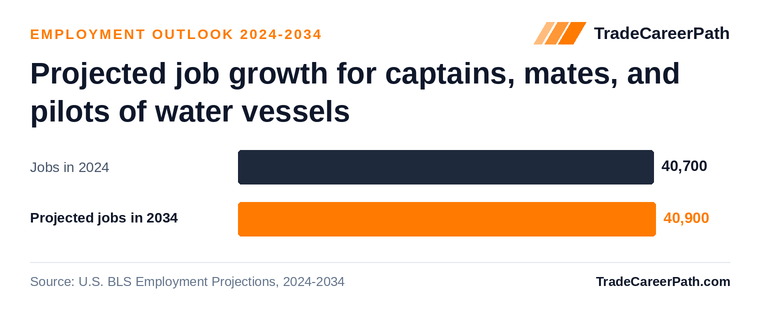
BLS projects employment of captains, mates, and pilots of water vessels to change +4.0% from 2025 to 2035 - from 41,300 to 42,900 jobs - essentially flat. The number that matters for a career changer is different: about 3,800 openings per year, almost entirely from retirements and officers coming ashore (BLS Employment Projections, 2025-35). In an occupation this size, that is steady hiring - the industry has complained of officer shortages for years, and licensed mariners rarely struggle to find a berth.
Wages are moving the right way, too. The 2024 base-year median was $85,540; the May 2025 OEWS median is $92,460 - a meaningful year-over-year rise that reflects how hard companies are competing for licensed officers. The Jones Act requirement that U.S.-flag vessels sail with U.S. crews puts a structural floor under domestic demand that most occupations do not have.
Cost and Time to Complete the Degree
For ship officers, the credential is: Bachelor’s from a maritime academy (deck or engine license track). The maritime-academy route is a 4-year residential program with training-ship sea terms; unlike the rest of this list, it is not a part-time-while-working degree, though the hawsepipe route trades time for tuition. Transfer credit is the other lever: prior college, military training - especially Navy and Coast Guard service - and industry certifications can be worth real credit at academy admissions, so get a written transfer evaluation before enrolling anywhere. Costs vary by academy; state academies at in-state rates are the value benchmark, and the federal USMMA charges no tuition in exchange for a service obligation.
Pros and Cons of Training as a Merchant Marine Officer
Pros
- Median pay of $92,460 nationally, with the top 10% above $170,640 (BLS OEWS, May 2025)
- About 3,800 openings per year despite flat headcount - retirement-driven demand (BLS Employment Projections, 2025-35)
- Field experience from the trades is a genuine hiring advantage
- Time-off rotations no shoreside job matches
Cons
- Requires a 4-year residential academy degree - or a slower hawsepipe climb
- Entry-level pay starts near $47,420 at the 10th percentile
- Licensing hurdle: USCG Merchant Mariner Credential with officer endorsement (required)
- Weeks to months away from home at sea
Frequently Asked Questions
Can a deckhand work as a ship's officer without the academy?
Yes - the 'hawsepipe' route uses sea time and USCG exams instead of the degree, but it is slower; the maritime-academy bachelor's remains the standard fast track to an officer license.
How much do ship officers make?
The national median annual wage for captains, mates, and pilots of water vessels is $92,460 (BLS OEWS, May 2025). The top 10% earn $170,640 or more, while entry-level pay starts around $47,420.
What is the job outlook for ship officers?
BLS projects employment of captains, mates, and pilots of water vessels to change by +4.0% from 2025 to 2035 (BLS Employment Projections, 2025-35).
How long does merchant marine officer training take?
Four years at a maritime academy - the bachelor's and the Third Mate or Third Assistant Engineer license are earned together, including training-ship sea terms. The hawsepipe route through sea time and USCG exams takes longer, because license upgrades depend on documented sea service rather than semesters.
Is training as a ship officer hard?
The academy path is demanding: engineering-level coursework, regimented training-ship terms, and rigorous USCG license exams covering navigation rules or engineering systems. Tradespeople with mechanical, vessel, or industrial experience usually find the engine-track material more familiar than fresh high-school graduates do.
Should I choose the deck track or the engine track?
Deck officers (mates) handle navigation, watchstanding, and cargo; engine officers run propulsion, power generation, and ship systems. Mechanics, welders, and industrial-trades workers usually transition fastest through the engine track. Both tracks lead to the same occupation with a $92,460 national median (BLS OEWS, May 2025).
Do ship officers need a license?
Yes - sailing as a mate or engineer requires a USCG Merchant Mariner Credential with the appropriate officer endorsement, plus supporting requirements such as a TWIC card, a medical certificate, and STCW training. There is no unlicensed path to the officer's chair.
How many jobs are there for ship officers?
BLS counts 36,850 captains, mates, and pilots of water vessels nationwide (OEWS, May 2025) and projects about 3,800 openings per year from 2025 to 2035, driven mostly by retirements (BLS Employment Projections, 2025-35).
Merchant Marine Officer Salary and Requirements by State
Alabama · Alaska · Arizona · California · Connecticut · Delaware · Florida · Georgia · Hawaii · Illinois · Indiana · Iowa · Louisiana · Maine · Maryland · Massachusetts · Michigan · Minnesota · Mississippi · Missouri · New Hampshire · New Jersey · New York · North Carolina · Ohio · Oklahoma · Oregon · Pennsylvania · Rhode Island · South Carolina · Tennessee · Texas · Utah · Vermont · Virginia · Washington · West Virginia · Wisconsin
Related Careers and Degree Paths
- Marine Engineer - the shoreside/design counterpart to the seagoing engine license
- Marine Technician - the vessel-systems trade that feeds the engine track
- Diesel Mechanic - the skill set closest to an engine officer’s daily work
- Logistician - the shoreside cargo and supply-chain path officers move into
- Heavy Equipment Operator - a parallel licensed-operator trade on land
Sources
- U.S. Bureau of Labor Statistics, Occupational Employment and Wage Statistics (OEWS), May 2025 - Captains, Mates, and Pilots of Water Vessels (SOC 53-5021)
- U.S. Bureau of Labor Statistics, Employment Projections, 2025-35
- U.S. Bureau of Labor Statistics, Occupational Outlook Handbook - Water Transportation Workers (education and licensing requirements)
Ship Officer Salary by State
About this guide: Researched and written by the TradeCareerPath Editorial Team. Our editorial team researches and sources every trade school and career guide using federal labor and education data, including BLS OEWS and Employment Projections, DOL apprenticeship records, IPEDS, College Scorecard, and state licensing boards. We follow the editorial standards documented at /editorial-policy/.
Data sources
Figures on this page are sourced from the federal and state datasets below. Methodology: how we rank and source data.
| Data | Provider | Vintage |
|---|---|---|
| Occupational Employment and Wage Statistics (OEWS) | U.S. Bureau of Labor Statistics | May 2025 |
| Employment Projections | U.S. Bureau of Labor Statistics | 2025-2035 |
| Integrated Postsecondary Education Data System | National Center for Education Statistics (IPEDS) | 2024 |
| College Scorecard (school-level outcomes) | U.S. Department of Education | latest release |
| College Scorecard (field-of-study earnings) | U.S. Department of Education | latest release (updated 2026-06-12) |
| Occupational licensing requirements | CareerOneStop (U.S. Department of Labor) | latest release (updated 2026-02-22) |
| Registered apprenticeship programs | CareerOneStop / Apprenticeship.gov (U.S. Department of Labor) | latest release (updated 2025-10-25) |
| O*NET occupation profiles (skills, tasks, tools, job zones) | U.S. Department of Labor (O*NET / Employment & Training Admin.) | O*NET 31.0 (updated 2026-10-14) |