
How to Become a Solar Installer in 2026
Is Solar Installer Right for You?
The U.S. Department of Labor's O*NET profile for Solar Photovoltaic Installers (SOC 47-2231) describes the work this way: Assemble, install, or maintain solar photovoltaic (PV) systems on roofs or other structures in compliance with site assessment and schematics. May include measuring, cutting, assembling, and bolting structural framing and solar modules. May perform minor electrical work such as current checks.
What the work involves
- Install photovoltaic (PV) systems in accordance with codes and standards, using drawings, schematics, and instructions.
- Check electrical installation for proper wiring, polarity, grounding, or integrity of terminations.
- Identify electrical, environmental, and safety hazards associated with photovoltaic (PV) installations.
- Identify installation locations with proper orientation, area, solar access, or structural integrity for photovoltaic (PV) arrays.
- Assemble solar modules, panels, or support structures, as specified.
Skills and knowledge that matter
Skills: Installation, Critical Thinking, Active Listening, Monitoring, Operations Monitoring, Quality Control Analysis.
Knowledge: Building and Construction, Engineering and Technology, Mechanical, Design.
Tools and technology you may use
Technology: Project management software, Enterprise application integration software, Spreadsheet software, Extensible markup language XML, Microsoft Excel, Microsoft Office software.
Typical preparation
O*NET Job Zone 1-2 (Very Little to Some Preparation Needed). Usually requires a high school diploma or GED, though some occupations may not. Ranges from a few days to one year of on-the-job training.
Interest fit
O*NET interest profile: Realistic, Conventional, Investigative. People who enjoy hands-on, practical work with tools, machines, plants, or materials often find this occupation a good fit.
Source: O*NET 31.0 (updated 2026-10-14)
Quick answer: Training as a solar installer usually takes 3 to 9 months of training plus on-the-job experience. You complete a solar or photovoltaic (PV) training program, add OSHA safety training and the NABCEP PV Installation Professional certification, and build skills in an entry-level installer role. No college degree is required, though some states require a license for electrical wiring. The median solar installer salary is $53,140 per year ($25.55/hour), and there are about 4,200 openings nationwide each year (BLS, May 2025).
Solar installers, also called photovoltaic (PV) installers, set up and maintain the panel systems that turn sunlight into electricity for homes, businesses, and utilities. It is a hands-on trade with strong projected growth and a short, affordable path to entry.
How to Become a Solar Installer
Most people enter this trade in under a year. There is no single national exam to pass. Instead, you build the career through short training, safety credentials, a recognized PV certification, and hands-on field experience.
1. Earn a high school diploma or GED
A high school diploma or GED is the baseline requirement for nearly every solar training program and entry-level installer job. The skills that carry over most are practical ones: basic algebra for sizing systems and reading specs, science for understanding how electricity and panels work, and any shop, construction, or technical classes that get you comfortable with tools and measurements. Being able to read a tape measure, follow a wiring diagram, and work safely on a ladder matters more here than a high grade-point average. If you are switching careers and already have a diploma or a background in construction, roofing, or electrical work, you can move straight to training. Those trades transfer well, since solar installation borrows heavily from carpentry, roofing, and electrical skills. Comfort working outdoors, at heights, and as part of a crew is just as important as classroom preparation, so it helps to be honest with yourself about that before you commit.
2. Complete a solar installation training program
This is the core of your preparation. Programs typically run 3 to 9 months and are offered by community colleges, trade schools, and some contractor-sponsored programs. Good training pairs classroom instruction with hands-on labs so you practice the actual job: mounting racking and panels, running conduit, wiring modules and inverters, sizing a system, and commissioning and testing a finished install. Coursework usually covers PV system fundamentals, electrical basics, the National Electrical Code as it applies to solar, blueprint reading, and rooftop safety. When comparing programs, look for ones recognized or with accreditation from the Interstate Renewable Energy Council (IREC), which sets standards for solar training quality. Many programs also prepare you to sit for the NABCEP exams. Training costs vary by program and school, so compare tuition, schedule, and the amount of hands-on lab or field time directly. Some installers skip formal school entirely and learn through paid on-the-job training with a contractor, which is a valid path if you can land an entry-level spot.
3. Add safety and PV certifications
Two credentials carry real weight in this trade. First, OSHA 10 or OSHA 30 construction safety training is required on most job sites, since solar work involves heights, electrical hazards, and heavy equipment. Many employers will not put you on a roof without it. Second, the gold-standard professional credential is the NABCEP PV Installation Professional certification from the North American Board of Certified Energy Practitioners. NABCEP certification is voluntary, but it is the recognized industry standard and signals to employers and customers that you have verified knowledge and field experience. It generally requires a combination of training hours and documented installation experience before you can sit for the exam, so most people earn it after they have some time on the job rather than right out of school. Check the official NABCEP requirements for current eligibility and exam details.
4. Gain on-the-job experience
Classroom training gets you started, but employers want crew members who can perform safely and efficiently on real installs. Look for an entry-level installer role or an apprenticeship with a residential or commercial solar contractor. You will start by carrying materials, mounting racking, and assisting with wiring under supervision, then take on more responsibility as you prove yourself. Many employers offer paid on-the-job training, so you earn while you build the documented installation hours that NABCEP certification requires. Field experience is also where you learn the parts of the job no classroom covers well: working efficiently in heat and cold, coordinating with a crew, dealing with odd roof angles, and troubleshooting systems that do not power up the first time. Treat this stage as the real foundation of your career, and keep a record of the installs you complete.
5. Advance your career
Once you have experience and certifications, the trade opens up. Many installers move into crew lead or site supervisor roles, then into project management, system design, sales, or inspection. Earning a state electrical license lets you take on the wiring and interconnection work that often pays more and broadens what jobs you can run. Advanced NABCEP credentials can move you into specialized, higher-paying roles. With enough experience and the right licensing, some installers start their own contracting business. Because the industry is projected to grow much faster than average through 2035, experienced, certified installers are well positioned for steady advancement.
What Does a Solar Installer Do?
Solar installers, also known as photovoltaic (PV) installers, set up and maintain systems that convert sunlight into electricity. Common responsibilities include:
- Installing solar panels on roofs or ground-mounted systems
- Connecting PV systems to electrical infrastructure and inverters
- Performing routine inspections and maintenance
- Troubleshooting and replacing faulty components
- Educating clients on system usage and care
Installers may work in residential, commercial, agricultural, or off-grid settings.
Skills Needed
- Basic electrical and mechanical aptitude
- Comfort working outdoors and at heights
- Problem-solving and critical thinking
- Familiarity with tools, schematics, and meters
- Customer service and teamwork
Training Options
Solar installers train through:
- Solar trade schools or community colleges
- PV training programs with hands-on labs
- Contractor-sponsored apprenticeships and paid on-the-job training
Certifications and Licensing
While not federally required, certifications boost your career and credibility:
- NABCEP PV Installation Professional certification, the recognized industry standard
- OSHA 10 or OSHA 30 construction safety training for job-site work
- State electrical licenses for installers working directly with wiring
Career Growth and Advancement
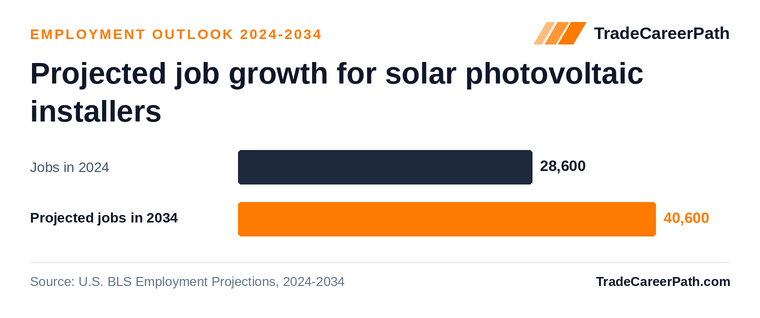
With experience, solar installers may move into roles such as:
- Crew Lead or Site Supervisor who runs an install team
- Project Manager overseeing schedules and multiple jobs
- Licensed Electrician for higher-paid wiring and interconnection work
- Business Owner running an independent solar contracting company
Cost and Duration of Training
- Time to complete: about 3 to 9 months for most training programs
- Program cost: varies by program and school; compare tuition and hands-on time directly
- On-the-job training: many employers offer paid training, which lowers out-of-pocket cost
State Licensing and Requirements
Each state has different requirements for solar installers.
We’ve written state-by-state guides that walk you through exactly what’s required.
| State | Step-by-Step Guide |
|---|---|
| Florida | How to Become a Solar Installer in Florida |
| Texas | How to Become a Solar Installer in Texas |
| California | How to Become a Solar Installer in California |
Explore more: All State Licensing Pages
Pros and Cons
Pros
- Fast-growing, purpose-driven career
- Low barrier to entry with quick training options
- Room to grow into electrical or project management roles
- Contributes to sustainability and clean energy
Cons
- Physically demanding, especially on rooftops
- Weather can affect work conditions
- Certification and licensing may add cost and time
Quick Facts: Solar Installer Salary, Education, and Outlook
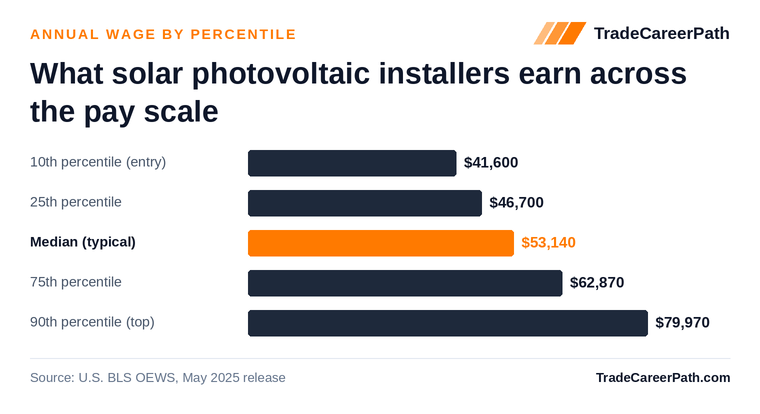
Industry Organizations & Certifying Bodies
These are the recognized national organizations, unions, certifying bodies, and regulatory authorities that shape this trade. They issue the credentials, sponsor the apprenticeships, publish the codes, and represent workers and employers.
- North American Board of Certified Energy Practitioners (NABCEP) Industry-standard PV Installation Professional certification.
- Solar Energy Industries Association (SEIA) National solar industry trade association.
- Interstate Renewable Energy Council (IREC) Accredits solar training programs and credentials.
- OSHA 10 / OSHA 30 Construction Safety Required job-site safety training for most solar installers.
Wage and Employment Charts
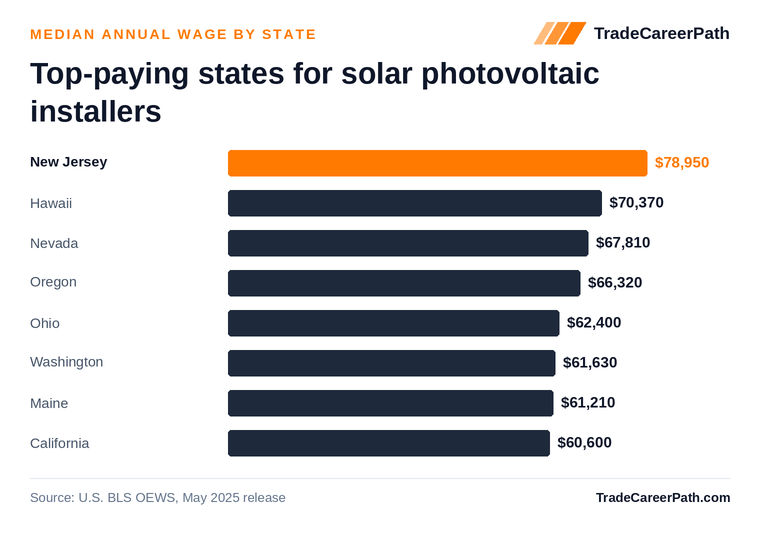
Solar Installation Technician Salary and Requirements by State
Select your state for local wage data, training options, and requirements:
Alabama · Alaska · Arizona · Arkansas · California · Colorado · Connecticut · Delaware · District of Columbia · Florida · Georgia · Hawaii · Idaho · Illinois · Indiana · Iowa · Kansas · Kentucky · Louisiana · Maine · Maryland · Massachusetts · Michigan · Minnesota · Mississippi · Missouri · Montana · Nebraska · Nevada · New Hampshire · New Jersey · New Mexico · New York · North Carolina · North Dakota · Ohio · Oklahoma · Oregon · Pennsylvania · Rhode Island · South Carolina · South Dakota · Tennessee · Texas · Utah · Vermont · Virginia · Washington · West Virginia · Wisconsin · Wyoming
Workplace Safety Snapshot
BLS Survey of Occupational Injuries and Illnesses data (2023-2024) report approximately 183.5 days-away, restricted, or transfer cases per 10,000 full-time-equivalent workers in solar photovoltaic installers (about 1.83 per 100 FTE). Source: BLS Survey of Occupational Injuries and Illnesses, Table R98.
Frequently Asked Questions
How long does solar installer training take?
Most people complete a solar installation training program in about 3 to 9 months, then build skills on the job. A high school diploma or GED is generally required to get started, and no four-year degree is needed.
Do you need a college degree to work as a solar installer?
No. A college degree is not required. Most installers enter the field through a short solar training program or by starting in an entry-level role and learning on the job. A high school diploma or GED is typically the only educational prerequisite.
Is solar installer certification required?
Certification is voluntary at the federal level, but the NABCEP PV Installation Professional credential from the North American Board of Certified Energy Practitioners is the recognized industry standard and can improve pay and job prospects. Some states require a license for work that involves electrical wiring, so check your state's rules.
How much does solar installer training cost?
Training costs vary widely by program and school, from short community college courses to longer certificate programs. Many installers also learn through paid on-the-job training, which lowers out-of-pocket cost. Compare programs directly for current tuition.
Is it hard to train as a solar installer?
Entry is relatively accessible because training is short and no degree is required. The work itself is physically demanding, since it involves lifting panels, climbing, and working on rooftops and outdoors in varying weather. Comfort with heights and basic electrical and mechanical skills help a lot.
Can you train to be a solar installer online?
Some PV training programs offer online coursework, but the trade requires hands-on skills, so the best programs pair online instruction with in-person labs or field work. Look for training accredited or recognized by groups such as the Interstate Renewable Energy Council (IREC).
Is solar installer a growing career?
Yes. BLS projects 36.5% employment growth for solar photovoltaic installers between 2025 and 2035, classified as much faster than average, with about 4,200 openings projected nationwide each year.
How Solar Technician Pay Compares to Similar Trades
Side-by-side comparison of Solar Installation Professional and the closest related careers, based on U.S. Bureau of Labor Statistics data (May 2025 OEWS + 2025-2035 Employment Projections).
| Career | Median Pay | 10-Year Growth | Annual Openings |
|---|---|---|---|
| Solar Installation Professional this guide | $53,140 | +36.5% | 4,200 |
| Electrician | $63,190 | +9.2% | 72,700 |
| Wind Turbine Technician | $64,120 | +29.5% | 1,500 |
| Lineworker | $95,320 | +10.3% | 10,900 |
| HVAC Technician | $61,010 | +10.9% | 40,600 |
Source: BLS Occupational Employment and Wage Statistics + BLS Employment Projections.
Advance Your Career with a Degree
Experienced Solar Technician professionals often step up into degree-track careers where field experience is a hiring advantage:
- Electrical Engineer - median pay $120,630 (BLS OEWS, May 2025); requires a 4-year degree
- Environmental Engineer - median pay $107,110 (BLS OEWS, May 2025); requires a 4-year degree
- Computer Hardware Engineer - median pay $161,740 (BLS OEWS, May 2025); requires a 4-year degree
- Electronics Engineer - median pay $130,220 (BLS OEWS, May 2025); requires a 4-year degree
See all trade careers that require a 4-year degree.
Degree and Program Guides
- Online Electrical Engineering Degrees - the degree route into power and renewables engineering
Sources
- U.S. Bureau of Labor Statistics, Occupational Employment and Wage Statistics (May 2025)
- U.S. Bureau of Labor Statistics, Employment Projections 2025-2035
- U.S. Bureau of Labor Statistics, Survey of Occupational Injuries and Illnesses (2023-2024, Table R98)
- U.S. Department of Labor, Wage and Hour Division, Davis-Bacon General Wage Determinations (2026)
Solar Technician Salary by State
About this guide: Researched and written by the TradeCareerPath Editorial Team. Our editorial team researches and sources every trade school and career guide using federal labor and education data, including BLS OEWS and Employment Projections, DOL apprenticeship records, IPEDS, College Scorecard, and state licensing boards. We follow the editorial standards documented at /editorial-policy/.
Data sources
Figures on this page are sourced from the federal and state datasets below. Methodology: how we rank and source data.
| Data | Provider | Vintage |
|---|---|---|
| Occupational Employment and Wage Statistics (OEWS) | U.S. Bureau of Labor Statistics | May 2025 |
| Employment Projections | U.S. Bureau of Labor Statistics | 2025-2035 |
| Integrated Postsecondary Education Data System | National Center for Education Statistics (IPEDS) | 2024 |
| College Scorecard (school-level outcomes) | U.S. Department of Education | latest release |
| College Scorecard (field-of-study earnings) | U.S. Department of Education | latest release (updated 2026-06-12) |
| Occupational licensing requirements | CareerOneStop (U.S. Department of Labor) | latest release (updated 2026-02-22) |
| Registered apprenticeship programs | CareerOneStop / Apprenticeship.gov (U.S. Department of Labor) | latest release (updated 2025-10-25) |
| O*NET occupation profiles (skills, tasks, tools, job zones) | U.S. Department of Labor (O*NET / Employment & Training Admin.) | O*NET 31.0 (updated 2026-10-14) |