
How to Become a Diagnostic Medical Sonographer in 2026
Is Diagnostic Medical Sonographer Right for You?
The U.S. Department of Labor's O*NET profile for Diagnostic Medical Sonographers (SOC 29-2032) describes the work this way: Produce ultrasonic recordings of internal organs for use by physicians. Includes vascular technologists.
What the work involves
- Observe screen during scan to ensure that image produced is satisfactory for diagnostic purposes, making adjustments to equipment as required.
- Observe and care for patients throughout examinations to ensure their safety and comfort.
- Provide sonogram and oral or written summary of technical findings to physician for use in medical diagnosis.
- Select appropriate equipment settings and adjust patient positions to obtain the best sites and angles.
- Operate ultrasound equipment to produce and record images of the motion, shape, and composition of blood, organs, tissues, or bodily masses, such as fluid accumulations.
Skills and knowledge that matter
Skills: Active Listening, Speaking, Social Perceptiveness, Reading Comprehension, Monitoring, Critical Thinking.
Knowledge: Customer and Personal Service, English Language, Physics, Medicine and Dentistry.
Tools and technology you may use
Tools: 3D sonography equipment, A-Mode ultrasound machines, Cardiac ultrasound equipment, Color Doppler ultrasound equipment, Continuous-wave ultrasound equipment, Desktop computers.
Technology: Calendar and scheduling software, Data base user interface and query software, Medical software, eClinicalWorks EHR software, MEDITECH software, Microsoft Excel.
Typical preparation
O*NET Job Zone Three (Medium Preparation Needed). Most occupations in this zone require training in vocational schools, related on-the-job experience, or an associate's degree. Employees in these occupations usually need one or two years of training involving both on-the-job experience and informal training with experienced workers. A recognized apprenticeship program may be associated with these occupations.
Interest fit
O*NET interest profile: Realistic, Conventional, Investigative. People who enjoy hands-on, practical work with tools, machines, plants, or materials often find this occupation a good fit.
Source: O*NET 29.1 (updated 2026-06-13)
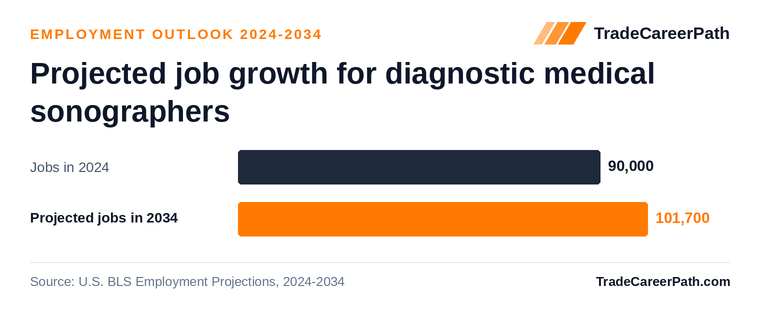
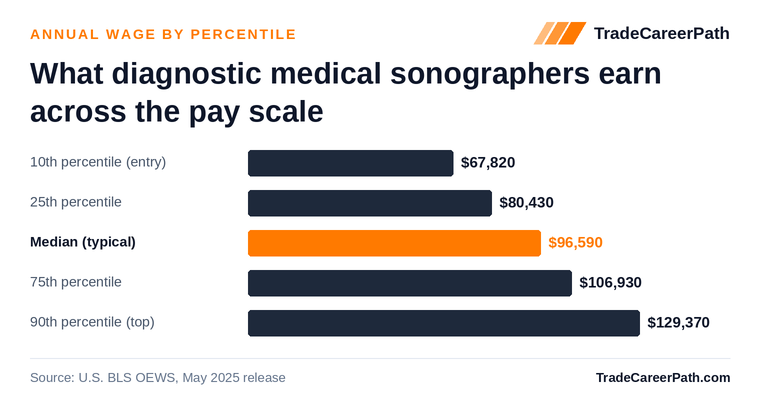
Quick answer: Training as a diagnostic medical sonographer usually takes about 2 years through an associate degree, or roughly 12 to 18 months through a certificate program if you already have a degree or health background. Certification is not legally required nationwide but is expected by most employers, most commonly the RDMS credential from ARDMS. A handful of states require a license. The median sonographer salary is $96,590 per year ($46.44/hour), and employers post about 5,800 openings nationwide each year (BLS, May 2025).
Diagnostic Medical Sonographers, also called Ultrasound Technicians, use sound waves to create images of organs, tissues, and blood flow that help physicians diagnose conditions and monitor pregnancies. It is a well paid healthcare career you can enter in about two years without a four year degree.
How to Become a Diagnostic Medical Sonographer
Most people enter the field in about two years through an accredited program, then certify and start working. There is no single national license, so the path runs through education, supervised clinical hours, and a recognized credential.
1. Earn a high school diploma or GED
A high school diploma or GED is the minimum requirement for every accredited sonography program. Because the training leans heavily on science, the courses you take in high school matter. Biology, anatomy and physiology, algebra, and physics give you a real head start, since ultrasound physics and human anatomy are two of the hardest parts of a sonography curriculum. Strong communication skills help too, because you will be working directly with patients, explaining procedures, and keeping them calm during exams. If you are changing careers and already have a diploma or a degree in another field, you can move straight to choosing a program. Many sonographers come from other allied health roles, such as nursing assistants or radiologic technologists, and bring patient-care experience that shortens the learning curve once clinical rotations begin.
2. Complete an accredited sonography program
This is the core of your training, and the format you choose depends on your background:
- Associate degree programs take about 2 years and are the most common route, combining general-education credits with sonography-specific coursework and clinical rotations.
- Certificate programs are built for people who already hold a degree or a related health credential and want to switch into sonography faster, often in 12 to 18 months.
- Bachelor’s degrees in sonography or medical imaging take about four years and can help with supervisory or specialized roles.
Look for programmatic accreditation, which most employers and credentialing bodies expect. Typical coursework covers human anatomy and physiology, ultrasound physics and instrumentation, cross-sectional anatomy, patient care, and a chosen specialty such as abdominal, OB/GYN, vascular, or cardiac sonography. Cost varies by school and program type, so compare tuition, fees, and clinical placement details before you enroll.
3. Complete supervised clinical training
Classroom learning gets you only part of the way. Sonography is a hands-on skill, and you build it by scanning real patients under supervision. Accredited programs place you in clinical rotations at hospitals, outpatient imaging centers, and physician offices, where you learn to position patients, operate ultrasound and Doppler equipment, capture diagnostic-quality images, and recognize normal versus abnormal anatomy. These rotations also let you log the documented clinical hours and case counts that credentialing organizations require before you can sit for their exams. Treat clinical training as an extended interview: the technologists and physicians you work with often work as references, and some students receive job offers from the sites where they rotated.
4. Earn ARDMS or ARRT certification
Certification is not legally required everywhere, but most employers expect it, and it is the clearest way to prove your skills. The most widely recognized path is through the American Registry for Diagnostic Medical Sonography (ARDMS), which issues the RDMS, RDCS, and RVT credentials. You typically pass the SPI (Sonography Principles and Instrumentation) exam plus a specialty exam, such as Abdomen or OB/GYN, to earn a credential. The American Registry of Radiologic Technologists (ARRT) offers a Sonography (S) credential as an alternative path, often suited to people already working in radiologic technology. The Society of Diagnostic Medical Sonography (SDMS) is the field’s professional association and a good source for continuing education and exam preparation. Confirm the exact eligibility route, since it depends on your education and clinical experience.
5. Apply for jobs and specialize
Hospitals, outpatient imaging centers, physician offices, and diagnostic labs all hire sonographers. Tailor your resume to the specialty you trained in, list your ARDMS or ARRT credentials prominently, and lean on the contacts you made during clinical rotations. A few states, including New Mexico, Oregon, and North Dakota, require a license, so verify your state’s rules before you apply. Once you are working, adding specialty credentials over time in areas such as vascular, cardiac (echocardiography), or musculoskeletal sonography broadens the jobs you qualify for and can raise your pay. Experienced sonographers also move into lead technologist, clinical instructor, and imaging department supervisor roles.
What Does a Diagnostic Medical Sonographer Do?
Ultrasound Technicians use specialized imaging equipment to help physicians diagnose medical conditions and monitor pregnancies. They guide patients through procedures and interpret the sound-wave reflections that produce high-resolution diagnostic images.
Common duties
- Preparing patients for imaging procedures
- Operating ultrasound and Doppler equipment
- Capturing and evaluating diagnostic images
- Communicating findings to physicians
- Maintaining patient records and imaging equipment
Diagnostic Medical Sonographers combine medical knowledge and technical precision to support patient care every day.
Key Skills for Ultrasound Technicians
- Precision and hand-eye coordination
- Compassionate patient communication
- Understanding of anatomy and pathology
- Ability to analyze real-time imaging data
- Physical stamina for long procedures
Sonography Program Options
Training options for sonographers include:
- Community Colleges - Associate of Applied Science in Diagnostic Medical Sonography
- Universities - Bachelor’s programs in Sonography or Medical Imaging
- Vocational and Trade Schools - Accelerated or hybrid diploma options
Certification and Licensing
National certification
- ARDMS, the American Registry for Diagnostic Medical Sonography, issues the RDMS, RDCS, and RVT credentials
- ARRT(S), the American Registry of Radiologic Technologists Sonography credential, is an alternative path
State licensing
- Most states do not license sonographers. A few do, including New Mexico, Oregon, and North Dakota.
Always verify your state’s current requirements before applying.
Check State Licensing Pages ->
Education and Certification Paths
| Pathway | Typical Duration | Outcome |
|---|---|---|
| Certificate | 12 to 18 months | For those with a prior degree or health credential |
| Associate Degree | About 2 years | Most common credential |
| Bachelor’s Degree | About 4 years | Helpful for advanced or supervisory roles |
Career Advancement Opportunities
With experience and additional certification, sonographers can move into roles like:
- Cardiac Sonographer (Echocardiography)
- Vascular Technologist
- OB/GYN Sonographer
- Lead Sonographer or Imaging Department Supervisor
Cost and Duration of Training
- Program cost: varies by program type and school, so compare tuition, fees, and clinical costs at each option
- Time to complete: about 2 years for an associate degree, or roughly 12 to 18 months for a certificate program
- Certification: ARDMS or ARRT exams, with fees set by the credentialing body
Many programs offer online coursework for the classroom portion, but the clinical scanning component must be completed in person.
Pros and Cons of Being an Ultrasound Tech
Pros
- High earning potential for a two year credential
- Strong job outlook
- Opportunities across multiple medical specialties
- Noninvasive diagnostic work
Cons
- Long hours and time on your feet during scans
- Emotional stress during difficult cases
- Ongoing continuing education and certification upkeep
Quick Facts: Sonographer Salary, Education, and Outlook
Industry Organizations & Certifying Bodies
These are the recognized national organizations, unions, certifying bodies, and regulatory authorities that shape this trade. They issue the credentials, sponsor the apprenticeships, publish the codes, and represent workers and employers.
- American Registry for Diagnostic Medical Sonography (ARDMS) Issues the RDMS, RDCS, and RVT sonographer credentials.
- American Registry of Radiologic Technologists (ARRT) Issues the ARRT Sonography (S) credential.
- Society of Diagnostic Medical Sonography (SDMS) Professional association for sonographers.
Wage and Employment Charts
Sonography Technician Salary and Requirements by State
Select your state for local wage data, training options, and requirements:
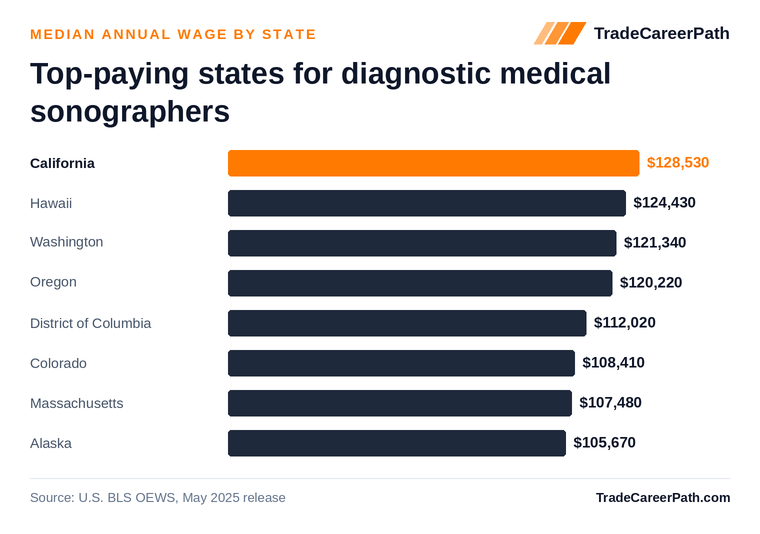
Alabama · Alaska · Arizona · Arkansas · California · Colorado · Connecticut · Delaware · District of Columbia · Florida · Georgia · Hawaii · Idaho · Illinois · Indiana · Iowa · Kansas · Kentucky · Louisiana · Maine · Maryland · Massachusetts · Michigan · Minnesota · Mississippi · Missouri · Montana · Nebraska · Nevada · New Hampshire · New Jersey · New Mexico · New York · North Carolina · North Dakota · Ohio · Oklahoma · Oregon · Pennsylvania · Rhode Island · South Carolina · South Dakota · Tennessee · Texas · Utah · Vermont · Virginia · Washington · West Virginia · Wisconsin · Wyoming
Workplace Safety Snapshot
BLS Survey of Occupational Injuries and Illnesses data (2023-2024) report approximately 155.9 days-away, restricted, or transfer cases per 10,000 full-time-equivalent workers in diagnostic medical sonographers (about 1.56 per 100 FTE). Source: BLS Survey of Occupational Injuries and Illnesses, Table R98.
Frequently Asked Questions
How long does diagnostic medical sonographer training take?
Most people finish training in about 2 years through an associate degree, the most common path into the field. If you already hold a degree or a health credential, a 12 to 18 month certificate program can be faster. A high school diploma or GED is required to start.
Do you need a college degree to work as a sonographer?
You do not always need a full degree, but you do need formal training. The most common route is a two year associate degree, while certificate programs serve people who already have a degree or a related health background. Bachelor's programs exist for those who want a four year path.
How much does sonography training cost?
Cost varies widely by program type and school, from lower priced community college programs to more expensive university degrees. Check tuition, fees, and clinical costs with each school, and compare accredited options before you enroll.
Is sonographer certification required?
Certification is not federally required, but most employers expect it. The American Registry for Diagnostic Medical Sonography (ARDMS) issues the widely recognized RDMS, RDCS, and RVT credentials. The American Registry of Radiologic Technologists (ARRT) offers a Sonography (S) credential as another path.
Do sonographers need a state license?
Most states do not license sonographers, but a few do, including New Mexico, Oregon, and North Dakota. Because rules change, confirm the current requirements with your state before you apply for jobs.
Is it hard to train as a sonographer?
The training is demanding because it blends anatomy, physics, and hands-on scanning skill that takes practice to master. Most students finish in about two years, and the clinical rotations are where the work gets real. People who enjoy detailed, technical, patient-facing work tend to do well.
Can you study sonography online?
Classroom coursework such as physics and anatomy is often available online, but the clinical scanning component must be done in person. Look for accredited hybrid programs and confirm they place you in supervised clinical rotations near you.
How Sonography Ultrasound Pay Compares to Similar Trades
Side-by-side comparison of Diagnostic Medical Sonographer (Ultrasound Tech) and the closest related careers, based on U.S. Bureau of Labor Statistics data (May 2025 OEWS + 2024-2034 Employment Projections).
| Career | Median Pay | 10-Year Growth | Annual Openings |
|---|---|---|---|
| Diagnostic Medical Sonographer (Ultrasound Tech) this guide | $96,590 | +13.0% | 5,800 |
| Radiologic Technologist (X-Ray Tech) | $80,110 | +4.3% | 12,900 |
| EKG Technician | $74,310 | +3.0% | 3,800 |
| Medical Assistant | $45,690 | +12.5% | 112,300 |
Source: BLS Occupational Employment and Wage Statistics + BLS Employment Projections.
Advance Your Career with a Degree
Experienced Sonography & Ultrasound Technician professionals often step up into degree-track careers where field experience is a hiring advantage:
- Medical Dosimetrist - median pay $147,470 (BLS OEWS, May 2025); requires a 4-year degree
See all trade careers that require a 4-year degree.
Degree and Program Guides
- Online Radiologic Technology Degrees - the wider imaging credential path
Sources
- U.S. Bureau of Labor Statistics, Occupational Employment and Wage Statistics (May 2025)
- U.S. Bureau of Labor Statistics, Employment Projections 2024-2034
- U.S. Bureau of Labor Statistics, Survey of Occupational Injuries and Illnesses (2023-2024, Table R98)
- U.S. Department of Labor, Wage and Hour Division, Davis-Bacon General Wage Determinations (2026)
Sonography Ultrasound Salary by State
About this guide: Researched and written by the TradeCareerPath Editorial Team. Our editorial team researches and sources every trade school and career guide using federal labor and education data, including BLS OEWS and Employment Projections, DOL apprenticeship records, IPEDS, College Scorecard, and state licensing boards. We follow the editorial standards documented at /editorial-policy/.
Data sources
Figures on this page are sourced from the federal and state datasets below. Methodology: how we rank and source data.
| Data | Provider | Vintage |
|---|---|---|
| Occupational Employment and Wage Statistics (OEWS) | U.S. Bureau of Labor Statistics | May 2025 |
| Employment Projections | U.S. Bureau of Labor Statistics | 2024-2034 |
| Integrated Postsecondary Education Data System | National Center for Education Statistics (IPEDS) | 2024 |
| College Scorecard (school-level outcomes) | U.S. Department of Education | latest release |
| College Scorecard (field-of-study earnings) | U.S. Department of Education | latest release (updated 2026-06-12) |
| Occupational licensing requirements | CareerOneStop (U.S. Department of Labor) | latest release (updated 2026-02-22) |
| Registered apprenticeship programs | CareerOneStop / Apprenticeship.gov (U.S. Department of Labor) | latest release (updated 2025-10-25) |
| O*NET occupation profiles (skills, tasks, tools, job zones) | U.S. Department of Labor (O*NET / Employment & Training Admin.) | O*NET 29.1 (updated 2026-06-13) |