
How to Become a Substance Abuse Counselor in 2026
Quick answer: Training as a substance abuse counselor requires a 4-year degree - typically a Bachelor’s in addiction counseling, psychology, or human services. The national median pay is $59,350 per year, and BLS projects +18.4% employment change from 2025 to 2035 (BLS OEWS, May 2025; BLS Employment Projections, 2025-35).
Substance Abuse Counselor at a Glance
| Metric | Detail | Source |
|---|---|---|
| Median annual wage | $59,350 | BLS OEWS, May 2025 |
| Typical wage range | $38,940 (10th pct) - $97,590 (90th pct) | BLS OEWS, May 2025 |
| Employment | 491,930 nationwide | BLS OEWS, May 2025 |
| Projected growth (2025-35) | +18.4%, about 50,500 openings per year | BLS Employment Projections, 2025-35 |
| Typical education | Bachelor’s in addiction counseling, psychology, or human services | BLS Occupational Outlook Handbook |
| License / certification | State licensure/certification required (LCDC/CADC tiers vary by state) | State licensing boards |
What Does a Substance Abuse Counselor Do?
Substance abuse, behavioral disorder, and mental health counselors assess clients, run individual and group counseling, build treatment plans, and coordinate recovery services - and they carry the clinical responsibility for the recovery work that peer coaches and techs support on the floor.
Day to day, the work depends on the setting. In a residential treatment center, a counselor runs a caseload: intake assessments, individual sessions, daily process groups, treatment-plan reviews, and the discharge planning that decides what happens when a client leaves. In outpatient and intensive outpatient programs, the rhythm is evening groups and scheduled sessions with clients who are still working and living at home - relapse prevention, motivational interviewing, urinalysis reviews, and coordination with probation officers or employers. Hospital and detox settings add crisis stabilization; school and community-agency roles lean toward early intervention and family work. In every setting, documentation is serious work - progress notes and treatment plans are legal clinical records, and confidentiality rules (42 CFR Part 2, HIPAA) shape what you can say and to whom.
If you are coming from recovery coach or mental health technician work, the shortest way to say it: the peer supports the client through the day; the counselor decides the treatment. The assessment that sets the level of care, the treatment plan the whole team works from, the call on whether a client steps up or steps down - with the degree and the license, those work as your decisions. Many states count peer-support and tech hours toward certification - the time you have already put in is the first rung, not wasted motion.
Skills That Make a Great Substance Abuse Counselor
- Motivational interviewing and other evidence-based counseling methods
- Assessment and treatment planning (ASAM criteria, level-of-care decisions)
- Group facilitation - most treatment happens in groups, and running one well is a craft
- Crisis intervention and de-escalation
- Clinical documentation: progress notes, treatment plans, insurance authorizations
- Ethics and confidentiality (42 CFR Part 2, HIPAA, dual-relationship boundaries)
- Boundaries and self-care - burnout is the occupational hazard; the counselors who last treat it like a safety practice
Substance Abuse Counselor Salary
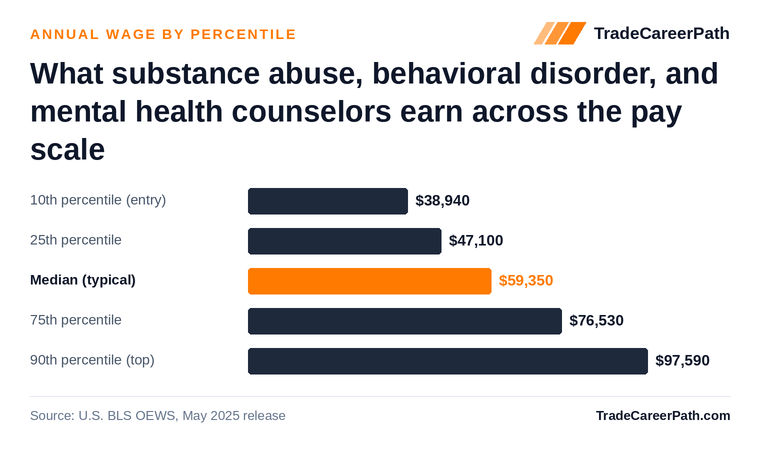
The national median for substance abuse, behavioral disorder, and mental health counselors is $59,350 per year, with a mean of $64,440 (BLS OEWS, May 2025). The spread matters more than the median here: the 10th percentile - roughly the unlicensed and entry-tier certification roles - sits at $38,940, while the 75th percentile reaches $76,530 and the top 10% earn $97,590 or more. The gap between those numbers is mostly credentials and setting: each licensure tier you clear, and each move from residential floor work toward clinical supervision, hospital, or government roles, shifts you up the distribution.
Where the Jobs and the Money Are
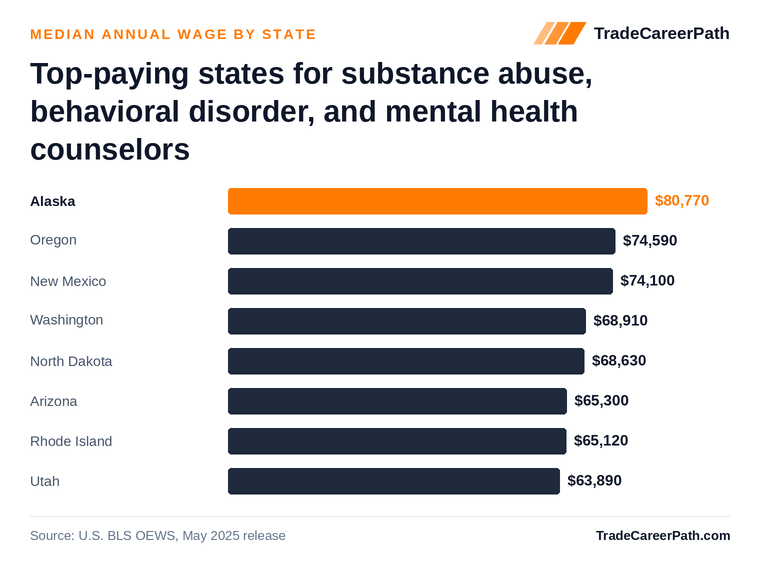
This is a big occupation - 491,930 jobs nationwide - so unlike many degree careers, you can practice almost anywhere. The pay leaders are concentrated in the West and Northern Plains: Alaska tops the table at $80,770, and Oregon and Washington pair strong pay with genuinely deep markets (BLS OEWS, May 2025).
| State | Median annual wage | Employment |
|---|---|---|
| Alaska | $80,770 | 1,290 |
| Oregon | $74,590 | 8,160 |
| New Mexico | $74,100 | 2,420 |
| Washington | $68,910 | 14,250 |
| North Dakota | $68,630 | 1,290 |
For sheer volume, California leads with 75,610 counselors, followed by Pennsylvania at 30,620 and Florida at 29,750. Concentration data tells the same story: counselors are noticeably more common than average in the labor markets of Pennsylvania, Oregon, California, Washington, and Alaska, which means more employers competing for licensed staff and more room to change jobs without relocating. Oregon and Washington are the sweet spot - top-five pay and above-average concentration in the same state.
How to Become a Substance Abuse Counselor
1. Start in peer or tech roles
Recovery coach and mental health technician experience counts toward many state certification tiers. If you are already working as a peer specialist, behavioral health tech, or detox tech, document everything - hours, supervision, trainings - because state boards credit that experience toward certification requirements. If you are still in a trade and considering the switch, a part-time or per-diem tech shift is the lowest-cost way to find out whether this work fits you before you commit to a degree.
2. Earn the bachelor’s degree
Addiction counseling, psychology, or human services - online programs are standard in this field, more so than in almost any other degree career on this site. Before enrolling, check two things: that the program’s coursework maps to your state board’s education requirements for the counselor tier you want, and that the school will grant transfer credit for prior college, military training, or certification coursework. A written transfer evaluation before you enroll can save a year.
3. Accumulate supervised clinical hours
State boards require documented supervised experience for licensure - commonly gathered through practicum placements during the degree, then paid post-degree work under a licensed supervisor. This is where the tech background pays off twice: agencies hire their own techs into counselor-trainee roles constantly, and you will already know how to function on a treatment unit.
4. Pass your state exam
IC&RC or NAADAC exams anchor most state credentials - which exam, and at which tier, depends on your state board. Study from your board’s published content outline, not a generic prep book, and confirm the exam window against your supervised-hours timeline so you are not sitting idle waiting for eligibility.
5. Advance
Clinical supervisor, program director, or a master’s for LPC-track therapy practice. The fork comes a few years after licensure: stay on the addiction-specific track and move up through clinical supervision into program leadership, or invest in a master’s for independent-practice licensure that opens private practice and broader mental health work. Employer tuition assistance is common in this field, so many counselors do the master’s on their agency’s dime.
Career Ladder: Titles and Realistic Pay
The BLS wage percentiles map onto the credential tiers this field runs on. Use this as a sanity check on offers, not a guarantee:
| Stage | Typical titles | Years in | Realistic pay (BLS OEWS, May 2025) |
|---|---|---|---|
| Entry level | Behavioral health tech, peer recovery specialist, counselor trainee/intern | 0-3 | ~$38,940-$47,100 (10th-25th pct) |
| Mid-career | Certified/licensed addiction counselor (CADC/LCDC), case manager | 3-8 | ~$59,350 (median) |
| Senior | Clinical supervisor, lead counselor, LPC-track therapist | 8-15 | ~$76,530 (75th pct) |
| Leadership | Program director, clinical director, private-practice owner | 15+ | $97,590+ (90th pct) |
Two notes for career changers. First, prior front-line experience compresses this ladder: former techs and peer specialists routinely clear the entry band faster because their pre-degree hours count toward certification and they need no orientation to how a treatment unit runs. Second, the upper bands are credential-gated more than tenure-gated - a counselor who adds the master’s and independent licensure can jump to the 75th-90th percentile range well before the fifteen-year mark, especially in hospital, VA, and private-practice settings.
Do You Need a License?
Yes - this is a regulated title in every state, and the license is the career. Unlike engineering, there is no industrial exemption: you cannot practice as a substance abuse counselor without holding the credential your state board issues. The structure is almost always tiered:
- Entry/associate tiers (names vary - registered or certified addiction counselor levels) - typically education plus training hours plus supervised experience, sometimes accessible before or during the bachelor’s.
- Full licensure tiers (CADC, LCDC, LADC, and similar) - degree, documented supervised clinical hours, and a passing score on an IC&RC or NAADAC exam.
- Independent-practice tiers (clinical or master’s-level licenses, and the LPC path) - a master’s degree plus additional supervised hours, for therapy practice without supervision.
Exact tier names, hour counts, and degree requirements vary significantly by state, and reciprocity is improving but not automatic. The practical advice: pick your state board first, then pick the degree program that satisfies it - not the other way around.
Why an Online Degree Works for This Career
Recovery coaches and mental health technicians already do the front-line work; the bachelor’s degree and state license convert that experience into the salaried clinical title. Online addiction counseling programs are widespread and well accepted by state boards, practicum hours are completed locally at agencies that are often already your employer, and BLS projects some of the fastest growth of any career on this site. Many treatment organizations offer tuition assistance precisely because they need their techs to work as their counselors.
Job Outlook for 2026 and Beyond
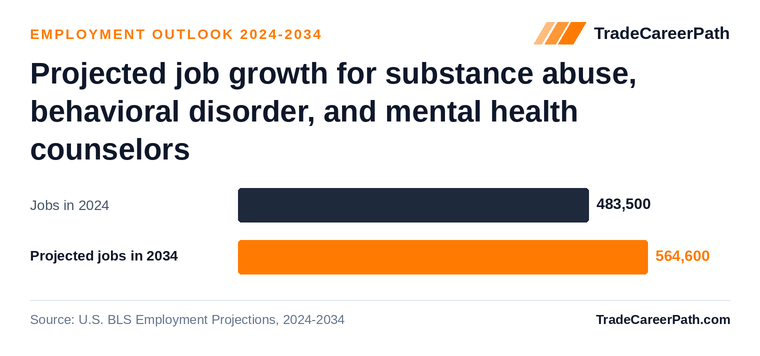
BLS projects employment of substance abuse, behavioral disorder, and mental health counselors to grow +18.4% from 2025 to 2035 - from 533,400 to 631,400 jobs - with about 50,500 openings per year once retirements and occupation changes are counted (BLS Employment Projections, 2025-35). The latest wage data (OEWS, May 2025) puts the median at $59,350, up modestly from the 2024 figure of $59,190 - pay in this field grows with credentials more than with market swings.
The demand drivers are structural: the opioid and fentanyl crisis has pushed sustained public funding into treatment capacity, insurance parity keeps expanding covered behavioral health services, and courts increasingly route people to treatment rather than around it. For career changers, the openings number is the one to focus on - 50,500 seats a year in a 491,930-person occupation means agencies in most markets are hiring continuously, and licensed counselors rarely stay unemployed long.
Cost and Time to Complete the Degree
For substance abuse counselors, the credential is: Bachelor’s in addiction counseling, psychology, or human services. A bachelor’s degree is typically 120 credit hours: four years full-time, and commonly five to six years part-time while working. Transfer credit is the other lever: prior college, military training, apprenticeship coursework, and industry certifications can be worth meaningful credit at transfer-friendly schools, so get a written transfer evaluation before enrolling anywhere. Costs vary widely by school type; in-state public online programs are usually the value benchmark, and employer tuition assistance is common for working adults in this field. Supervised clinical hours after the degree are paid work, though exam and licensing fees are usually out of pocket.
Pros and Cons of Training as a Substance Abuse Counselor
Pros
- Median pay of $59,350 nationally (BLS OEWS, May 2025)
- BLS projects +18.4% employment growth through 2035 - about 50,500 openings per year
- Field experience from the trades is a genuine hiring advantage
- Accredited online and hybrid degree paths exist for working adults
Cons
- Requires a 4-year degree (typically 120 credit hours)
- Entry-level pay starts near $38,940 at the 10th percentile
- Licensing hurdle: State licensure/certification required (LCDC/CADC tiers vary by state)
Frequently Asked Questions
Can a recovery coach work as a substance abuse counselor?
Yes - it is the designed career ladder. Peer-support experience counts toward certification in many states, and the bachelor's degree unlocks the licensed counselor tiers and salaried clinical roles.
How much do substance abuse counselors make?
The national median annual wage for substance abuse, behavioral disorder, and mental health counselors is $59,350 (BLS OEWS, May 2025). The top 10% earn $97,590 or more, while entry-level pay starts around $38,940.
What is the job outlook for substance abuse counselors?
BLS projects employment of substance abuse, behavioral disorder, and mental health counselors to change by +18.4% from 2025 to 2035 (BLS Employment Projections, 2025-35).
How long does substance abuse counselor training take?
The bachelor's degree is 120 credit hours: four years full-time, commonly five to six years part-time while working. After graduation, most states require supervised clinical hours before full licensure. Peer-support and behavioral health tech experience can count toward certification requirements in many states, and transfer credit can shorten the degree.
Is training as a substance abuse counselor hard?
The coursework is less technical than an engineering or nursing degree, but the job itself is emotionally demanding - relapse, crisis calls, and heavy documentation are part of the work. People who arrive with peer-support or tech-level experience usually find the clinical concepts easier to absorb because they have already sat in the room where recovery happens.
Should I get a bachelor's or a master's to be a substance abuse counselor?
Start with the bachelor's - it unlocks the certified and licensed addiction counselor tiers in most states and gets you into salaried clinical work at or near the median of $59,350 (BLS OEWS, May 2025). A master's comes later if you want independent-practice licensure (LPC track), private practice, or clinical supervision roles, and many employers help pay for it.
Can you train as a substance abuse counselor without a degree?
In some states, yes at the lowest certification tiers - peer recovery specialist and entry-level addiction counselor credentials sometimes accept a high school diploma plus training hours. But those tiers sit near the $38,940 10th-percentile end of the pay scale, and the licensed counselor titles that reach the $59,350 median and above generally require a bachelor's or master's degree.
Do substance abuse counselors need a license?
Yes - every state regulates the title through a licensure or certification board, usually in tiers (such as CADC or LCDC levels) built on education, supervised hours, and an IC&RC or NAADAC exam. Requirements vary significantly by state, so check your state board before choosing a program.
Substance Abuse Counselor Salary and Requirements by State
Alabama · Alaska · Arizona · Arkansas · California · Colorado · Connecticut · Delaware · District of Columbia · Florida · Georgia · Hawaii · Idaho · Illinois · Indiana · Iowa · Kansas · Kentucky · Louisiana · Maine · Maryland · Massachusetts · Michigan · Minnesota · Mississippi · Missouri · Montana · Nebraska · Nevada · New Hampshire · New Jersey · New Mexico · New York · North Carolina · North Dakota · Ohio · Oklahoma · Oregon · Pennsylvania · Rhode Island · South Carolina · South Dakota · Tennessee · Texas · Utah · Vermont · Virginia · Washington · West Virginia · Wisconsin · Wyoming
Related Careers and Degree Paths
- Recovery Coach - the peer-support entry point that feeds directly into this career
- Mental Health Technician - the other front-line role whose hours count toward certification
- Registered Nurse - the clinical alternative on the medical side of the same treatment settings
- Online Healthcare Administration Degrees - the management track for program director and agency leadership roles
- All trade careers that require a 4-year degree
Degree and Program Guides
- Online Counseling Degrees - the degree and licensure path for clinical counseling
Degree and Program Guides
- Online Social Work Degrees - the social work alternative to counseling licensure
Sources
- U.S. Bureau of Labor Statistics, Occupational Employment and Wage Statistics (OEWS), May 2025 - Substance Abuse, Behavioral Disorder, and Mental Health Counselors (SOC 21-1018)
- U.S. Bureau of Labor Statistics, Employment Projections, 2025-35
- U.S. Bureau of Labor Statistics, Occupational Outlook Handbook - education, licensing, and outlook for substance abuse, behavioral disorder, and mental health counselors
Substance Abuse Counselor Salary by State
About this guide: Researched and written by the TradeCareerPath Editorial Team. Our editorial team researches and sources every trade school and career guide using federal labor and education data, including BLS OEWS and Employment Projections, DOL apprenticeship records, IPEDS, College Scorecard, and state licensing boards. We follow the editorial standards documented at /editorial-policy/.
Data sources
Figures on this page are sourced from the federal and state datasets below. Methodology: how we rank and source data.
| Data | Provider | Vintage |
|---|---|---|
| Occupational Employment and Wage Statistics (OEWS) | U.S. Bureau of Labor Statistics | May 2025 |
| Employment Projections | U.S. Bureau of Labor Statistics | 2025-2035 |
| Integrated Postsecondary Education Data System | National Center for Education Statistics (IPEDS) | 2024 |
| College Scorecard (school-level outcomes) | U.S. Department of Education | latest release |
| College Scorecard (field-of-study earnings) | U.S. Department of Education | latest release (updated 2026-06-12) |
| Occupational licensing requirements | CareerOneStop (U.S. Department of Labor) | latest release (updated 2026-02-22) |
| Registered apprenticeship programs | CareerOneStop / Apprenticeship.gov (U.S. Department of Labor) | latest release (updated 2025-10-25) |
| O*NET occupation profiles (skills, tasks, tools, job zones) | U.S. Department of Labor (O*NET / Employment & Training Admin.) | O*NET 31.0 (updated 2026-10-14) |