
How to Become a Land Surveyor in 2026
Is Land Surveyor Right for You?
The U.S. Department of Labor's O*NET profile for Surveyors (SOC 17-1022) describes the work this way: Make exact measurements and determine property boundaries. Provide data relevant to the shape, contour, gravitation, location, elevation, or dimension of land or land features on or near the earth's surface for engineering, mapmaking, mining, land evaluation, construction, and other purposes.
What the work involves
- Direct or conduct surveys to establish legal boundaries for properties, based on legal deeds and titles.
- Prepare and maintain sketches, maps, reports, and legal descriptions of surveys to describe, certify, and assume liability for work performed.
- Write descriptions of property boundary surveys for use in deeds, leases, or other legal documents.
- Verify the accuracy of survey data, including measurements and calculations conducted at survey sites.
- Search legal records, survey records, and land titles to obtain information about property boundaries in areas to be surveyed.
Skills and knowledge that matter
Skills: Mathematics, Reading Comprehension, Writing, Critical Thinking, Speaking, Active Listening.
Knowledge: Mathematics, Engineering and Technology, Geography, Computers and Electronics.
Tools and technology you may use
Technology: Computer aided design CAD software, Graphics or photo imaging software, Map creation software, Autodesk AutoCAD, Autodesk AutoCAD Civil 3D, Bentley MicroStation.
Typical preparation
O*NET Job Zone Four (Considerable Preparation Needed). Most of these occupations require a four-year bachelor's degree, but some do not. Employees in these occupations usually need several years of work-related experience, on-the-job training, and/or vocational training.
Interest fit
O*NET interest profile: Conventional, Realistic, Investigative. People who enjoy structured, detail-oriented work with clear procedures and data often find this occupation a good fit.
Source: O*NET 31.0 (updated 2026-10-14)
Quick answer: Training as a land surveyor requires a 4-year degree - typically a Bachelor’s in surveying, geomatics, or civil engineering technology. The national median pay is $75,440 per year, and BLS projects +5.8% employment change from 2025 to 2035 (BLS OEWS, May 2025; BLS Employment Projections, 2025-35).
Land Surveyor at a Glance
| Metric | Detail | Source |
|---|---|---|
| Median annual wage | $75,440 | BLS OEWS, May 2025 |
| Typical wage range | $46,880 (10th pct) - $125,590 (90th pct) | BLS OEWS, May 2025 |
| Employment | 50,830 nationwide | BLS OEWS, May 2025 |
| Projected growth (2025-35) | +5.8%, about 3,100 openings per year | BLS Employment Projections, 2025-35 |
| Typical education | Bachelor’s in surveying, geomatics, or civil engineering technology | BLS Occupational Outlook Handbook |
| License / certification | State PS (Professional Surveyor) license required to certify boundaries | State licensing boards |
What Does a Land Surveyor Do?
Land surveyors establish official property boundaries, map terrain for design and construction, and certify the measurements that deeds, plats, and construction layouts legally depend on. It is one of the few careers where a professional’s seal carries direct legal weight: when a licensed surveyor certifies a boundary, courts, lenders, and title companies rely on it.
The daily work depends on the specialty. A boundary surveyor pulls deeds and old plats at the courthouse, recovers monuments in the field with GPS and a total station, and reconciles conflicting evidence into a defensible boundary opinion. A construction surveyor stakes buildings, roads, and utilities from engineering plans and checks as-built work against design grades. Topographic and geodetic surveyors map terrain - increasingly with drones, LiDAR, and laser scanners - then process point clouds and draft deliverables in CAD. Across all of it, the split is roughly half field, half office.
If you are coming off a survey crew or a construction site, the honest framing: you already know the field half. Running the instrument, staking grade, reading plans - that is the part a degree cannot teach. The bachelor’s adds the other half: boundary law, least-squares adjustment, geodesy, and the legal authority to sign the survey. The party chief executes the fieldwork; the licensed surveyor decides where the boundary is and takes legal responsibility for it. That signature is the difference between the technician pay band and the professional one.
Skills That Make a Great Land Surveyor
- GPS/GNSS and total-station operation
- Boundary law, easements, and deed research
- CAD drafting of plats, ALTA surveys, and site plans
- Applied trigonometry, coordinate geometry, and least-squares adjustment
- Drone, LiDAR, and laser-scanning workflows with point-cloud processing
- Detailed field notes - your records may be evidence in a boundary dispute decades later
- Writing: legal descriptions, survey reports, and client explanations carry the job
Land Surveyor Salary
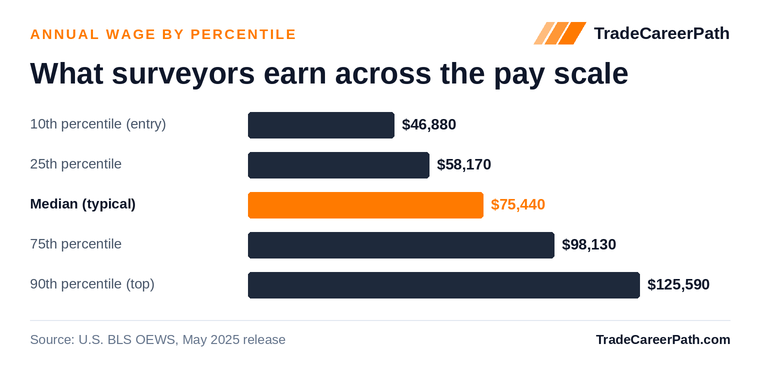
The national median for surveyors is $75,440 per year, with the 10th percentile at $46,880 - roughly where unlicensed technicians and new graduates sit - and the 90th percentile at $125,590, territory occupied by licensed surveyors running projects or owning firms (BLS OEWS, May 2025). The mean of $80,570 sitting above the median tells you the top pulls hard: the license is the gate, and pay on the far side of it is a different market.
Where the Jobs and the Money Are
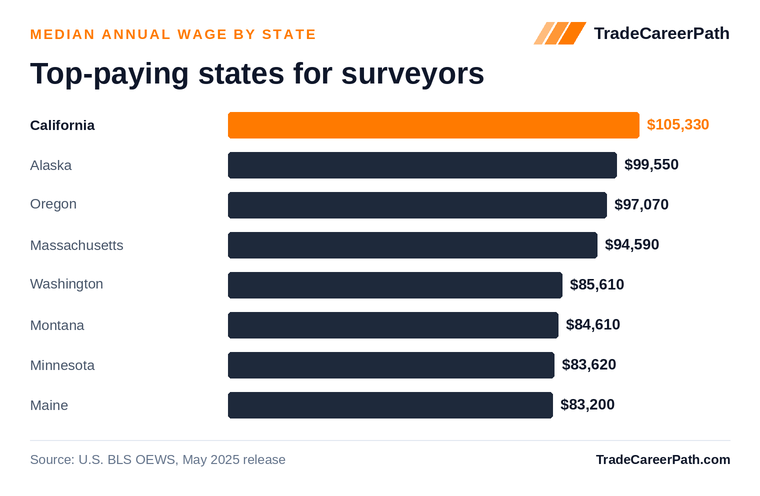
Surveying follows land development and infrastructure spending, so the job map looks different from the pay map. Texas is the biggest employer by far with 6,410 surveyors, followed by California at 4,520 and Florida at 4,000 (BLS OEWS, May 2025). Texas and Florida are also concentration hubs - surveyors are noticeably more common there than in the average state labor market - which means deep markets where you can change firms without moving.
| State | Median annual wage | Employment |
|---|---|---|
| California | $105,330 | 4,520 |
| Alaska | $99,550 | 250 |
| Oregon | $97,070 | 530 |
| Massachusetts | $94,590 | 1,290 |
| Washington | $85,610 | 780 |
The pay leaders tell a different story. California pays a $105,330 median on a large market. Alaska pays $99,550 on a small one - but surveyors there are more than twice as common as in the typical state labor market, driven by resource and public-land work. And note the trade-off: Texas pays a $61,150 median and Florida $65,480, both well under the national figure - the high-volume states are not the high-wage states in this field.
How to Become a Land Surveyor
1. Earn a bachelor’s degree
Surveying, geomatics, or civil engineering technology - but check your state board’s approved-degree list before you enroll anywhere, because boards differ on what counts. A dedicated surveying or geomatics program is the cleanest route to the FS exam and the license; civil engineering technology keeps more construction doors open but may need extra surveying credits to satisfy some boards. Several accredited programs run online or in evening formats for working survey technicians - get a written transfer evaluation of your prior coursework first.
2. Pass the FS exam
The Fundamentals of Surveying exam, administered by NCEES, starts the licensure clock and earns the surveyor-in-training (SIT/LSIT) designation. Most candidates sit for it in the final year of the degree. For working technicians it is worth taking as early as your state allows: the SIT designation alone typically moves you up the pay scale and changes what work employers route to you.
3. Gain supervised field experience
Typically four years under a licensed professional surveyor, with the exact requirement set by your state board. This is where career changers hold the advantage: if you are already on a crew, much of your existing work may qualify, and some boards count experience earned before or during the degree. Document everything - boards want detailed experience records, and the candidates who struggle at application time are the ones who did not keep them.
4. Pass the PS exam
The Principles and Practice of Surveying exam, plus a state-specific exam on local boundary law in most states, grants the license. The state component is not a formality - boundary law, water rights, and platting rules vary sharply by state. Once licensed, you can certify boundary surveys, sign and seal plats, and take legal responsibility for survey products - the authority the entire path exists to earn.
5. Advance
The ladder runs from crew to authority: instrument operator, party chief, project surveyor, then licensed PS running work under your own seal. From there the forks are firm ownership, a county or city surveyor seat, or a specialty practice - ALTA/title work, geodetic control, hydrographic surveying, or the fast-growing drone and scanning side. Because every boundary survey legally requires a licensee, the license is scarce, and many PSs eventually hang their own shingle.
Career Ladder: Titles and Realistic Pay
The BLS wage percentiles map cleanly onto how surveying careers actually progress. Use this as a sanity check on offers, not a guarantee:
| Stage | Typical titles | Years in | Realistic pay (BLS OEWS, May 2025) |
|---|---|---|---|
| Entry level | Survey technician, instrument operator, rodman | 0-3 | ~$46,880-$58,170 (10th-25th pct) |
| Mid-career | Party chief, surveyor-in-training (SIT) | 3-10 | ~$75,440 (median) |
| Senior | Licensed PS, project surveyor | 10-15 | ~$98,130 (75th pct) |
| Principal / leadership | Senior PS, survey department manager, firm owner, county surveyor | 15+ | $125,590+ (90th pct) |
Two notes for career changers. First, crew experience compresses this ladder: a party chief who finishes the degree and passes the FS may already have the supervised-experience years banked, putting the PS exam within reach almost immediately after graduation. Second, the 90th-percentile figure understates the top of this field for owners - firm profit on a licensed practice is not captured in wage data, and in states with surveyor shortages a PS’s signing authority is worth more than the salary tables suggest.
Do You Need a PS License?
Yes - this is not an optional credential. Unlike engineering, surveying has no industrial exemption: every boundary survey must be performed under the responsible charge of a state-licensed Professional Surveyor, and only the licensee can sign and seal the plat. Technicians and party chiefs do real, skilled work, but always under a PS, and the pay ceiling reflects it. The standard path in most states:
- Degree: a bachelor’s from your state board’s approved list (a few states retain experience-only routes, but they are disappearing).
- FS exam: the NCEES Fundamentals of Surveying exam earns the surveyor-in-training designation.
- Experience: typically four years of progressive responsibility under a licensed PS.
- PS exam plus state exam: the NCEES Principles and Practice of Surveying exam, plus a jurisdiction-specific boundary-law exam in most states.
Licensure is state by state - moving means comity applications and often another state law exam, so check the destination board before relocating a practice.
Why an Online Degree Works for This Career
Survey crew members and construction workers already know the field half of this career - the bachelor’s in surveying or geomatics adds the legal, computational, and licensure half. Online surveying and geomatics programs are built for working field technicians: boundary law, adjustment computations, and geodesy travel well online, while your day job keeps supplying the field practice and, in many states, the supervised experience hours the license requires. Many firms offer tuition help precisely because licensed surveyors are hard to hire - it is often cheaper to grow one than to recruit one.
Job Outlook for 2026 and Beyond
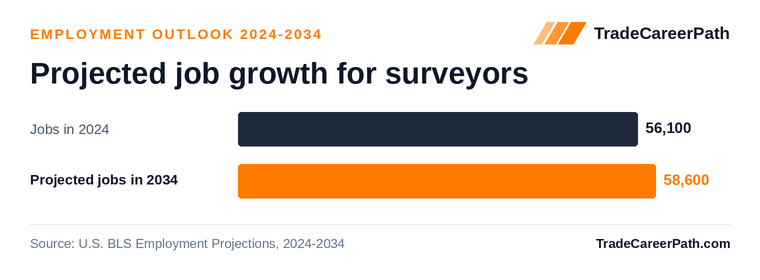
BLS projects surveyor employment to grow +5.8% from 2025 to 2035 - from 52,000 to 55,000 jobs - with about 3,100 openings per year once retirements and occupation changes are counted (BLS Employment Projections, 2025-35). Wages are moving the right way too: the May 2025 median of $75,440 is up from the 2024 figure of $72,740.
The more important number for a career changer is the openings figure: 3,100 seats a year against 50,830 employed nationally is brisk turnover, much of it retirements - surveying skews older, and boards tightened degree requirements just as the veteran generation exits. Demand drivers are steady: infrastructure programs, land development, title and lending work that requires surveys by law, and expanding drone and scanning services - all requiring a licensee’s seal, which keeps qualified competition tight.
Cost and Time to Complete the Degree
For land surveyors, the credential is: Bachelor’s in surveying, geomatics, or civil engineering technology. A bachelor’s degree is typically 120 credit hours: four years full-time, and commonly five to six years part-time while working. Transfer credit is the other lever: prior college, military training, apprenticeship coursework, and industry certifications can be worth meaningful credit at transfer-friendly schools, so get a written transfer evaluation before enrolling anywhere. Costs vary widely by school type; in-state public online programs are usually the value benchmark, and employer tuition assistance is common in this field. One surveying-specific note: supervised experience can often accrue while you study, so the degree and the experience clock can run at the same time - the part-time route costs less momentum here than in most degree careers.
Pros and Cons of Training as a Land Surveyor
Pros
- Median pay of $75,440 nationally (BLS OEWS, May 2025)
- BLS projects +5.8% employment growth through 2035
- Field experience from the trades is a genuine hiring advantage
- Accredited online and hybrid degree paths exist for working adults
Cons
- Requires a 4-year degree (typically 120 credit hours)
- Entry-level pay starts near $46,880 at the 10th percentile
- Licensing hurdle: State PS (Professional Surveyor) license required to certify boundaries
Frequently Asked Questions
Do surveyors need a degree?
Most states now require a bachelor's degree for the professional surveyor (PS) license; survey technicians can start without one, which makes the online degree a common mid-career step.
How much do land surveyors make?
The national median annual wage for surveyors is $75,440 (BLS OEWS, May 2025). The top 10% earn $125,590 or more, while entry-level pay starts around $46,880.
What is the job outlook for land surveyors?
BLS projects employment of surveyors to change by +5.8% from 2025 to 2035 (BLS Employment Projections, 2025-35).
How long does licensed land surveyor training take?
Plan on roughly eight years from a standing start: a 120-credit bachelor's (four years full-time, five to six part-time), then typically four years of supervised experience between the FS and PS exams. Experienced survey technicians can run the experience clock and the degree in parallel, which shortens the total considerably.
Is training as a land surveyor hard?
The math is real but manageable - applied trigonometry, least-squares adjustments, and coordinate geometry rather than calculus-heavy engineering. The harder parts for most people are boundary law and deed research. Field technicians usually find the coursework easier than fresh students do because they have already run the instruments.
Should I get a surveying degree or a civil engineering technology degree?
If you are certain about the PS license, a surveying or geomatics degree is the cleaner path - it maps directly onto your state board's approved-degree list and the FS exam. Civil engineering technology keeps more doors open in construction, but check your state board first: not every board accepts it without extra surveying coursework.
Can you train as a land surveyor without a degree?
You can work as a survey technician, instrument operator, or party chief without one, and a handful of states still allow an experience-only route to licensure. But most states now require the bachelor's for the PS license, and only the licensed surveyor can certify boundaries - so without the degree, the license and the top of the pay scale are out of reach in most of the country.
What license do land surveyors need?
A state Professional Surveyor (PS) license is mandatory to certify boundary surveys - there is no industrial exemption as in engineering. The standard path is the Fundamentals of Surveying (FS) exam, supervised experience (typically four years), then the Principles and Practice of Surveying (PS) exam plus any state-specific exam.
Land Surveyor Salary and Requirements by State
Alabama · Alaska · Arizona · Arkansas · California · Colorado · Connecticut · Delaware · Florida · Georgia · Hawaii · Idaho · Illinois · Indiana · Iowa · Kansas · Kentucky · Louisiana · Maine · Maryland · Massachusetts · Michigan · Minnesota · Mississippi · Missouri · Montana · Nebraska · Nevada · New Hampshire · New Jersey · New Mexico · New York · North Carolina · North Dakota · Ohio · Oklahoma · Oregon · Pennsylvania · Rhode Island · South Carolina · South Dakota · Tennessee · Texas · Utah · Vermont · Virginia · Washington · West Virginia · Wisconsin · Wyoming
Related Careers and Degree Paths
- Civil Engineer - the design side of the same projects; shared coursework and job sites
- Cartographer / GIS Specialist - the mapping and geospatial-data branch of the same skill set
- Cost Estimator - another office-side move built on plan reading and quantity takeoff
- Construction Manager - run the whole project rather than the survey scope
- Geoscientist - field measurement and mapping applied to resources and environment
Degree and Program Guides
- Online Civil Engineering Degrees - the degree that opens design and PE-track work
Degree and Program Guides
- Online Surveying Degrees - the licensure sequence and FS/PS exams
Sources
- U.S. Bureau of Labor Statistics, Occupational Employment and Wage Statistics (OEWS), May 2025 - Surveyors (SOC 17-1022)
- U.S. Bureau of Labor Statistics, Employment Projections, 2025-35 - Surveyors
- U.S. Bureau of Labor Statistics, Occupational Outlook Handbook - Surveyors: education and licensing requirements
Surveyor Salary by State
About this guide: Researched and written by the TradeCareerPath Editorial Team. Our editorial team researches and sources every trade school and career guide using federal labor and education data, including BLS OEWS and Employment Projections, DOL apprenticeship records, IPEDS, College Scorecard, and state licensing boards. We follow the editorial standards documented at /editorial-policy/.
Data sources
Figures on this page are sourced from the federal and state datasets below. Methodology: how we rank and source data.
| Data | Provider | Vintage |
|---|---|---|
| Occupational Employment and Wage Statistics (OEWS) | U.S. Bureau of Labor Statistics | May 2025 |
| Employment Projections | U.S. Bureau of Labor Statistics | 2025-2035 |
| Integrated Postsecondary Education Data System | National Center for Education Statistics (IPEDS) | 2024 |
| College Scorecard (school-level outcomes) | U.S. Department of Education | latest release |
| College Scorecard (field-of-study earnings) | U.S. Department of Education | latest release (updated 2026-06-12) |
| Occupational licensing requirements | CareerOneStop (U.S. Department of Labor) | latest release (updated 2026-02-22) |
| Registered apprenticeship programs | CareerOneStop / Apprenticeship.gov (U.S. Department of Labor) | latest release (updated 2025-10-25) |
| O*NET occupation profiles (skills, tasks, tools, job zones) | U.S. Department of Labor (O*NET / Employment & Training Admin.) | O*NET 31.0 (updated 2026-10-14) |