
How to Become a Tile Setter
Is Tile Setter Right for You?
The U.S. Department of Labor's O*NET profile for Tile and Stone Setters (SOC 47-2044) describes the work this way: Apply hard tile, stone, and comparable materials to walls, floors, ceilings, countertops, and roof decks.
What the work involves
- Align and straighten tile using levels, squares, and straightedges.
- Finish and dress the joints and wipe excess grout from between tiles, using damp sponge.
- Cut and shape tile to fit around obstacles and into odd spaces and corners, using hand and power cutting tools.
- Determine and implement the best layout to achieve a desired pattern.
- Mix, apply, and spread plaster, concrete, mortar, cement, mastic, glue or other adhesives to form a bed for the tiles, using brush, trowel and screed.
Skills and knowledge that matter
Skills: Active Listening, Time Management, Speaking, Mathematics, Critical Thinking, Coordination.
Knowledge: Building and Construction, Mathematics, Customer and Personal Service, Design.
Tools and technology you may use
Tools: Acoustic ear muffs or defenders, Adjustable widemouth pliers, Air compressors, Angle grinders, Articulating boom lifts, Base grinders.
Technology: Data base user interface and query software, Computer aided design CAD software, Project management software, Microsoft Excel, Microsoft Office software, Microsoft Outlook.
Typical preparation
O*NET Job Zone Two (Some Preparation Needed). These occupations usually require a high school diploma. Employees in these occupations need anywhere from a few months to one year of working with experienced employees. A recognized apprenticeship program may be associated with these occupations.
Interest fit
O*NET interest profile: Realistic, Conventional, Artistic. People who enjoy hands-on, practical work with tools, machines, plants, or materials often find this occupation a good fit.
Source: O*NET 29.1 (updated 2026-06-13)
Ever admired a perfectly tiled kitchen backsplash or marble floor and thought, “I’d love to create that”?
Tile setters make those designs a reality.
Tile setters, also known as flooring installers, prepare surfaces and lay ceramic, porcelain, and stone tiles with precision. They combine craftsmanship, math, and artistry to produce durable, attractive surfaces in homes, businesses, and public spaces.
If you enjoy hands-on work and seeing the results of your effort, tile setting may be a good fit within the construction and remodeling industries.
Quick answers
At a glance
- Also called: flooring installer
- Installs: ceramic, porcelain, and stone tile on floors, walls, and countertops
- Typical responsibilities: surface prep, measurement, cutting, grouting, and sealing
- Typical training timeline: 2-4 years
- Typical program cost: varies by school, format and location; certification fees typically under $200
- Work settings: residential and commercial jobsites, tile companies, or self-employed contracting
What does a tile setter do?
Tile setters prepare surfaces and install ceramic, porcelain, and stone tile on floors, walls, and countertops. They measure spaces, cut tiles to fit, apply adhesives, and finish projects with grouting and sealing.
How long does tile setter training take?
It typically takes 2-4 years to train as a professional tile setter, depending on apprenticeship or program length.
What training paths can lead to tile setting?
Common paths include a certificate or short course (6-12 months), an apprenticeship (2-4 years), and ongoing on-the-job training.
Do tile setters need certification or licensing?
Some states or unions may require certification. Examples include flooring installer credentials or OSHA safety certification.
Where do tile setters work?
Tile setters work in residential home construction and remodeling, commercial buildings, and public spaces like schools and hospitals. Some work for specialized flooring and tile companies, or as self-employed contractors.
What does tile setter training cost?
Program cost is typically varies by school, format and location depending on school and location. Certification fees are typically under $200.
What Tile Setters Do
Tile setters install materials like ceramic, marble, and glass tile on floors, walls, and countertops. They measure spaces, cut tiles to fit, apply adhesives, and finish projects with grouting and sealing.
Typical Responsibilities
- Prepare and level surfaces for installation
- Measure and cut tiles to precise dimensions
- Mix and apply mortar, thinset, and grout
- Align tiles and ensure consistent spacing
- Clean and finish surfaces for a professional look
Tile setters are precision craftspeople who merge form and function in every project.
Key Skills and Traits for Success
- Strong attention to detail
- Manual dexterity and hand-eye coordination
- Physical endurance and balance
- Basic math and measurement ability
- Understanding of materials and tools
- Artistic eye for design and symmetry
Work Settings for Tile Setters
Tile setters work in a variety of settings:
- Residential home construction and remodeling
- Commercial buildings and hotels
- Schools, hospitals, and office complexes
- Specialized flooring and tile companies
- Self-employed contractor or subcontractor work
How to Become a Tile Setter (5 Steps)
It typically takes 2-4 years to train as a professional tile setter, depending on apprenticeship or program length.
1. Earn a High School Diploma or GED
Focus on math, shop, and art classes. These build practical and creative skills for construction work.
2. Enroll in a Flooring or Tile Setting Program
Trade schools and community colleges offer short programs covering layout, adhesives, and safety standards. Many programs include jobsite practice.
3. Complete an Apprenticeship
Most tile setters start through an apprenticeship lasting 2-4 years, combining paid work with classroom training.
4. Obtain Certification or Licensing (If Required)
Some states or unions may require certification. Examples include flooring installer credentials or OSHA safety certification.
5. Gain Experience and Build a Portfolio
As you gain experience, collect photos of completed work and client feedback to showcase your craftsmanship and reliability.
Education and Training Paths
| Pathway | Typical Duration | Outcome |
|---|---|---|
| Certificate or Short Course | 6-12 months | Basic trade entry skills |
| Apprenticeship | 2-4 years | Full journeyman status |
| On-the-Job Training | Continuous | Skills refined through practice |
Career Growth and Advancement
Experienced tile setters may move into supervisory or specialized roles:
- Lead Installer or Foreman - oversees installation teams
- Estimator or Project Manager - manages materials and client bids
- Business Owner - starts a tile contracting company
- Specialist - focuses on high-end or artistic installations
Cost and Duration of Training
- Program Cost: varies by school, format and location depending on school and location
- Duration: 6 months to 4 years (certificate or apprenticeship)
- Certification Fees: typically under $200
Many tile setting programs offer flexible or part-time schedules for working adults.
Pros and Cons
Pros
- High demand in construction and renovation
- Creative, hands-on work
- Self-employment potential
- Low barrier to entry
Cons
- Physically demanding and repetitive
- Variable income during slow seasons
- Work may require travel or outdoor conditions
Take the First Step Toward a Tile Setter Career
If you’re detail-oriented and enjoy transforming raw materials into polished finishes, tile setting can be a creative skilled trade with long-term opportunity.
Explore Flooring and Tile Setting Programs
Quick Facts: Tile Setter Salary, Education, and Outlook
Industry Organizations & Certifying Bodies
These are the recognized national organizations, unions, certifying bodies, and regulatory authorities that shape this trade. They issue the credentials, sponsor the apprenticeships, publish the codes, and represent workers and employers.
- Ceramic Tile Education Foundation (CTEF) Issues the Certified Tile Installer (CTI) credential.
- International Union of Bricklayers and Allied Craftworkers (BAC) Represents tile setters; sponsors registered apprenticeships.
- Tile Council of North America (TCNA) Publishes the TCNA Handbook of installation methods.
Wage and Employment Charts
| Percentile | Annual wage |
|---|---|
| 10th | $37,140 |
| 25th | $45,200 |
| 50th (median) | $55,690 |
| 75th | $70,220 |
| 90th | $86,110 |
| Year | Employment |
|---|---|
| 2024 | 52,600 |
| 2034 projected | 58,000 |
| Percent change | +10.1% |
Tile Setter Salary and Requirements by State
Select your state for local wage data, training options, and requirements:
Alabama · Alaska · Arizona · Arkansas · California · Colorado · Connecticut · Delaware · District of Columbia · Florida · Georgia · Hawaii · Idaho · Illinois · Indiana · Iowa · Kansas · Kentucky · Louisiana · Maine · Maryland · Massachusetts · Michigan · Minnesota · Mississippi · Missouri · Montana · Nebraska · Nevada · New Hampshire · New Jersey · New Mexico · New York · North Carolina · North Dakota · Ohio · Oklahoma · Oregon · Pennsylvania · Rhode Island · South Carolina · South Dakota · Tennessee · Texas · Utah · Vermont · Virginia · Washington · West Virginia · Wisconsin · Wyoming
Workplace Safety Snapshot
BLS Survey of Occupational Injuries and Illnesses data (2023-2024) report approximately 172.3 days-away, restricted, or transfer cases per 10,000 full-time-equivalent workers in tile and stone setters (about 1.72 per 100 FTE). Source: BLS Survey of Occupational Injuries and Illnesses, Table R98.
Frequently Asked Questions
How long does tile setter training take?
It typically takes typically 6 months to 2 years of training. The most common entry path is through a certificate or associate degree program. A high school diploma or GED is generally required to get started.
How much do tile setters make?
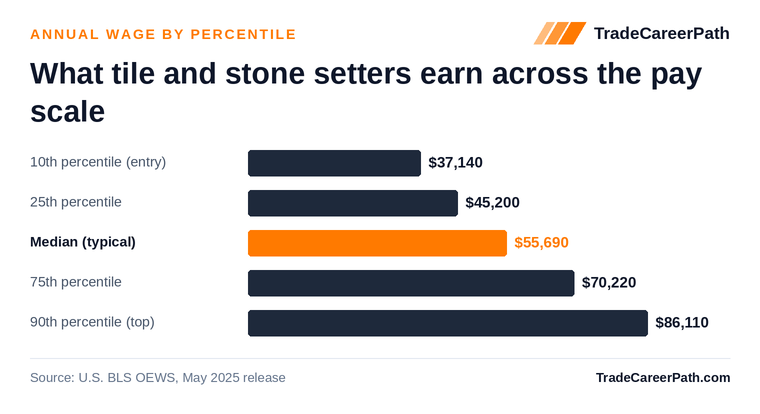
The median annual salary for tile setters is $55,690 according to the Bureau of Labor Statistics (May 2025). Entry-level workers earn around $37,140, while those in the 90th percentile earn over $86,110. Pay varies by state, experience, and specialization.
What is the job outlook for tile setters?
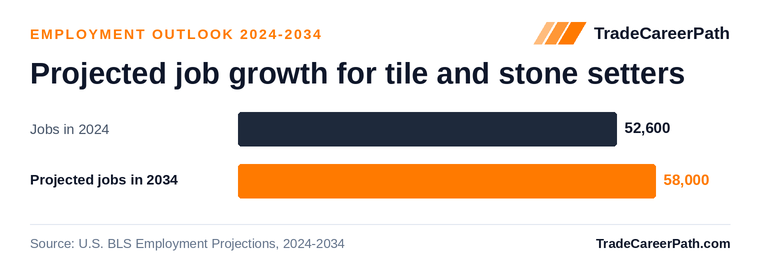
The Bureau of Labor Statistics projects 10.1% employment growth for this occupation from 2024 to 2034, which is faster than average. Approximately 4,200 job openings are expected each year due to growth, retirements, and workers leaving the field.
Do you need a college degree to work as a tile setter?
No. A college degree is not required to work as a tile setter. Most people enter the field through a certificate or associate degree program. A high school diploma or GED is typically the only educational prerequisite.
Which states pay tile setters the most?
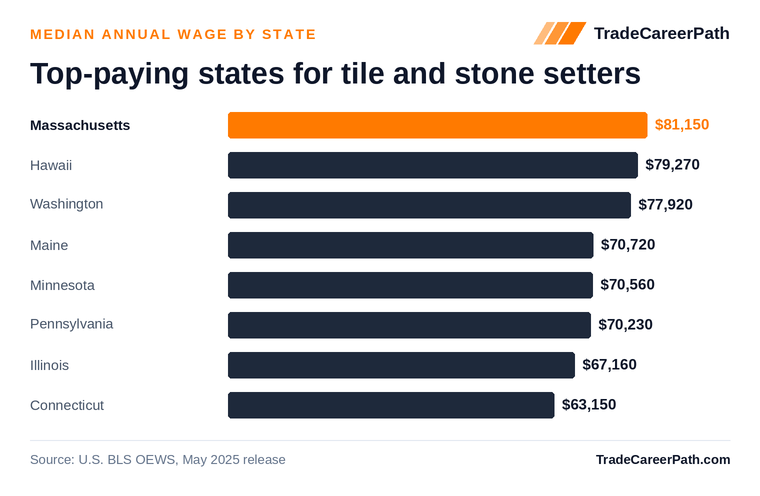
According to the U.S. Bureau of Labor Statistics (May 2025 OEWS), the highest-paying states for tile setters are Massachusetts, Hawaii, and Washington. Median annual wages: Massachusetts ($81,150); Hawaii ($79,270); Washington ($77,920).
Which states employ the most tile setters?
BLS reports the largest concentrations of tile setters in California, Florida, and New York. Employment levels: California (8,250 workers); Florida (4,070 workers); New York (2,990 workers) (May 2025).
How much do experienced tile setters earn?
The top 10% of tile setters earn more than $86,110 per year, according to BLS Occupational Employment and Wage Statistics (May 2025). Experienced workers in this band typically hold senior credentials, supervisory roles, or specialty certifications.
What is entry-level pay for tile setters?
BLS reports the bottom 10% of tile setters earn under $37,140 per year. New workers often start near this level and see pay rise as they accumulate experience and credentials.
How many tile setters work in the United States?
BLS reports approximately 35,850 tile setters employed nationwide as of May 2025.
How many job openings are expected for tile setters each year?
BLS projects approximately 4,200 openings per year for tile setters from 2024 through 2034, including new positions, retirements, and workers transitioning out. The occupation is projected to grow 10.1% from 2024 to 2034, classified as much faster than average growth.
Is tile setter a growing career?
Yes. BLS projects 10.1% employment growth for tile setters between 2024 and 2034, classified as much faster than average. Employment is projected to rise from approximately 52,600 jobs in 2024 to 58,000 in 2034.
How much do tile setters make per hour?
The median hourly wage for tile setters is $26.77, according to BLS (May 2025). Hourly pay ranges from about $17.86 (bottom 10%) to $41.40 (top 10%).
Sources
- U.S. Bureau of Labor Statistics, Occupational Employment and Wage Statistics (May 2025)
- U.S. Bureau of Labor Statistics, Employment Projections 2024-2034
- U.S. Bureau of Labor Statistics, Survey of Occupational Injuries and Illnesses (2023-2024, Table R98)
- U.S. Department of Labor, Wage and Hour Division, Davis-Bacon General Wage Determinations (2026)
Tile Setter Salary by State
About this guide: Researched and written by the TradeCareerPath Editorial Team. Our editorial team researches and sources every trade school and career guide using federal labor and education data, including BLS OEWS and Employment Projections, DOL apprenticeship records, IPEDS, College Scorecard, and state licensing boards. We follow the editorial standards documented at /editorial-policy/.
Data sources
Figures on this page are sourced from the federal and state datasets below. Methodology: how we rank and source data.
| Data | Provider | Vintage |
|---|---|---|
| Occupational Employment and Wage Statistics (OEWS) | U.S. Bureau of Labor Statistics | May 2025 |
| Employment Projections | U.S. Bureau of Labor Statistics | 2024-2034 |
| Integrated Postsecondary Education Data System | National Center for Education Statistics (IPEDS) | 2024 |
| College Scorecard (school-level outcomes) | U.S. Department of Education | latest release |
| College Scorecard (field-of-study earnings) | U.S. Department of Education | latest release (updated 2026-06-12) |
| Occupational licensing requirements | CareerOneStop (U.S. Department of Labor) | latest release (updated 2026-02-22) |
| Registered apprenticeship programs | CareerOneStop / Apprenticeship.gov (U.S. Department of Labor) | latest release (updated 2025-10-25) |
| O*NET occupation profiles (skills, tasks, tools, job zones) | U.S. Department of Labor (O*NET / Employment & Training Admin.) | O*NET 29.1 (updated 2026-06-13) |