
How to Become a Tower Technician in 2026
Is Tower Technician Right for You?
The U.S. Department of Labor's O*NET profile for Telecommunications Equipment Installers and Repairers, Except Line Installers (SOC 49-2022) describes the work this way: Install, set up, rearrange, or remove switching, distribution, routing, and dialing equipment used in central offices or headends. Service or repair telephone, cable television, Internet, and other communications equipment on customers' property. May install communications equipment or communications wiring in buildings.
What the work involves
- Note differences in wire and cable colors so that work can be performed correctly.
- Test circuits and components of malfunctioning telecommunications equipment to isolate sources of malfunctions, using test meters, circuit diagrams, polarity probes, and other hand tools.
- Drive crew trucks to and from work areas.
- Assemble and install communication equipment such as data and telephone communication lines, wiring, switching equipment, wiring frames, power apparatus, computer systems, and networks.
- Run wires between components and to outside cable systems, connecting them to wires from telephone poles or underground cable accesses.
Skills and knowledge that matter
Skills: Troubleshooting, Repairing, Critical Thinking, Operations Monitoring, Quality Control Analysis, Installation.
Knowledge: Telecommunications, Computers and Electronics, Customer and Personal Service, English Language.
Tools and technology you may use
Technology: Web platform development software, Computer aided design CAD software, Operating system software, Autodesk AutoCAD, Microsoft Excel, Microsoft Office software.
Typical preparation
O*NET Job Zone Three (Medium Preparation Needed). Most occupations in this zone require training in vocational schools, related on-the-job experience, or an associate's degree. Employees in these occupations usually need one or two years of training involving both on-the-job experience and informal training with experienced workers. A recognized apprenticeship program may be associated with these occupations.
Interest fit
O*NET interest profile: Realistic, Conventional, Investigative. People who enjoy hands-on, practical work with tools, machines, plants, or materials often find this occupation a good fit.
Source: O*NET 31.0 (updated 2026-10-14)
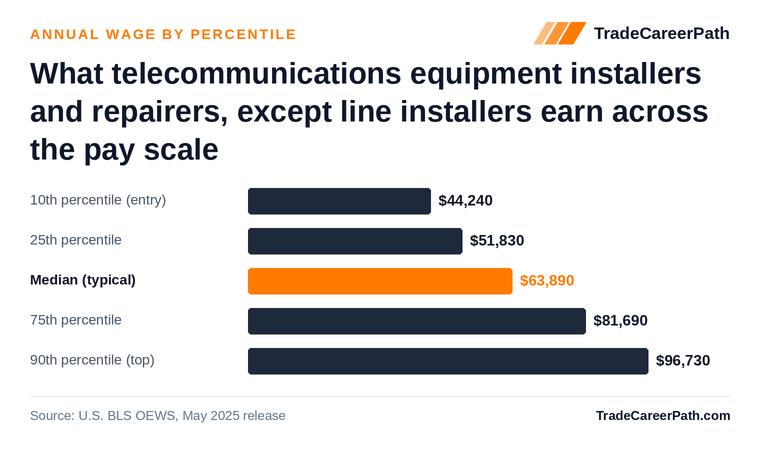
Quick answer: Training as a tower technician takes a few months to start, with climbing and safety training often running 3 to 6 months and apprenticeships adding 1 to 2 years of paid field experience. Training costs about $2,000 to $8,000, though many employers pay for safety training once you are hired. There is no single nationwide license, but employers require safety credentials such as OSHA, CPR, RF safety, and tower climbing and rescue certification before you climb. The median pay is $63,890 per year ($30.72/hour) (BLS, May 2025), with about 11,300 openings nationwide each year (BLS, May 2025).
Tower technicians, also called cell tower technicians or wireless communications technicians, install, maintain, and repair the tall structures that carry cell, radio, and broadband signals. It is hands-on outdoor work that mixes technical skill with climbing and strict safety discipline.
How to Become a Tower Technician
1. Meet the Basic Requirements
Most employers ask for a high school diploma or GED, and that is usually the only formal education you need. Math, physics, and basic electronics classes give you a head start on understanding antennas, transmitters, and signal flow. Physical readiness matters just as much as schoolwork here. You will be carrying gear up structures that can reach hundreds of feet, so build up your strength, grip, and stamina before you apply. Comfort with heights is essential, and many crews want to see that you can handle long days outdoors in heat, cold, and wind. A valid driver's license and a clean driving record help too, since technicians often drive company trucks to remote tower sites and travel for weeks at a time. If you can, get a few certifications out of the way early, such as CPR and first aid, to show employers you take safety seriously from day one.
2. Complete a Tower Technician Training Program
Enroll in a tower technician program at a trade school or dedicated training center, or join a registered apprenticeship. Training covers tower climbing technique, fall protection, rigging and hoisting loads, RF awareness, and how to install and tension coax and fiber lines. Look for programs that put you on a real or simulated tower so you practice clipping in, climbing, and performing a rescue before you ever do it on a paid job. The Telecommunications Industry Registered Apprenticeship Program (TIRAP) is a federally registered path that combines classroom learning with paid on-the-job hours, which lets you earn while you learn instead of paying tuition up front. The National Association of Tower Erectors (NATE) is the industry's trade association and a useful place to understand the safety and training standards employers follow. Expect short certificate programs to last a few months, while apprenticeship paths run longer because they include extended field time.
3. Earn Climbing and Safety Certifications
Safety credentials are what get you cleared to climb, so this step is non-negotiable with most employers. Common requirements include OSHA construction safety training, current CPR and first aid, and RF safety awareness so you understand exposure limits around live antennas. The credential that carries the most weight is authorized climber and rescue training, which proves you can ascend safely, work suspended, and rescue a fellow climber in an emergency. ComTrain is a widely recognized provider of tower-climber and rescue training, and finishing a course like theirs signals to crews that you meet a known standard. Some workers also pursue formal tower technician certifications offered through the industry to validate their skills. Keep copies of every card and certificate organized, because contractors and carriers audit them regularly and an expired credential can keep you off a site.
4. Gain Field Experience
Almost everyone starts on the ground. Entry-level roles such as ground hand or apprentice climber let you learn the job under experienced technicians while you handle rigging from below, manage the gin pole and tag lines, and keep the work area organized. As you prove your reliability and safety habits, you will spend more time on the structure doing antenna installs, line runs, inspections, and troubleshooting. This is where the classroom material clicks into place, and it is also how you build the track record contractors look for. Treat your first year as paid training: ask questions, watch how senior techs solve problems, and document the work you complete. Many positions are posted directly by wireless infrastructure firms and contractors, and connections you make on a crew often lead to your next, better-paying assignment.
5. Advance Your Career
After a few years of solid field work, you can step into roles with more responsibility and pay. Common moves include crew leader or foreman, where you manage a team and run a job site, and safety coordinator, where you handle compliance and train newer climbers. Some technicians specialize, shifting into RF or fiber optic work, network commissioning, or project management that oversees tower builds across a region. Stacking advanced certifications and a clean safety record makes these jumps easier, and experienced techs who are willing to travel or take on storm and emergency restoration work can earn significantly more. Keep your credentials current and build a reputation for safe, clean installs, and the industry's ongoing wireless and broadband buildout will keep opportunities coming.
What Tower Technicians Do
Tower technicians build and maintain wireless communication towers that transmit cell, radio, and data signals. They climb hundreds of feet to inspect antennas, run cables, and ensure systems meet federal safety standards.
Typical Responsibilities
- Install and repair antennas, transmitters, and cables
- Inspect and test signal strength and connections
- Perform tower climbs and rigging safely
- Maintain tools, winches, and safety gear
- Work closely with engineers and network contractors
Key Skills and Traits for Success
- Strong physical fitness and balance
- Comfort working at heights
- Technical understanding of electronics and RF systems
- Attention to safety protocols
- Problem-solving under pressure
- Willingness to travel and work outdoors
Work Settings for Tower Technicians
- Wireless infrastructure companies
- Telecom carriers (AT&T, Verizon, T-Mobile)
- Construction and maintenance contractors
- Government or military communication sites
- Utility companies installing broadband towers
Training and Certification Paths
| Pathway | Typical Duration | Outcome |
|---|---|---|
| Short-Term Certificate | 3 to 6 months | Entry-level technician |
| Apprenticeship | 1 to 2 years | Field experience with pay |
| Advanced Certification | 6 to 12 months | Lead or safety trainer roles |
Career Growth and Advancement
With experience, tower techs can advance into:
- Crew Leader or Foreman, managing tower teams
- Safety Coordinator, ensuring compliance and training
- RF Engineer or Fiber Optic Technician
- Project Manager, overseeing tower builds nationwide
Cost and Duration of Training
- Program Cost: varies by school, format and location depending on location and included certifications
- Duration: 3 months to 1 year
- Certifications: OSHA, CPR, RF safety, climbing and rescue training
Costs vary by program and school. Many tower training programs include career support with telecom contractors, and some employers cover safety training after you are hired.
Pros and Cons
✅ Pros
- Steady demand from wireless and broadband buildout
- Good earning potential with overtime and travel
- Hands-on, outdoor work environment
- Career mobility into advanced telecom roles
⚠️ Cons
- Physically demanding and weather-dependent
- Requires climbing at extreme heights
- Frequent travel or on-call work
State Licensing and Requirements
Licensing for tower technicians varies, but nearly all employers require safety certifications and recognized climbing and rescue credentials before you can work on a tower.
View Tower Technician Licensing by State
Quick Facts: Tower Technician Salary, Education, and Outlook
Industry Organizations & Certifying Bodies
These are the recognized national organizations, unions, certifying bodies, and regulatory authorities that shape this trade. They issue the credentials, sponsor the apprenticeships, publish the codes, and represent workers and employers.
- National Association of Tower Erectors (NATE) Wireless infrastructure trade association; safety and training standards.
- Telecommunications Industry Registered Apprenticeship Program (TIRAP) Federally registered apprenticeship for tower technicians.
- ComTrain Recognized tower-climber and rescue training provider.
Wage and Employment Charts
Tower Technician Salary and Requirements by State
Select your state for local wage data, training options, and requirements:
Alabama · Alaska · Arizona · Arkansas · California · Colorado · Connecticut · Delaware · District of Columbia · Florida · Georgia · Hawaii · Idaho · Illinois · Indiana · Iowa · Kansas · Kentucky · Louisiana · Maine · Maryland · Massachusetts · Michigan · Minnesota · Mississippi · Missouri · Montana · Nebraska · Nevada · New Hampshire · New Jersey · New Mexico · New York · North Carolina · North Dakota · Ohio · Oklahoma · Oregon · Pennsylvania · Rhode Island · South Carolina · South Dakota · Tennessee · Texas · Utah · Vermont · Virginia · Washington · West Virginia · Wisconsin · Wyoming
Workplace Safety Snapshot
BLS Survey of Occupational Injuries and Illnesses data (2023-2024) report approximately 224.4 days-away, restricted, or transfer cases per 10,000 full-time-equivalent workers in telecommunications equipment installers and repairers, except line installers (about 2.24 per 100 FTE). Source: BLS Survey of Occupational Injuries and Illnesses, Table R98.
Frequently Asked Questions
How long does tower technician training take?
Most people are working on a crew within a few months. Entry-level climbing and safety training often runs 3 to 6 months, and apprenticeship paths add 1 to 2 years of paid field experience. A high school diploma or GED is generally the only educational requirement to get started.
Do you need a college degree to work as a tower technician?
No. A college degree is not required. Most technicians enter the field through a short certificate program or a registered apprenticeship and learn the rest on the job. A high school diploma or GED is typically the only educational prerequisite.
How much does tower technician training cost?
Training programs generally run about $2,000 to $8,000 depending on the provider and what certifications are included. Costs vary by program and school, and some employers pay for safety and climbing training once you are hired.
Do you need a certification or license to be a tower technician?
There is no single nationwide license, but nearly every employer requires safety credentials before you climb. Common requirements include OSHA construction safety training, CPR and first aid, RF safety awareness, and tower climbing and rescue certification through a recognized provider such as ComTrain.
Is being a tower technician hard?
It is physically demanding. The work involves climbing structures that can reach hundreds of feet, carrying gear, and working outdoors in changing weather. Strong fitness, comfort with heights, and strict attention to safety are essential.
Can you train to be a tower technician online?
Some classroom topics like RF theory and safety awareness can be studied online, but climbing, rigging, and rescue skills require hands-on, in-person training. Plan on attending a physical training center or learning these skills through an apprenticeship.
How many tower technicians work in the United States?
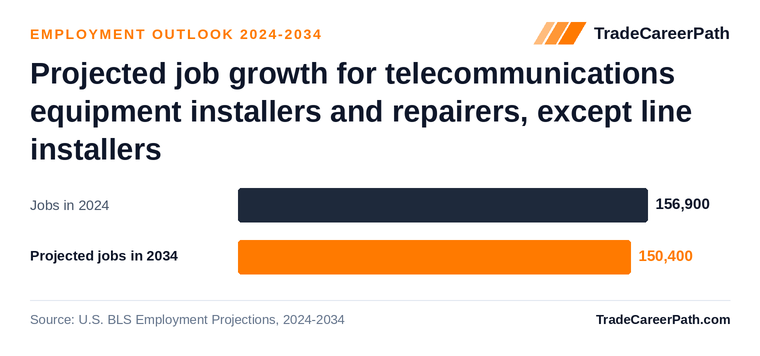
BLS reports about 140,920 telecommunications equipment installers and repairers, the category that includes tower technicians, employed nationwide as of May 2025.
How Tower Technician Pay Compares to Similar Trades
Side-by-side comparison of Tower Technician Training and the closest related careers, based on U.S. Bureau of Labor Statistics data (May 2025 OEWS + 2025-2035 Employment Projections).
| Career | Median Pay | 10-Year Growth | Annual Openings |
|---|---|---|---|
| Tower Technician Training this guide | $63,890 | -3.3% | 11,300 |
| Lineworker | $95,320 | +10.3% | 10,900 |
| Wind Turbine Technician | $64,120 | +29.5% | 1,500 |
| Solar Installation Professional | $53,140 | +36.5% | 4,200 |
| Electrician | $63,190 | +9.2% | 72,700 |
Source: BLS Occupational Employment and Wage Statistics + BLS Employment Projections.
Advance Your Career with a Degree
Experienced Tower Technician professionals often step up into degree-track careers where field experience is a hiring advantage:
- Computer Hardware Engineer - median pay $161,740 (BLS OEWS, May 2025); requires a 4-year degree
- Electronics Engineer - median pay $130,220 (BLS OEWS, May 2025); requires a 4-year degree
- Computer Network Architect - median pay $134,050 (BLS OEWS, May 2025); requires a 4-year degree
See all trade careers that require a 4-year degree.
Sources
- U.S. Bureau of Labor Statistics, Occupational Employment and Wage Statistics (May 2025)
- U.S. Bureau of Labor Statistics, Employment Projections 2025-2035
- U.S. Bureau of Labor Statistics, Survey of Occupational Injuries and Illnesses (2023-2024, Table R98)
- U.S. Department of Labor, Wage and Hour Division, Davis-Bacon General Wage Determinations (2026)
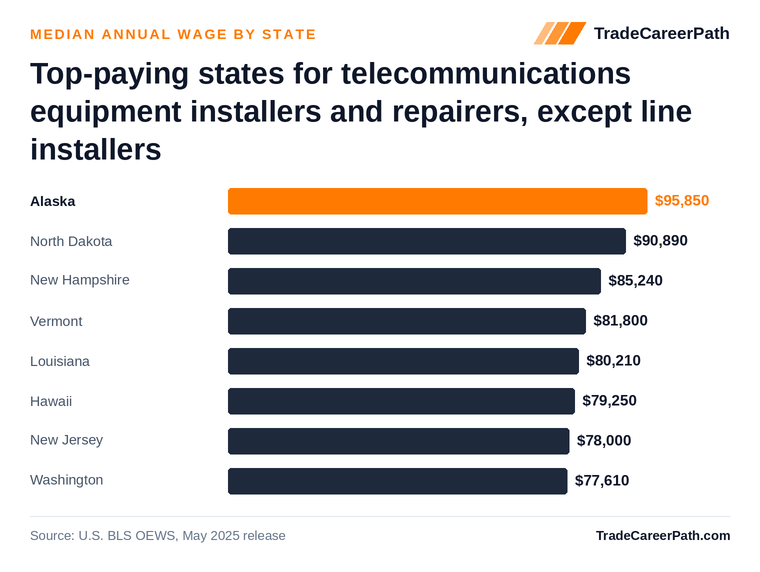
Tower Technician Salary by State
About this guide: Researched and written by the TradeCareerPath Editorial Team. Our editorial team researches and sources every trade school and career guide using federal labor and education data, including BLS OEWS and Employment Projections, DOL apprenticeship records, IPEDS, College Scorecard, and state licensing boards. We follow the editorial standards documented at /editorial-policy/.
Data sources
Figures on this page are sourced from the federal and state datasets below. Methodology: how we rank and source data.
| Data | Provider | Vintage |
|---|---|---|
| Occupational Employment and Wage Statistics (OEWS) | U.S. Bureau of Labor Statistics | May 2025 |
| Employment Projections | U.S. Bureau of Labor Statistics | 2025-2035 |
| Integrated Postsecondary Education Data System | National Center for Education Statistics (IPEDS) | 2024 |
| College Scorecard (school-level outcomes) | U.S. Department of Education | latest release |
| College Scorecard (field-of-study earnings) | U.S. Department of Education | latest release (updated 2026-06-12) |
| Occupational licensing requirements | CareerOneStop (U.S. Department of Labor) | latest release (updated 2026-02-22) |
| Registered apprenticeship programs | CareerOneStop / Apprenticeship.gov (U.S. Department of Labor) | latest release (updated 2025-10-25) |
| O*NET occupation profiles (skills, tasks, tools, job zones) | U.S. Department of Labor (O*NET / Employment & Training Admin.) | O*NET 31.0 (updated 2026-10-14) |