
How to Become a Travel Agent in 2026
Is Travel Agent Right for You?
The U.S. Department of Labor's O*NET profile for Travel Agents (SOC 41-3041) describes the work this way: Plan and sell transportation and accommodations for customers. Determine destination, modes of transportation, travel dates, costs, and accommodations required. May also describe, plan, and arrange itineraries and sell tour packages. May assist in resolving clients' travel problems.
What the work involves
- Collect payment for transportation and accommodations from customer.
- Plan, describe, arrange, and sell itinerary tour packages and promotional travel incentives offered by various travel carriers.
- Converse with customer to determine destination, mode of transportation, travel dates, financial considerations, and accommodations required.
- Compute cost of travel and accommodations, using calculator, computer, carrier tariff books, and hotel rate books, or quote package tour's costs.
- Record and maintain information on clients, vendors, and travel packages.
Skills and knowledge that matter
Skills: Active Listening, Service Orientation, Reading Comprehension, Speaking, Social Perceptiveness, Persuasion.
Knowledge: Customer and Personal Service, English Language, Sales and Marketing, Geography.
Tools and technology you may use
Technology: Data base user interface and query software, Calendar and scheduling software, Customer relationship management CRM software, Intuit QuickBooks, Microsoft Access, Microsoft Excel.
Typical preparation
O*NET Job Zone Three (Medium Preparation Needed). Most occupations in this zone require training in vocational schools, related on-the-job experience, or an associate's degree. Employees in these occupations usually need one or two years of training involving both on-the-job experience and informal training with experienced workers. A recognized apprenticeship program may be associated with these occupations.
Interest fit
O*NET interest profile: Enterprising, Conventional, Social. People who enjoy starting projects, leading others, and making decisions often find this occupation a good fit.
Source: O*NET 31.0 (updated 2026-10-14)
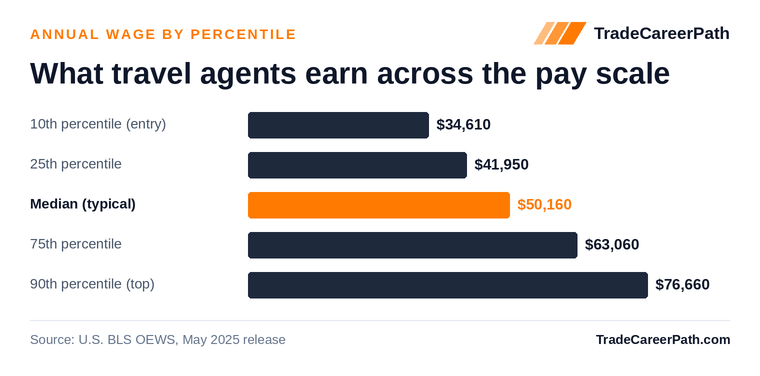
Quick answer: Training as a travel agent usually takes 6 months to 2 years. You complete a travel or tourism certificate ($2,000 to $7,500) or an associate degree, get hands-on experience in an entry-level booking role, and can earn an optional credential such as the Certified Travel Associate (CTA). Most states do not require an individual license, though a few require Seller of Travel registration for independent agencies. The median travel agent salary is $50,160 per year ($24.11/hour), and there are about 5,900 openings nationwide each year (BLS, May 2025).
Travel agents plan and book trips for leisure and business clients. They coordinate flights, hotels, tours, and travel insurance while helping people choose destinations, budgets, and experiences that fit their plans.
How to Become a Travel Agent
Most people enter the field in about six months to two years, depending on the training path they choose. There is no national licensing exam. You build the career through education, hands-on booking experience, and an optional industry certification.
1. Earn a high school diploma or GED
A high school diploma or GED is the baseline requirement for travel and tourism programs and for most entry-level agency jobs. The work rewards a few skills you can start building early: clear writing, comfort with numbers for pricing and budgets, and confident communication with clients and suppliers. Classes in business, communication, and geography are useful, and basic computer skills matter because the job runs on booking platforms, supplier portals, and email. If you are changing careers and already have a diploma or another degree, you can move straight to training. Many successful agents come from customer service, hospitality, or sales backgrounds and bring transferable skills in organization and relationship building.
2. Complete travel or tourism training
This is the core preparation, and you have a few formats to choose from. A travel or tourism certificate takes roughly 6 to 12 months and is popular with career changers who want to enter quickly. An associate degree takes about 2 years and opens broader hospitality opportunities. Good programs teach reservation systems, fare and itinerary construction, travel law, supplier relationships, and customer service. Many include hands-on practice with a global distribution system such as Sabre or Amadeus, the booking tools agents use daily. Training is widely available online or in person, which lets working students learn at a flexible pace. Confirm a program’s accreditation before you enroll, and look for coursework that includes real booking practice rather than theory alone.
3. Gain industry experience
Coursework prepares you, but employers and clients want to see that you can handle real bookings. Entry-level roles such as travel assistant, booking specialist, or customer support representative put you inside an agency or supplier where you can learn the workflow, practice quoting and ticketing, and build references. Pay attention to how experienced agents handle changes, cancellations, and problems during a trip, since solving those issues well is what earns repeat clients. As you go, start specializing in an area you enjoy, such as cruises, group travel, or a specific region, so you can build expertise that sets you apart. This experience also teaches the supplier relationships and commission structures you will rely on if you later go independent.
4. Earn optional certification
Certification is voluntary in most states, but it can strengthen your resume and signal professionalism to clients and host agencies. The most recognized credentials come from The Travel Institute, which issues the Certified Travel Associate (CTA) for newer agents and the Certified Travel Counselor (CTC) for experienced ones. The American Society of Travel Advisors (ASTA) is the major U.S. professional association and supports advisor education and standards. For agents handling international travel, the International Air Transport Association (IATA) offers a widely recognized Travel and Tourism diploma and accreditation. Certification fees commonly run about $150 to $400. Pick the credential that matches your experience level and the type of travel you want to sell.
5. Join an agency or start a home-based business
With experience and an optional certification, you can join an established travel agency, partner with a host agency, or register your own business. A host agency is a common path for new and home-based agents because it provides supplier relationships, booking tools, and commission processing so you do not have to build those systems from scratch. Before going independent, check whether your state requires Seller of Travel registration, which applies in California, Florida, Hawaii, Iowa, and Washington. Many agents specialize in niche markets such as cruises, destination weddings, or luxury tours, then grow through referrals, a strong online presence, and repeat clients.
What Does a Travel Agent Do?
Travel agents act as planners, consultants, and problem-solvers. They handle the details of a client’s trip while offering professional advice about destinations, budgets, and experiences.
Typical Responsibilities
- Research and recommend destinations, flights, and accommodations
- Create customized itineraries for individuals and groups
- Stay updated on travel regulations, visas, and safety guidelines
- Manage bookings, cancellations, and travel insurance
- Build strong client relationships and handle special requests
The best travel agents combine hospitality, organization, and destination knowledge to make each trip run smoothly.
Key Skills and Qualities
| Skill | Why It Matters |
|---|---|
| Customer Service | Builds trust and repeat clients |
| Attention to Detail | Ensures accurate bookings and itineraries |
| Sales and Marketing | Helps promote services and close bookings |
| Destination Knowledge | Adds value and credibility |
| Time Management | Keeps multiple client schedules organized |
| Communication | Improves client satisfaction and vendor relations |
Common Work Environments
- Travel agencies or tour operators
- Corporate travel departments
- Cruise lines and resorts
- Home-based or remote agencies
- Online travel platforms and host agencies
Many agents now work fully online through host agency partnerships, which gives them the flexibility to work remotely.
Travel Agent Training and Certification Overview
| Pathway | Typical Duration | Outcome |
|---|---|---|
| Travel Certificate | 6 to 12 months | Entry-level training |
| Associate Degree | 2 years | Broader hospitality opportunities |
| CTA or CTC Certification | Varies | Professional credential |
| IATA or ASTA Recognition | Varies | Industry recognition |
Travel Agent License Requirements by State
Travel agents generally do not need an individual state license. Some states require Seller of Travel registration for agencies operating independently.
States with Seller-of-Travel laws (core SOT states):
- California
- Florida
- Hawaii
- Iowa
- Washington
For a deeper breakdown of who must register and what disclosures are required, see our Travel Agent License Requirements by State guide.
Career Growth and Opportunities
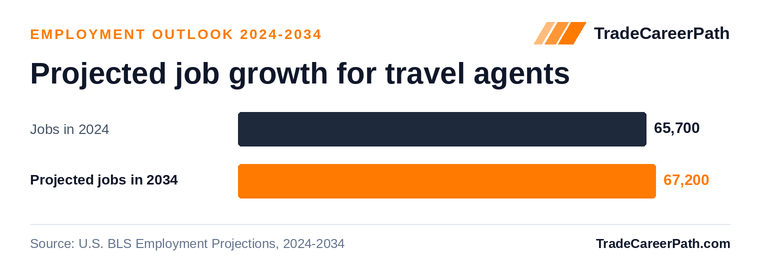
With experience, travel agents can move into:
- Corporate travel management
- Cruise or luxury travel consulting
- Destination marketing or tour operations
- Agency ownership or franchise management
Agents who develop digital marketing skills and specialize in trending travel niches often build sustainable, independent businesses.
Training Costs and Duration
- Typical tuition: varies by program and format
- Duration: 6 months to 2 years
- Certification fees: $150 to $400
- Startup costs (home-based agency): may include state registration and host agency fees
Pros and Cons
Pros
- Flexible, often remote work opportunities
- Chance to explore destinations and earn travel perks
- Creative and client-focused career path
- Independence to specialize in niche travel markets
Cons
- Income varies based on commissions and client volume
- Requires ongoing learning about travel policies and systems
- Peak seasons can be fast-paced and demanding
Quick Facts: Travel Agent Salary, Education, and Outlook
Industry Organizations & Certifying Bodies
These are the recognized national organizations, unions, certifying bodies, and regulatory authorities that shape this trade. They issue the credentials, sponsor the apprenticeships, publish the codes, and represent workers and employers.
- American Society of Travel Advisors (ASTA) Major U.S. travel advisor professional association.
- The Travel Institute Issues the Certified Travel Associate (CTA), CTC, and CTIE credentials.
- International Air Transport Association (IATA) IATA Travel and Tourism diploma is widely recognized for international travel agents.
Wage and Employment Charts
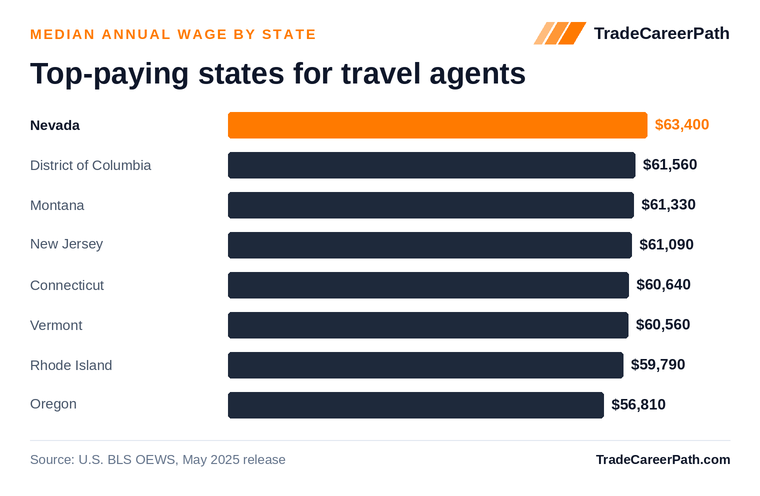
Travel Agent Salary and Requirements by State
Select your state for local wage data, training options, and requirements:
Alabama · Alaska · Arizona · Arkansas · California · Colorado · Connecticut · Delaware · District of Columbia · Florida · Georgia · Hawaii · Idaho · Illinois · Indiana · Iowa · Kansas · Kentucky · Louisiana · Maine · Maryland · Massachusetts · Michigan · Minnesota · Mississippi · Missouri · Montana · Nebraska · Nevada · New Hampshire · New Jersey · New Mexico · New York · North Carolina · North Dakota · Ohio · Oklahoma · Oregon · Pennsylvania · Rhode Island · South Carolina · South Dakota · Tennessee · Texas · Utah · Vermont · Virginia · Washington · West Virginia · Wisconsin · Wyoming
Find Travel Agent Training Programs Near You
Frequently Asked Questions
How long does travel agent training take?
It typically takes 6 months to 2 years. A travel or tourism certificate runs about 6 to 12 months, while an associate degree takes around 2 years. A high school diploma or GED is generally the only educational prerequisite to start.
Do you need a college degree to work as a travel agent?
No. A college degree is not required to work as a travel agent. Most people enter through a certificate or associate degree program, and a high school diploma or GED is typically the only educational prerequisite.
How much does travel agent training cost?
Tuition commonly runs about $2,000 to $7,500 depending on the program and format. Optional certification fees usually add roughly $150 to $400, and a home-based agency may have extra startup costs such as state registration and host agency fees.
Is a license required to work as a travel agent?
Most U.S. states do not require an individual travel agent license. Some states require Seller of Travel registration for agencies operating independently, including California, Florida, Hawaii, Iowa, and Washington.
Is certification required to work as a travel agent?
Certification is optional, but it can help demonstrate credibility. Common credentials include the Certified Travel Associate (CTA) and Certified Travel Counselor (CTC) from The Travel Institute, plus recognition through ASTA and IATA.
Can travel agents work from home?
Yes. Many agents work remotely by partnering with a host agency and using online booking platforms. A host agency provides supplier relationships, booking tools, and commission processing so new agents can start without building those systems alone.
Can you train to be a travel agent online?
Yes. Many travel and tourism certificate and associate degree programs are offered fully online, and The Travel Institute delivers its CTA and CTC coursework online as well. Confirm the program's accreditation before enrolling.
How Travel Agent Pay Compares to Similar Trades
Side-by-side comparison of Travel Agent and the closest related careers, based on U.S. Bureau of Labor Statistics data (May 2025 OEWS + 2025-2035 Employment Projections).
| Career | Median Pay | 10-Year Growth | Annual Openings |
|---|---|---|---|
| Travel Agent this guide | $50,160 | +0.2% | 5,900 |
| Medical Office Administration | $45,930 | +4.8% | 89,200 |
| Bookkeeper | $50,670 | -5.6% | 144,100 |
| Paralegal | $62,890 | -0.3% | 40,800 |
Source: BLS Occupational Employment and Wage Statistics + BLS Employment Projections.
Sources
- U.S. Bureau of Labor Statistics, Occupational Employment and Wage Statistics (May 2025)
- U.S. Bureau of Labor Statistics, Employment Projections 2025-2035
- U.S. Bureau of Labor Statistics, Survey of Occupational Injuries and Illnesses (2023-2024, Table R98)
- U.S. Department of Labor, Wage and Hour Division, Davis-Bacon General Wage Determinations (2026)
Travel Agent Salary by State
About this guide: Researched and written by the TradeCareerPath Editorial Team. Our editorial team researches and sources every trade school and career guide using federal labor and education data, including BLS OEWS and Employment Projections, DOL apprenticeship records, IPEDS, College Scorecard, and state licensing boards. We follow the editorial standards documented at /editorial-policy/.
Data sources
Figures on this page are sourced from the federal and state datasets below. Methodology: how we rank and source data.
| Data | Provider | Vintage |
|---|---|---|
| Occupational Employment and Wage Statistics (OEWS) | U.S. Bureau of Labor Statistics | May 2025 |
| Employment Projections | U.S. Bureau of Labor Statistics | 2025-2035 |
| Integrated Postsecondary Education Data System | National Center for Education Statistics (IPEDS) | 2024 |
| College Scorecard (school-level outcomes) | U.S. Department of Education | latest release |
| College Scorecard (field-of-study earnings) | U.S. Department of Education | latest release (updated 2026-06-12) |
| Occupational licensing requirements | CareerOneStop (U.S. Department of Labor) | latest release (updated 2026-02-22) |
| Registered apprenticeship programs | CareerOneStop / Apprenticeship.gov (U.S. Department of Labor) | latest release (updated 2025-10-25) |
| O*NET occupation profiles (skills, tasks, tools, job zones) | U.S. Department of Labor (O*NET / Employment & Training Admin.) | O*NET 31.0 (updated 2026-10-14) |