
How to Become a Truck Driver in 2026
Is Truck Driver Right for You?
The U.S. Department of Labor's O*NET profile for Heavy and Tractor-Trailer Truck Drivers (SOC 53-3032) describes the work this way: Drive a tractor-trailer combination or a truck with a capacity of at least 26,001 pounds Gross Vehicle Weight (GVW). May be required to unload truck. Requires commercial drivers' license. Includes tow truck drivers.
What the work involves
- Check all load-related documentation for completeness and accuracy.
- Inspect loads to ensure that cargo is secure.
- Check vehicles to ensure that mechanical, safety, and emergency equipment is in good working order.
- Crank trailer landing gear up or down to safely secure vehicles.
- Obtain receipts or signatures for delivered goods and collect payment for services when required.
Skills and knowledge that matter
Skills: Operations Monitoring, Operation and Control, Monitoring, Troubleshooting, Time Management, Speaking.
Knowledge: Transportation, Public Safety and Security, Customer and Personal Service, English Language.
Tools and technology you may use
Tools: 4-ranger tower trucks, Air compressors, Blocks and tackle, Boom trucks, Cargo hoists, Cell phones.
Technology: Word processing software, Time accounting software, Route navigation software, Microsoft Excel, Microsoft Office software, Microsoft Outlook.
Typical preparation
O*NET Job Zone Two (Some Preparation Needed). These occupations usually require a high school diploma. Employees in these occupations need anywhere from a few months to one year of working with experienced employees. A recognized apprenticeship program may be associated with these occupations.
Interest fit
O*NET interest profile: Realistic, Conventional, Investigative. People who enjoy hands-on, practical work with tools, machines, plants, or materials often find this occupation a good fit.
Source: O*NET 29.1 (updated 2026-06-13)
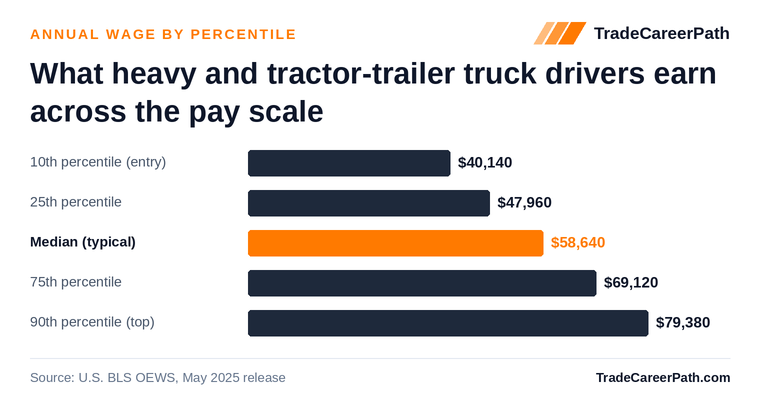
Quick answer: Most people earn a commercial driver’s license (CDL) in about 3 to 7 weeks of training, plus a short period to get a learner’s permit and DOT physical first. CDL training costs vary by program and school, and some carriers sponsor tuition in exchange for a work commitment. Entry-level drivers must complete FMCSA Entry-Level Driver Training (ELDT) before the skills test, and a CDL is required to drive most large trucks. The median pay for heavy and tractor-trailer drivers is $58,640 per year ($28.19/hour), with about 237,600 openings nationwide each year (BLS, May 2025).
Truck drivers move freight across the country and within local areas using heavy commercial vehicles. The route into the job is short and practical: get a learner’s permit, complete required CDL training, and pass the knowledge and skills tests. If you like working independently and staying in steady demand, this is a direct path into a skilled career without a degree.
How to Become a Truck Driver
Most new drivers go from no license to a CDL in a matter of weeks, not years. The path is regulated by the Federal Motor Carrier Safety Administration (FMCSA), which sets the federal training and licensing standards, while your state issues the actual license. Here is how it works, step by step.
1. Meet the basic requirements
Before you start, confirm you meet the baseline rules. You must be at least 18 to drive within your own state and 21 to drive across state lines, a federal requirement set by FMCSA. You also need to pass a DOT physical from a certified medical examiner, which checks vision, hearing, blood pressure, and overall fitness to drive a commercial vehicle. A clean driving record matters too, since serious violations or a recent DUI can disqualify you. A high school diploma or GED is not legally required for a CDL, though many carriers prefer one. If you have a medical condition such as diabetes or sleep apnea, it does not automatically rule you out, but you may need documentation from your doctor. Sorting out these basics first saves you from paying for training you cannot finish.
2. Get your commercial learner’s permit (CLP)
Before you can train behind the wheel, you need a commercial learner’s permit. Study your state’s CDL manual and pass the written knowledge tests, which cover general commercial driving rules, air brakes, and combination vehicles for Class A. If you plan to add endorsements such as Hazmat or Tanker, you can take those knowledge tests now too. Once you pass, you hold the CLP for a short waiting period before you are eligible for the skills test. The permit lets you practice driving a commercial vehicle as long as a licensed CDL holder is in the cab with you. This is also the stage where you decide between a Class A license, which covers tractor-trailers and the widest range of jobs, and a Class B license for straight trucks like box trucks and dump trucks.
3. Complete FMCSA-approved CDL training
Federal law requires entry-level applicants to complete Entry-Level Driver Training (ELDT) with a provider listed on the FMCSA Training Provider Registry before taking the CDL skills test. Programs are offered by private CDL schools, community colleges, and many carriers, and full-time training typically runs about 3 to 7 weeks. Good programs combine classroom theory with extensive behind-the-wheel and range time: pre-trip inspections, backing and docking, shifting, coupling and uncoupling trailers, and real on-road driving. Some schools are also certified by the Professional Truck Driver Institute (PTDI) or are members of the Commercial Vehicle Training Association (CVTA), both signals of a recognized curriculum. Costs vary widely by program and school, so compare length, drive time, and job-placement help. Some carriers sponsor tuition in exchange for an employment commitment, with terms that vary and may include repayment if you leave early.
4. Pass the CDL skills test
Once your training is complete and the permit waiting period has passed, you take the CDL skills test at a state-approved site. It has three parts: a vehicle inspection where you identify and explain safety components, a basic control segment with maneuvers like straight-line and offset backing, and an on-road driving test in real traffic. You provide a vehicle that matches the license class you want, which your school usually supplies. Pass all three and your state issues your Class A or Class B CDL. Any endorsements you tested for are added to the license at the same time, as long as you passed the related knowledge test and any required background check.
5. Add endorsements and find a job
Endorsements expand the loads and equipment you are allowed to handle and can raise your pay. Common ones include Hazmat (H) for hazardous materials, which requires a federal background check, Tanker (N) for liquids and fuel, Doubles/Triples (T), and Passenger (P). With your CDL in hand, apply directly to carriers, use a school’s job-placement service, or join an employer-sponsored hiring program. New drivers often start with regional or over-the-road (OTR) freight to build experience, then move into dedicated routes, local delivery, or specialized hauling. Industry groups such as the American Trucking Associations (ATA) publish job and pay trends that can help you compare carriers and freight types as you decide where to start.
What Do Truck Drivers Do?
Truck drivers transport goods over short or long distances using heavy-duty commercial vehicles. Depending on your license and endorsements, you may:
- Drive 18-wheelers (Class A) across state lines
- Make local box truck deliveries (Class B)
- Haul fuel, livestock, or hazardous materials
- Operate dump trucks, flatbeds, or tankers
- Use digital logs and GPS routing for tracking
“Everything you own was delivered by a trucker. They are essential workers.” - Brad Fishbein
Types of CDL Licenses
CDL classes describe which commercial vehicles you are qualified to operate.
| CDL Type | Vehicle Types | Common Jobs |
|---|---|---|
| Class A | Tractor-trailers, tankers, flatbeds | Long-haul, OTR, heavy freight |
| Class B | Box trucks, dump trucks, school buses | Local delivery, construction |
| Class C | Hazmat, passenger vans | Airport shuttles, medical transport |
Many drivers start with Class A training to open the most doors.
Truck Driving Schools and Training Options
- Private CDL Schools: Short programs with career help
- Community Colleges: Affordable and local training options
- Employer-Sponsored CDL Training: Some carriers cover tuition in exchange for a work commitment; terms vary and may include repayment if commitments aren’t met
- Military CDL Programs: Transition assistance for veterans
Some companies sponsor tuition in exchange for an employment commitment; availability and terms vary by carrier and may include repayment if commitments aren’t met.
Endorsements to Boost Pay
CDL endorsements are add-ons that qualify you for specific loads or equipment.
- Hazmat (H): Required for transporting hazardous materials
- Tanker (N): Haul liquids or fuel
- Doubles/Triples (T): Pull multi-trailer rigs
- Passenger (P): For buses and vans
Adding endorsements to your CDL makes you more versatile and valuable.
Skills That Make Great Truck Drivers
- Focus and patience during long drives
- Basic mechanical knowledge for inspections
- Time management and route planning
- Physical fitness and alertness
- Communication and safety awareness
Pros and Cons of Trucking Careers
Pros:
- Solid earning potential without a degree
- Steady demand and strong job security
- Opportunity to travel the country
- Many carriers offer full benefits
Cons:
- Long hours and time away from home
- Physical and mental fatigue
- Must pass drug tests and DOT physicals
- Some roles require night or weekend shifts
Quick Facts: Truck Driver Salary, Education, and Outlook
Start Your Trucking Career
If you are ready to roll, qualified CDL holders stay in demand across the country. With a short, practical training path and steady freight needs, trucking is one of the fastest ways into a skilled career without a degree.
Industry Organizations & Certifying Bodies
These are the recognized national organizations, unions, certifying bodies, and regulatory authorities that shape this trade. They issue the credentials, sponsor the apprenticeships, publish the codes, and represent workers and employers.
- Federal Motor Carrier Safety Administration (FMCSA) Federal regulator; sets CDL requirements and Entry-Level Driver Training (ELDT) standards.
- American Trucking Associations (ATA) Industry trade association representing trucking companies and drivers.
- Commercial Vehicle Training Association (CVTA) Association of accredited commercial driver training schools.
- Professional Truck Driver Institute (PTDI) Certifies CDL training-school programs against the PTDI curriculum standard.
Wage and Employment Charts
CDL Truck Driver Salary and Requirements by State
Select your state for local wage data, training options, and requirements:
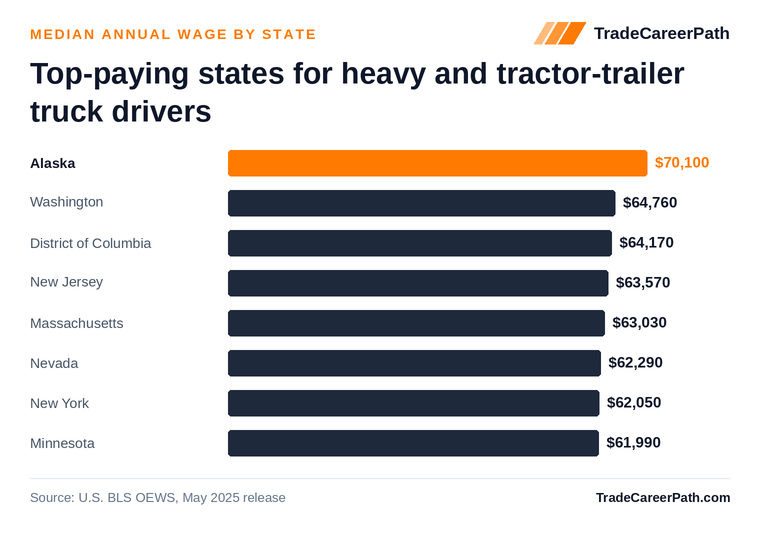
Alabama · Alaska · Arizona · Arkansas · California · Colorado · Connecticut · Delaware · District of Columbia · Florida · Georgia · Hawaii · Idaho · Illinois · Indiana · Iowa · Kansas · Kentucky · Louisiana · Maine · Maryland · Massachusetts · Michigan · Minnesota · Mississippi · Missouri · Montana · Nebraska · Nevada · New Hampshire · New Jersey · New Mexico · New York · North Carolina · North Dakota · Ohio · Oklahoma · Oregon · Pennsylvania · Rhode Island · South Carolina · South Dakota · Tennessee · Texas · Utah · Vermont · Virginia · Washington · West Virginia · Wisconsin · Wyoming
Workplace Safety Snapshot
BLS Survey of Occupational Injuries and Illnesses data (2023-2024) report approximately 328.2 days-away, restricted, or transfer cases per 10,000 full-time-equivalent workers in heavy and tractor-trailer truck drivers (about 3.28 per 100 FTE). Source: BLS Survey of Occupational Injuries and Illnesses, Table R98.
FMCSA-Registered Training
Federal law requires entry-level CDL applicants to complete training with a provider listed on the FMCSA Training Provider Registry (TPR) before taking the CDL skills test.
As of 2026-05-05, the FMCSA Training Provider Registry lists approximately 28,326 federally registered in-person CDL training providers nationwide, including roughly 15,000 that offer Class A behind-the-wheel training and 22,721 that offer Class B behind-the-wheel training. Search the official registry at https://tpr.fmcsa.dot.gov/ to confirm a provider before enrolling. Source: FMCSA Training Provider Registry.
Frequently Asked Questions
How long does truck driver training take?
Most people get their CDL in about 3 to 7 weeks of full-time training. Add a few days to a couple of weeks before that to get your commercial learner's permit (CLP) and DOT physical. A high school diploma or GED is not legally required for a CDL, but many carriers prefer one.
Do you need a college degree to work as a truck driver?
No. A college degree is not required to drive a truck. You need a commercial driver's license (CDL) and, for entry-level applicants, completion of FMCSA Entry-Level Driver Training (ELDT) from a provider on the FMCSA Training Provider Registry.
Is a CDL required to drive a truck?
Yes. A commercial driver's license is required to operate most large commercial trucks. Class A covers tractor-trailers and heavy combination vehicles, while Class B covers straight trucks such as box trucks and dump trucks. The Federal Motor Carrier Safety Administration (FMCSA) sets the federal standards and states issue the license.
How much does CDL training cost?
Costs vary by program and school. Private CDL schools, community colleges, and employer-sponsored programs all differ in price and length. Some carriers cover tuition in exchange for an employment commitment, with terms that vary and may include repayment if the commitment is not met. Compare programs before you enroll.
Is it hard to train as a truck driver?
The entry path is relatively short compared with many careers, but the training is demanding. You learn vehicle inspections, backing and maneuvering, and on-road driving, then pass a written knowledge test and a skills test. The job itself can mean long hours and time away from home.
How many truck drivers work in the United States?
BLS reports approximately 2,062,040 heavy and tractor-trailer truck drivers employed nationwide as of May 2025, with a median wage of $58,640 per year.
Can you train for a CDL online?
The classroom or theory portion of Entry-Level Driver Training can be offered online, but behind-the-wheel training must be done in person on a real truck and range. Confirm any provider is listed on the FMCSA Training Provider Registry before enrolling.
How Truck Driver Pay Compares to Similar Trades
Side-by-side comparison of CDL & Truck Driver Training and the closest related careers, based on U.S. Bureau of Labor Statistics data (May 2025 OEWS + 2024-2034 Employment Projections).
| Career | Median Pay | 10-Year Growth | Annual Openings |
|---|---|---|---|
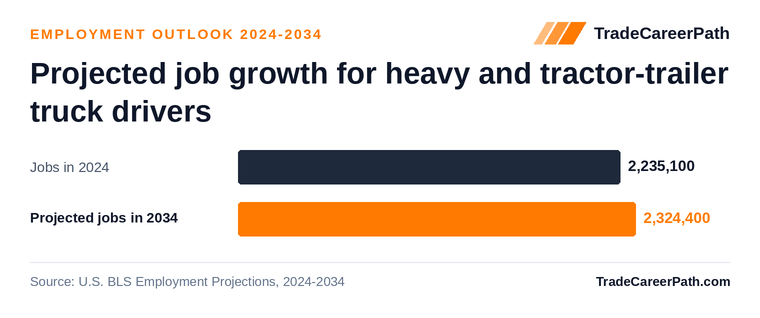
| CDL & Truck Driver Training this guide | $58,640 | +4.0% | 237,600 |
| Diesel Mechanic | $61,770 | +2.4% | 26,500 |
| Heavy Equipment Operator | $59,850 | +3.6% | 41,900 |
| Mechanic & Engine Technician | $50,620 | +4.2% | 70,000 |
| Maintenance Technician | $49,590 | +3.8% | 159,800 |
Source: BLS Occupational Employment and Wage Statistics + BLS Employment Projections.
Advance Your Career with a Degree
Experienced Truck Driver professionals often step up into degree-track careers where field experience is a hiring advantage:
- Logistician - median pay $82,320 (BLS OEWS, May 2025); requires a 4-year degree
See all trade careers that require a 4-year degree.
Degree and Program Guides
- Online Supply Chain Management Degrees - moving from driving to planning and logistics
Sources
- U.S. Bureau of Labor Statistics, Occupational Employment and Wage Statistics (May 2025)
- U.S. Bureau of Labor Statistics, Employment Projections 2024-2034
- U.S. Bureau of Labor Statistics, Survey of Occupational Injuries and Illnesses (2023-2024, Table R98)
- U.S. Department of Labor, Wage and Hour Division, Davis-Bacon General Wage Determinations (2026)
Truck Driver Salary by State
About this guide: Researched and written by the TradeCareerPath Editorial Team. Our editorial team researches and sources every trade school and career guide using federal labor and education data, including BLS OEWS and Employment Projections, DOL apprenticeship records, IPEDS, College Scorecard, and state licensing boards. We follow the editorial standards documented at /editorial-policy/.
Data sources
Figures on this page are sourced from the federal and state datasets below. Methodology: how we rank and source data.
| Data | Provider | Vintage |
|---|---|---|
| Occupational Employment and Wage Statistics (OEWS) | U.S. Bureau of Labor Statistics | May 2025 |
| Employment Projections | U.S. Bureau of Labor Statistics | 2024-2034 |
| Integrated Postsecondary Education Data System | National Center for Education Statistics (IPEDS) | 2024 |
| College Scorecard (school-level outcomes) | U.S. Department of Education | latest release |
| College Scorecard (field-of-study earnings) | U.S. Department of Education | latest release (updated 2026-06-12) |
| Occupational licensing requirements | CareerOneStop (U.S. Department of Labor) | latest release (updated 2026-02-22) |
| Registered apprenticeship programs | CareerOneStop / Apprenticeship.gov (U.S. Department of Labor) | latest release (updated 2025-10-25) |
| O*NET occupation profiles (skills, tasks, tools, job zones) | U.S. Department of Labor (O*NET / Employment & Training Admin.) | O*NET 29.1 (updated 2026-06-13) |