
How to Become a Veterinary Assistant in 2026
Is Veterinary Assistant Right for You?
The U.S. Department of Labor's O*NET profile for Veterinary Assistants and Laboratory Animal Caretakers (SOC 31-9096) describes the work this way: Feed, water, and examine pets and other nonfarm animals for signs of illness, disease, or injury in laboratories and animal hospitals and clinics. Clean and disinfect cages and work areas, and sterilize laboratory and surgical equipment. May provide routine postoperative care, administer medication orally or topically, or prepare samples for laboratory examination under the supervision of veterinary or laboratory animal technologists or technicians, veterinarians, or scientists.
What the work involves
- Hold or restrain animals during veterinary procedures.
- Monitor animals recovering from surgery and notify veterinarians of any unusual changes or symptoms.
- Fill medication prescriptions.
- Clean and maintain kennels, animal holding areas, examination or operating rooms, or animal loading or unloading facilities to control the spread of disease.
- Examine animals to detect behavioral changes or clinical symptoms that could indicate illness or injury.
Skills and knowledge that matter
Skills: Active Listening, Critical Thinking, Writing, Service Orientation, Reading Comprehension, Monitoring.
Knowledge: Customer and Personal Service, English Language, Biology, Administrative.
Tools and technology you may use
Tools: Animal nail clippers, Animal razors, Animal restraints, Balling guns, Bandage scissors, Benchtop centrifuges.
Technology: Medical software, Label making software, Data base user interface and query software, Microsoft Access, Microsoft Excel, Microsoft Office software.
Typical preparation
O*NET Job Zone Two (Some Preparation Needed). These occupations usually require a high school diploma. Employees in these occupations need anywhere from a few months to one year of working with experienced employees. A recognized apprenticeship program may be associated with these occupations.
Interest fit
O*NET interest profile: Realistic, Investigative, Conventional. People who enjoy hands-on, practical work with tools, machines, plants, or materials often find this occupation a good fit.
Source: O*NET 29.1 (updated 2026-06-13)
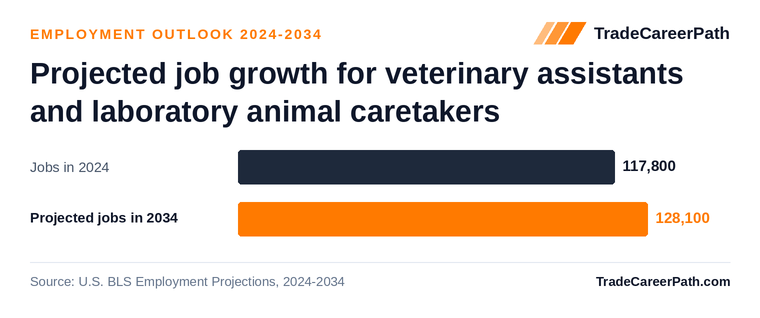
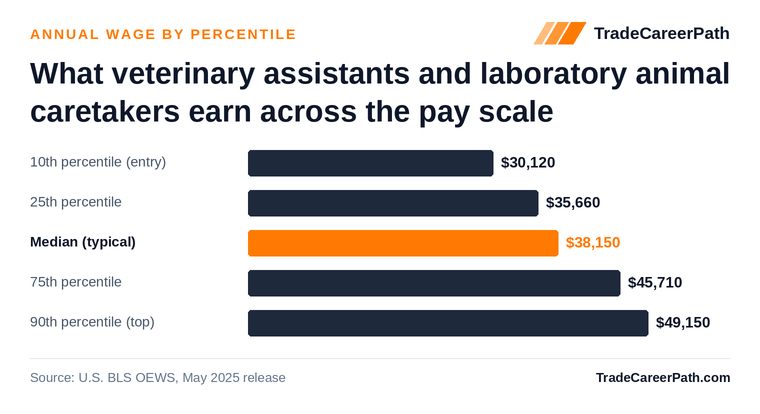
Quick answer: Training as a veterinary assistant usually takes 6 months to 2 years. You complete a certificate or associate degree program ($2,000 to $8,000), get hands-on experience through an externship or clinic job, and can earn the optional Approved Veterinary Assistant (AVA) credential from NAVTA. Most states do not require a license. The median veterinary assistant salary is $38,150 per year ($18.34/hour), and employers post about 22,200 openings nationwide each year (BLS, May 2025).
Veterinary assistants help veterinarians and technicians care for pets and other animals in clinics, shelters, and hospitals. It is an entry-level way into veterinary medicine that you can start with a short training program and no four-year degree.
How to Become a Veterinary Assistant
Most people enter the field in about six months to two years, depending on the program they choose. There is no national licensing exam. You build the career through training, hands-on experience, and an optional certification.
1. Earn a high school diploma or GED
A high school diploma or GED is the baseline requirement for most veterinary assistant programs and for almost every clinic job. Before you enroll, the most useful preparation comes from science classes, especially biology, chemistry, and anatomy, because the work involves animal physiology, medications, and basic medical procedures. Math helps with measuring doses and recording vital signs accurately. Just as important is real exposure to animal care: volunteering at an animal shelter, humane society, or a local clinic shows you what the day-to-day work feels like and gives you something concrete to put on an application. Many shelters welcome volunteers for cleaning, feeding, and socializing animals, which builds the comfort and handling skills you will use every day. If you are changing careers and already hold a diploma or another degree, you can move straight to a training program.
2. Complete a veterinary assistant program
This is the core training, and you have a few formats to choose from. Certificate programs usually take 6 to 12 months and get you working quickly. Associate degree programs take about 2 years and can serve as a stepping stone toward training as a veterinary technician later. Coursework typically covers animal handling and restraint, common diseases, medical terminology, pharmacy and dosage basics, sanitation and biosecurity, surgical prep, and clinic safety. Good programs build in lab work so you practice on models or live animals under supervision rather than only reading about procedures. Many programs are offered online or in a hybrid format, which lets you study around a job, but confirm that any online option includes a supervised hands-on component. If you plan to pursue NAVTA certification later, look for a program that follows the NAVTA-approved curriculum, since completing one is one path toward the AVA credential.
3. Gain hands-on experience
Classroom learning gets you started, but employers want to see that you can handle real animals and a real clinic environment. Most programs include a clinical externship at an animal hospital or shelter, where you assist actual veterinarians and technicians with exams, restraint, sample collection, and post-surgery monitoring. If your program does not include one, an entry-level role such as a kennel attendant, veterinary receptionist, or shelter assistant gets you inside a practice where you can learn the workflow and earn references. Pay attention to the routine tasks that fill most of the job: cleaning and sterilizing equipment, preparing exam rooms, calming nervous animals, and accurately recording patient histories and vital signs. Many employers also offer short-term on-the-job training, so steady, reliable work during this stage often leads directly to a permanent position.
4. Consider NAVTA certification
Certification is optional in most states, but it can set you apart. The most recognized credential is the Approved Veterinary Assistant (AVA), issued by the National Association of Veterinary Technicians in America (NAVTA). You generally qualify by completing a NAVTA-approved veterinary assistant program and then passing the AVA exam, which tests knowledge of animal care, clinical procedures, safety, and office practices. The exam fee is typically around $100. Holding the AVA credential signals to employers that your training meets a recognized national standard, which can help when you are competing for a first job or asking for a raise. Because requirements can change, check the NAVTA website for the current list of approved programs and exam details before you apply.
5. Apply for veterinary assistant jobs
Veterinary clinics, animal hospitals, shelters, humane societies, zoos, research labs, and mobile or emergency veterinary services all hire assistants. Tailor your resume to highlight hands-on experience, animal handling skills, and any externship or volunteer work, and mention the AVA credential if you earned it. Local clinics often post openings directly or hire from their pool of volunteers and externs, so the connections you made during training matter. Be ready to describe how you stay calm and careful in stressful situations, since employers screen heavily for temperament. Once you are working, on-the-job experience opens the door to advancement. With additional schooling you can work as a veterinary technician, and over time you may move into practice management, specialized animal care, or research support roles.
What Veterinary Assistants Do
Veterinary assistants perform essential support duties that help veterinarians and technicians care for animals. They keep clinics running smoothly and make sure animals are comfortable, clean, and safe.
Typical Responsibilities
- Feed, bathe, and exercise animals
- Clean and sterilize equipment and cages
- Assist during exams and minor procedures
- Record patient histories and vital signs
- Provide comfort to pets before and after surgery
Veterinary assistants help animals receive compassionate care while learning the fundamentals of veterinary practice.
Key Skills and Traits for Success
- Compassion and patience with animals
- Strong communication and teamwork
- Physical stamina for lifting and cleaning
- Attention to detail and safety
- Ability to handle stressful situations calmly
Work Settings for Veterinary Assistants
- Veterinary clinics and hospitals
- Animal shelters and humane societies
- Zoos, aquariums, and wildlife centers
- Research laboratories and universities
- Mobile or emergency veterinary services
Education and Certification Paths
| Pathway | Typical Duration | Outcome |
|---|---|---|
| Certificate | 6 to 12 months | Entry-level employment |
| Associate Degree | 2 years | Pathway to Veterinary Technician |
| NAVTA-Approved Program | About 1 year | Eligible for AVA certification |
Career Growth and Advancement
Veterinary assistants can grow into:
- Veterinary Technician (Vet Tech), which requires an associate degree and credentialing
- Practice Manager or Office Coordinator
- Animal Care Specialist or Groomer
- Wildlife Rehabilitation or Research Assistant
Cost and Duration of Training
- Program cost: about varies by school, format and location depending on format and school
- Time to complete: 6 months to 2 years
- Certification exam fee: around $100 for the NAVTA AVA exam
Many programs are offered online or in a hybrid format, which makes it easier to train while working or volunteering.
Pros and Cons
Pros
- Quick entry into the animal care field
- Emotionally rewarding work
- Hands-on experience with animals
- Flexible work settings
Cons
- Physically demanding
- Lower starting pay than licensed vet techs
- Occasional exposure to injury or emotional stress
State Licensing and Requirements
Most states do not require licensing for veterinary assistants, but the NAVTA-approved AVA certification is widely recognized.
View Veterinary Assistant Requirements by State
Quick Facts: Veterinary Assistant Salary, Education, and Outlook
Industry Organizations & Certifying Bodies
These are the recognized national organizations, unions, certifying bodies, and regulatory authorities that shape this trade. They issue the credentials, sponsor the apprenticeships, publish the codes, and represent workers and employers.
- National Association of Veterinary Technicians in America (NAVTA) Issues the Approved Veterinary Assistant (AVA) credential.
Wage and Employment Charts
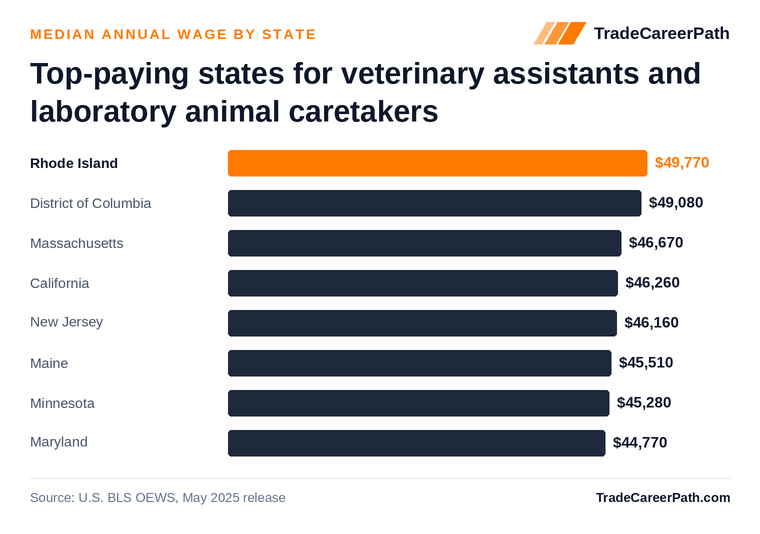
Veterinary Assistant Salary and Requirements by State
Select your state for local wage data, training options, and requirements:
Alabama · Alaska · Arizona · Arkansas · California · Colorado · Connecticut · Delaware · District of Columbia · Florida · Georgia · Hawaii · Idaho · Illinois · Indiana · Iowa · Kansas · Kentucky · Louisiana · Maine · Maryland · Massachusetts · Michigan · Minnesota · Mississippi · Missouri · Montana · Nebraska · Nevada · New Hampshire · New Jersey · New Mexico · New York · North Carolina · North Dakota · Ohio · Oklahoma · Oregon · Pennsylvania · Rhode Island · South Carolina · South Dakota · Tennessee · Texas · Utah · Vermont · Virginia · Washington · West Virginia · Wisconsin · Wyoming
Workplace Safety Snapshot
BLS Survey of Occupational Injuries and Illnesses data (2023-2024) report approximately 521.0 days-away, restricted, or transfer cases per 10,000 full-time-equivalent workers in veterinary assistants and laboratory animal caretakers (about 5.21 per 100 FTE). Source: BLS Survey of Occupational Injuries and Illnesses, Table R98.
Frequently Asked Questions
How long does veterinary assistant training take?
It typically takes 6 months to 2 years. Many people start working after a certificate program of 6 to 12 months, while an associate degree takes about 2 years and can lead toward training as a veterinary technician. A high school diploma or GED is generally required to get started.
Do you need a college degree to work as a veterinary assistant?
No. A college degree is not required to work as a veterinary assistant. Most people enter the field through a certificate or associate degree program, and some learn through short-term on-the-job training. A high school diploma or GED is typically the only educational prerequisite.
How much does veterinary assistant training cost?
Veterinary assistant programs typically cost about $2,000 to $8,000 depending on the format and school, with certificate programs generally costing less than degree programs. The optional NAVTA certification exam usually adds a fee of around $100.
Is veterinary assistant certification required?
Most states do not require a license or certification for veterinary assistants. Certification is voluntary, but the Approved Veterinary Assistant (AVA) credential from the National Association of Veterinary Technicians in America (NAVTA) is widely recognized and can strengthen your resume.
Is it hard to train as a veterinary assistant?
Entry is relatively accessible because no degree or licensing exam is required, and many people finish training in under a year. The work itself is physically demanding and can be emotionally difficult, so stamina, patience, and a calm approach under stress matter a lot.
Can you train to be a veterinary assistant online?
Yes. Many schools offer veterinary assistant programs online or in a hybrid format, with the classroom portion online and hands-on practice completed at a local clinic or shelter. Confirm that any program includes supervised clinical experience before you enroll.
What is the difference between a veterinary assistant and a veterinary technician?
A veterinary assistant provides support care such as feeding, cleaning, and helping during exams, and usually needs only a high school diploma plus short training. A veterinary technician completes a longer program, typically an associate degree, and is credentialed to perform more advanced clinical tasks. Many assistants later train to work as technicians.
How Veterinary Assistant Pay Compares to Similar Trades
Side-by-side comparison of Veterinary Assistant Programs and the closest related careers, based on U.S. Bureau of Labor Statistics data (May 2025 OEWS + 2024-2034 Employment Projections).
| Career | Median Pay | 10-Year Growth | Annual Openings |
|---|---|---|---|
| Veterinary Assistant Programs this guide | $38,150 | +8.7% | 22,200 |
| Vet Technician | $47,380 | +9.1% | 14,300 |
Source: BLS Occupational Employment and Wage Statistics + BLS Employment Projections.
Sources
- U.S. Bureau of Labor Statistics, Occupational Employment and Wage Statistics (May 2025)
- U.S. Bureau of Labor Statistics, Employment Projections 2024-2034
- U.S. Bureau of Labor Statistics, Survey of Occupational Injuries and Illnesses (2023-2024, Table R98)
- U.S. Department of Labor, Wage and Hour Division, Davis-Bacon General Wage Determinations (2026)
Veterinary Assistant Salary by State
About this guide: Researched and written by the TradeCareerPath Editorial Team. Our editorial team researches and sources every trade school and career guide using federal labor and education data, including BLS OEWS and Employment Projections, DOL apprenticeship records, IPEDS, College Scorecard, and state licensing boards. We follow the editorial standards documented at /editorial-policy/.
Data sources
Figures on this page are sourced from the federal and state datasets below. Methodology: how we rank and source data.
| Data | Provider | Vintage |
|---|---|---|
| Occupational Employment and Wage Statistics (OEWS) | U.S. Bureau of Labor Statistics | May 2025 |
| Employment Projections | U.S. Bureau of Labor Statistics | 2024-2034 |
| Integrated Postsecondary Education Data System | National Center for Education Statistics (IPEDS) | 2024 |
| College Scorecard (school-level outcomes) | U.S. Department of Education | latest release |
| College Scorecard (field-of-study earnings) | U.S. Department of Education | latest release (updated 2026-06-12) |
| Occupational licensing requirements | CareerOneStop (U.S. Department of Labor) | latest release (updated 2026-02-22) |
| Registered apprenticeship programs | CareerOneStop / Apprenticeship.gov (U.S. Department of Labor) | latest release (updated 2025-10-25) |
| O*NET occupation profiles (skills, tasks, tools, job zones) | U.S. Department of Labor (O*NET / Employment & Training Admin.) | O*NET 29.1 (updated 2026-06-13) |