
How to Become a Veterinary Technician in 2026
Is Veterinary Technician Right for You?
The U.S. Department of Labor's O*NET profile for Veterinary Technologists and Technicians (SOC 29-2056) describes the work this way: Perform medical tests in a laboratory environment for use in the treatment and diagnosis of diseases in animals. Prepare vaccines and serums for prevention of diseases. Prepare tissue samples, take blood samples, and execute laboratory tests, such as urinalysis and blood counts. Clean and sterilize instruments and materials and maintain equipment and machines. May assist a veterinarian during surgery.
What the work involves
- Administer anesthesia to animals, under the direction of a veterinarian, and monitor animals' responses to anesthetics so that dosages can be adjusted.
- Care for and monitor the condition of animals recovering from surgery.
- Maintain controlled drug inventory and related log books.
- Perform laboratory tests on blood, urine, or feces, such as urinalyses or blood counts, to assist in the diagnosis and treatment of animal health problems.
- Prepare and administer medications, vaccines, serums, or treatments, as prescribed by veterinarians.
Skills and knowledge that matter
Skills: Active Listening, Critical Thinking, Reading Comprehension, Speaking, Writing, Monitoring.
Knowledge: Medicine and Dentistry, Customer and Personal Service, Biology, English Language.
Tools and technology you may use
Technology: Medical software, Data base user interface and query software, Spreadsheet software, Microsoft Access, Microsoft Excel, Microsoft Office software.
Typical preparation
O*NET Job Zone Three (Medium Preparation Needed). Most occupations in this zone require training in vocational schools, related on-the-job experience, or an associate's degree. Employees in these occupations usually need one or two years of training involving both on-the-job experience and informal training with experienced workers. A recognized apprenticeship program may be associated with these occupations.
Interest fit
O*NET interest profile: Realistic, Investigative, Conventional. People who enjoy hands-on, practical work with tools, machines, plants, or materials often find this occupation a good fit.
Source: O*NET 31.0 (updated 2026-10-14)
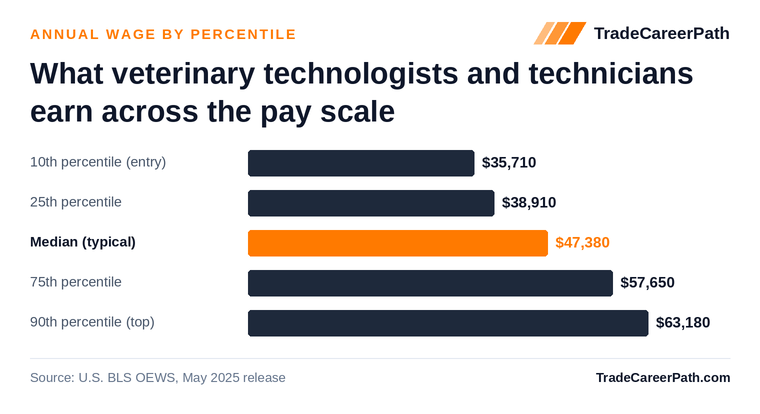
Quick answer: Training as a veterinary technician usually takes 6 months to 2 years, most often through a two-year associate degree with accreditation from the American Veterinary Medical Association (AVMA). Costs vary by program and school. After graduating, you pass the Veterinary Technician National Examination (VTNE) and apply for state credentialing as a registered, licensed, or certified veterinary technician. The median veterinary technician salary is $47,380 per year ($22.78/hour), and employers post about 13,400 openings nationwide each year (BLS, May 2025).
Veterinary technicians work alongside veterinarians in clinics, hospitals, shelters, and research labs. They assist with exams and surgeries, run lab tests, take x-rays, give medications, and help pet owners understand their animal’s care.
How to Become a Veterinary Technician
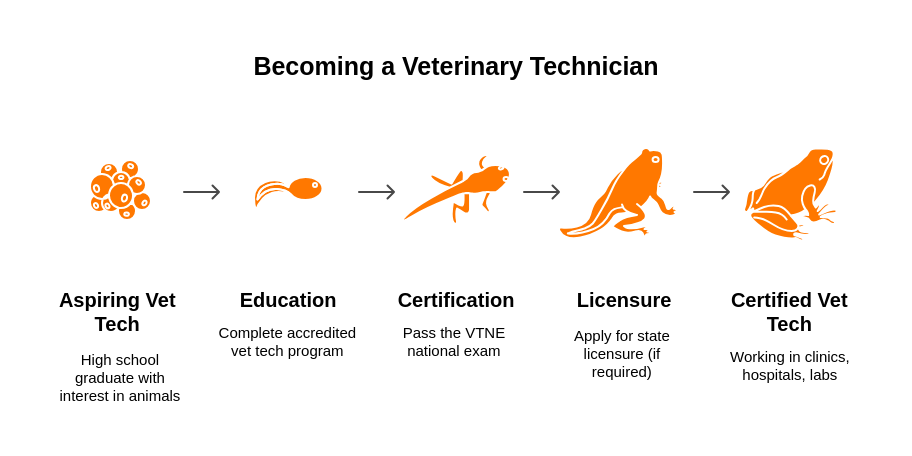
Most people enter the field in about six months to two years, depending on the program they choose. The path runs through an accredited education program, a national exam, and state credentialing, followed by hands-on work in a clinical setting.
1. Earn a high school diploma or GED
A high school diploma or GED is the minimum requirement to enroll in a veterinary technology program. Before you apply, it helps to build a foundation in the sciences the work depends on. Biology, chemistry, and anatomy give you a head start on the medical coursework, and math is useful for calculating medication doses and fluid rates. Comfort with computers matters too, since clinics run on electronic medical records, lab equipment, and digital imaging systems. If you can get any early exposure to animal care, such as volunteering at a shelter, fostering animals, or working part-time at a clinic or boarding facility, do it. That experience helps you confirm the field is right for you and strengthens your application to competitive programs. Career changers who already hold a diploma or another degree can move straight to the next step and apply directly to an accredited program.
2. Complete an AVMA-accredited program
This is the core credential, and accreditation is what makes it count. Look specifically for programs with accreditation from the American Veterinary Medical Association (AVMA) through its Committee on Veterinary Technician Education and Activities (CVTEA). Most states require graduation from an AVMA-accredited program before you can take the licensing exam, so verifying accreditation before you enroll is the single most important thing you can do. The most common credential is a two-year associate degree, though some schools offer certificate options or four-year bachelor’s degrees in veterinary technology. Coursework covers animal anatomy and physiology, pharmacology, anesthesia, surgical nursing, radiography and diagnostic imaging, laboratory procedures, and dentistry. Programs build in supervised clinical rotations so you practice drawing blood, placing catheters, monitoring anesthesia, and handling patients under the eye of experienced staff. Some accredited programs offer distance or hybrid formats, but the hands-on clinical hours must be completed in person at an approved site.
3. Pass the VTNE
After you graduate, the next step is the Veterinary Technician National Examination (VTNE), administered by the American Association of Veterinary State Boards (AAVSB). The VTNE is the national standard most states use to credential veterinary technicians, and it tests the practical knowledge you built in school, including pharmacology, anesthesia, surgical nursing, dentistry, laboratory procedures, and diagnostic imaging. Plan to study in the weeks leading up to your exam date, using review materials and practice questions to find weak spots. Many programs help graduates prepare and walk them through the application process. Check the AAVSB for current eligibility rules, scheduling, and fees, since requirements and testing windows can change.
4. Apply for state credentialing
Passing the VTNE is usually not the final step on its own. Most states require you to register, license, or certify with the state veterinary board before you can work, and the title varies by state: registered veterinary technician, licensed veterinary technician, or certified veterinary technician. The exact requirements differ, so check your state board for the rules that apply to you. Some states require a background check, a separate state exam, or proof of continuing education to keep your credential active. Joining the National Association of Veterinary Technicians in America (NAVTA) can help you keep up with state rules and connect with the wider profession.
5. Find a job and advance
Veterinary technicians are hired by private clinics, animal hospitals, emergency and specialty practices, shelters and humane societies, research laboratories, and zoos. Tailor your resume to the setting you want, highlight your clinical rotations and any animal-care experience, and ask instructors or rotation supervisors for references. Once you are working, experience opens the door to advancement. You can pursue a recognized Veterinary Technician Specialty (VTS) credential in areas such as emergency and critical care, anesthesia, or dentistry through NAVTA-recognized academies, or move into lead technician, practice management, or training roles over time.
What Veterinary Technicians Do
Veterinary technicians support veterinarians in nearly every part of animal care and treatment. They handle the hands-on clinical work that keeps a practice running, which frees the veterinarian to focus on diagnosis and treatment decisions.
Day to day, vet techs prepare patients for exams and surgery, monitor anesthesia, run blood and urine tests, take x-rays, administer medications and vaccines, and watch over animals as they recover. They also keep medical records accurate and talk with owners about home care, medications, and follow-up visits.
Common Responsibilities
- Assisting veterinarians during surgeries and procedures
- Collecting blood, urine, or tissue samples for lab testing
- Administering medications, vaccines, and anesthesia
- Taking x-rays and performing diagnostic imaging
- Monitoring patient recovery and updating medical records
- Educating pet owners about care and treatment
Key Skills and Traits for Success
- Compassion and patience with animals
- Attention to detail under pressure
- Clear communication with owners and the veterinary team
- Steady hands and technical skill for lab and surgical work
- Emotional resilience and problem solving
Where You Will Work
Veterinary technicians work in a range of settings:
- Veterinary clinics and animal hospitals
- Emergency and specialty practices
- Animal shelters and humane societies
- Research laboratories
- Zoos and wildlife rehabilitation centers
- Military and government agencies
Education and Credentialing Paths
| Pathway | Typical Duration | Outcome |
|---|---|---|
| Certificate | 6 to 12 months | Entry-level preparation, where accepted |
| Associate Degree | About 2 years | Most common credential |
| Bachelor’s Degree | About 4 years | Helpful for advanced or research roles |
To practice in most states, you complete an AVMA-accredited program, pass the VTNE, and earn state credentialing as a registered, licensed, or certified veterinary technician.
Career Growth and Advancement

With experience and added credentials, veterinary technicians can move into roles such as:
- Veterinary Technician Specialist (VTS) in fields like emergency and critical care, anesthesia, or dentistry
- Lead or Head Veterinary Technician who oversees other techs
- Veterinary Practice Manager
- Research or Laboratory Animal Technician
Cost and Duration of Training
- Program cost: varies by program and school; community colleges generally cost less than private institutions
- Time to complete: six months to two years for most credentials
- Credential to practice: AVMA-accredited program, VTNE, and state credentialing
Contact the AVMA-accredited programs you are considering for current tuition, fees, and financial aid options.
Pros and Cons
Pros
- Growing career field with strong demand
- Meaningful work helping animals and their owners
- Variety of settings and specialties
- Entry path without a four-year degree
Cons
- Physically and emotionally demanding
- Exposure to injured, sick, or distressed animals
- Pay is modest compared with some human healthcare roles
Quick Facts: Veterinary Technician Salary, Education, and Outlook
Industry Organizations & Certifying Bodies
These are the recognized national organizations, unions, certifying bodies, and regulatory authorities that shape this trade. They issue the credentials, sponsor the apprenticeships, publish the codes, and represent workers and employers.
- American Association of Veterinary State Boards (AAVSB) Administers the Veterinary Technician National Examination (VTNE).
- National Association of Veterinary Technicians in America (NAVTA) Professional association for veterinary technicians.
- American Veterinary Medical Association (AVMA) - CVTEA Accredits veterinary technology programs.
Wage and Employment Charts
Veterinary Technician Salary and Requirements by State
Select your state for local wage data, training options, and requirements:
Alabama · Alaska · Arizona · Arkansas · California · Colorado · Connecticut · Delaware · District of Columbia · Florida · Georgia · Hawaii · Idaho · Illinois · Indiana · Iowa · Kansas · Kentucky · Louisiana · Maine · Maryland · Massachusetts · Michigan · Minnesota · Mississippi · Missouri · Montana · Nebraska · Nevada · New Hampshire · New Jersey · New Mexico · New York · North Carolina · North Dakota · Ohio · Oklahoma · Oregon · Pennsylvania · Rhode Island · South Carolina · South Dakota · Tennessee · Texas · Utah · Vermont · Virginia · Washington · West Virginia · Wisconsin · Wyoming
Workplace Safety Snapshot
BLS Survey of Occupational Injuries and Illnesses data (2023-2024) report approximately 367.0 days-away, restricted, or transfer cases per 10,000 full-time-equivalent workers in veterinary technologists and technicians (about 3.67 per 100 FTE). Source: BLS Survey of Occupational Injuries and Illnesses, Table R98.
Frequently Asked Questions
How long does veterinary technician training take?
It typically takes 6 months to 2 years of training. The most common entry path is an associate degree in veterinary technology, which runs about 2 years. A high school diploma or GED is generally required to get started.
Do you need a college degree to work as a veterinary technician?
Most states require graduation from a program with accreditation from the American Veterinary Medical Association (AVMA), and the common credential is a two-year associate degree. A high school diploma or GED is the educational prerequisite to enroll.
How much does veterinary technician training cost?
Costs vary widely by program and school, and depend on whether you attend a community college or a private institution. Contact the AVMA-accredited programs you are considering for current tuition and fees, and ask about financial aid.
Do you need to pass the VTNE to work as a vet tech?
In most states, yes. After graduating from an AVMA-accredited program, you take the Veterinary Technician National Examination (VTNE), administered by the American Association of Veterinary State Boards (AAVSB), and then apply for state credentialing as a registered, licensed, or certified veterinary technician.
Is training as a veterinary technician hard?
Entry is accessible because no four-year degree is required and most people finish training in 6 months to 2 years. The coursework covers anatomy, pharmacology, and surgical support, and the job itself can be physically and emotionally demanding.
Can you train as a veterinary technician online?
Some AVMA-accredited programs are offered in distance or hybrid formats, but they still require hands-on clinical training completed at an approved veterinary site. Confirm AVMA accreditation before you enroll in any program.
How many veterinary technicians work in the United States?
BLS reports approximately 129,140 veterinary technologists and technicians employed nationwide as of May 2025, with employment projected to grow 9.4% from 2025 to 2035.
How Veterinary Technician Pay Compares to Similar Trades
Side-by-side comparison of Vet Technician and the closest related careers, based on U.S. Bureau of Labor Statistics data (May 2025 OEWS + 2025-2035 Employment Projections).
| Career | Median Pay | 10-Year Growth | Annual Openings |
|---|---|---|---|
| Vet Technician this guide | $47,380 | +9.4% | 13,400 |
| Veterinary Assistant Programs | $38,150 | +9.1% | 23,200 |
Source: BLS Occupational Employment and Wage Statistics + BLS Employment Projections.
Sources
- U.S. Bureau of Labor Statistics, Occupational Employment and Wage Statistics (May 2025)
- U.S. Bureau of Labor Statistics, Employment Projections 2025-2035
- U.S. Bureau of Labor Statistics, Survey of Occupational Injuries and Illnesses (2023-2024, Table R98)
- U.S. Department of Labor, Wage and Hour Division, Davis-Bacon General Wage Determinations (2026)
Veterinary Technician Salary by State
About this guide: Researched and written by the TradeCareerPath Editorial Team. Our editorial team researches and sources every trade school and career guide using federal labor and education data, including BLS OEWS and Employment Projections, DOL apprenticeship records, IPEDS, College Scorecard, and state licensing boards. We follow the editorial standards documented at /editorial-policy/.
Data sources
Figures on this page are sourced from the federal and state datasets below. Methodology: how we rank and source data.
| Data | Provider | Vintage |
|---|---|---|
| Occupational Employment and Wage Statistics (OEWS) | U.S. Bureau of Labor Statistics | May 2025 |
| Employment Projections | U.S. Bureau of Labor Statistics | 2025-2035 |
| Integrated Postsecondary Education Data System | National Center for Education Statistics (IPEDS) | 2024 |
| College Scorecard (school-level outcomes) | U.S. Department of Education | latest release |
| College Scorecard (field-of-study earnings) | U.S. Department of Education | latest release (updated 2026-06-12) |
| Occupational licensing requirements | CareerOneStop (U.S. Department of Labor) | latest release (updated 2026-02-22) |
| Registered apprenticeship programs | CareerOneStop / Apprenticeship.gov (U.S. Department of Labor) | latest release (updated 2025-10-25) |
| O*NET occupation profiles (skills, tasks, tools, job zones) | U.S. Department of Labor (O*NET / Employment & Training Admin.) | O*NET 31.0 (updated 2026-10-14) |