
How to Become a Veterinary Technologist in 5 Steps
Is Veterinary Technologist Right for You?
The U.S. Department of Labor's O*NET profile for Veterinary Technologists and Technicians (SOC 29-2056) describes the work this way: Perform medical tests in a laboratory environment for use in the treatment and diagnosis of diseases in animals. Prepare vaccines and serums for prevention of diseases. Prepare tissue samples, take blood samples, and execute laboratory tests, such as urinalysis and blood counts. Clean and sterilize instruments and materials and maintain equipment and machines. May assist a veterinarian during surgery.
What the work involves
- Administer anesthesia to animals, under the direction of a veterinarian, and monitor animals' responses to anesthetics so that dosages can be adjusted.
- Care for and monitor the condition of animals recovering from surgery.
- Maintain controlled drug inventory and related log books.
- Perform laboratory tests on blood, urine, or feces, such as urinalyses or blood counts, to assist in the diagnosis and treatment of animal health problems.
- Prepare and administer medications, vaccines, serums, or treatments, as prescribed by veterinarians.
Skills and knowledge that matter
Skills: Critical Thinking, Active Listening, Speaking, Reading Comprehension, Writing, Monitoring.
Knowledge: Medicine and Dentistry, Customer and Personal Service, Biology, English Language.
Tools and technology you may use
Tools: Adult Magill forceps, Adult non-rebreather oxygen masks, Adult stylets, Aerosol nebulizers, Airway suction units, Ambu bags.
Technology: Medical software, Data base user interface and query software, Spreadsheet software, Microsoft Access, Microsoft Excel, Microsoft Office software.
Typical preparation
O*NET Job Zone Three (Medium Preparation Needed). Most occupations in this zone require training in vocational schools, related on-the-job experience, or an associate's degree. Employees in these occupations usually need one or two years of training involving both on-the-job experience and informal training with experienced workers. A recognized apprenticeship program may be associated with these occupations.
Interest fit
O*NET interest profile: Realistic, Investigative, Conventional. People who enjoy hands-on, practical work with tools, machines, plants, or materials often find this occupation a good fit.
Source: O*NET 29.1 (updated 2026-06-13)
Veterinary technologists assist veterinarians in diagnosing and treating animals.
They combine compassion for animals with clinical and laboratory skills that support animal health every day.
If you’re passionate about science, pets, and medical care, training as a veterinary technologist offers a hands-on healthcare career that makes a real difference.
Quick answers
What does a veterinary technologist do? Veterinary technologists assist veterinarians by performing clinical tests, helping with diagnostic imaging, and supporting surgery and patient care.
Where do veterinary technologists work? Common workplaces include animal hospitals and private clinics, research laboratories, zoos and wildlife rehabilitation centers, government and public health agencies, and universities.
What education do you need? This page covers both associate and bachelor’s degree paths. Bachelor’s programs are used for many veterinary technologist roles, while associate degrees typically align with veterinary technician positions.
Do you need to pass the VTNE and get licensed? After graduation, you take the Veterinary Technician National Exam (VTNE) to qualify for state licensing. You also need a state license to practice legally.
How long does training take? Training can take 2-4 years depending on the degree path.
How much does training and the VTNE cost? Program costs range from varies by school, format and location depending on degree and location. The VTNE exam fee is around $325.
At a glance
- Typical duties include lab tests, anesthesia monitoring, X-rays, medications, and medical records
- Work settings include clinics, labs, zoos, universities, and public health agencies
- Common education paths are an associate degree (2 years) or a bachelor’s degree (4 years)
- Licensure typically requires the VTNE and a state license
- Program costs range from varies by school, format and location; VTNE exam fee is around $325
What Veterinary Technologists Do
Veterinary technologists work closely with veterinarians to provide medical care for animals. They perform clinical tests, assist during surgeries, and help with diagnostic imaging and laboratory procedures.
Typical Responsibilities
- Collect samples and perform lab tests
- Monitor anesthesia and surgical patients
- Take X-rays and diagnostic images
- Administer medications and vaccines
- Assist in emergency and critical care
- Communicate with pet owners and maintain medical records
Veterinary technologists are the backbone of animal healthcare teams, blending compassion with science to improve animal well-being.
Key Skills and Traits for Success
- Compassion for animals and their owners
- Strong attention to detail
- Knowledge of anatomy and medical procedures
- Manual dexterity and steady hands
- Communication and teamwork skills
- Ability to handle stressful clinical situations
Common Work Environments
Veterinary technologists work in:
- Animal hospitals and private veterinary clinics
- Research laboratories
- Zoos and wildlife rehabilitation centers
- Government and public health agencies
- Universities and diagnostic labs
How to Become a Veterinary Technologist (5 Steps)
1. Earn a High School Diploma or GED
Take science classes such as biology, chemistry, and animal science to prepare for veterinary technology programs.
2. Complete an Accredited Veterinary Technology Program
Enroll in a bachelor's degree program with accreditation from the American Veterinary Medical Association (AVMA). Coursework covers anatomy, animal nursing, and radiology.
3. Gain Clinical Experience
Participate in internships or externships through your program to develop real-world experience in animal care settings.
4. Pass the VTNE
After graduation, take the Veterinary Technician National Exam (VTNE) to qualify for state licensing.
5. Get Licensed and Continue Education
Obtain a state license to practice legally. Ongoing continuing education ensures skills stay current with veterinary medicine standards.
Education and Certification Options
| Pathway | Typical Duration | Outcome |
|---|---|---|
| Bachelor’s Degree | 4 years | Required for most veterinary technologist roles |
| Associate Degree | 2 years | Qualifies for veterinary technician positions |
| Continuing Education | Ongoing | Maintains state license and certification |
Career Growth and Advancement
With experience, veterinary technologists can move into:
- Veterinary Laboratory Specialist - focuses on diagnostics and testing
- Research Technician - works in biomedical or pharmaceutical labs
- Veterinary Practice Manager - handles operations and team management
- Animal Nutrition or Behavior Specialist - supports advanced animal care programs
Cost and Duration of Training
- Program Cost: varies by school, format and location depending on degree and location
- Duration: 2-4 years
- Certification Exam Fee: around $325 for the VTNE
Accredited veterinary technology programs blend classroom science with hands-on clinical training for a complete learning experience.
Pros and Cons
Pros
- Rewarding work helping animals
- Strong demand in animal healthcare
- Opportunities for specialization
- Variety of work environments
Cons
- Emotionally challenging cases
- Physical and fast-paced environment
- May involve nights, weekends, or on-call shifts
Quick Facts: Veterinary Technologist Salary, Education, and Outlook
Wage and Employment Charts
| Percentile | Annual wage |
|---|---|
| 10th | $35,710 |
| 25th | $38,910 |
| 50th (median) | $47,380 |
| 75th | $57,650 |
| 90th | $63,180 |
| Year | Employment |
|---|---|
| 2024 | 134,200 |
| 2034 projected | 146,400 |
| Percent change | +9.1% |
Veterinary Technologist Salary and Requirements by State
Select your state for local wage data, training options, and requirements:
Alabama · Alaska · Arizona · Arkansas · California · Colorado · Connecticut · Delaware · District of Columbia · Florida · Georgia · Hawaii · Idaho · Illinois · Indiana · Iowa · Kansas · Kentucky · Louisiana · Maine · Maryland · Massachusetts · Michigan · Minnesota · Mississippi · Missouri · Montana · Nebraska · Nevada · New Hampshire · New Jersey · New Mexico · New York · North Carolina · North Dakota · Ohio · Oklahoma · Oregon · Pennsylvania · Rhode Island · South Carolina · South Dakota · Tennessee · Texas · Utah · Vermont · Virginia · Washington · West Virginia · Wisconsin · Wyoming
Workplace Safety Snapshot
BLS Survey of Occupational Injuries and Illnesses data (2023-2024) report approximately 367.0 days-away, restricted, or transfer cases per 10,000 full-time-equivalent workers in veterinary technologists and technicians (about 3.67 per 100 FTE). Source: BLS Survey of Occupational Injuries and Illnesses, Table R98.
Frequently Asked Questions
How long does veterinary technologist training take?
It typically takes typically 6 months to 2 years of training. The most common entry path is through a certificate or associate degree program. A high school diploma or GED is generally required to get started.
How much do veterinary technologists make?
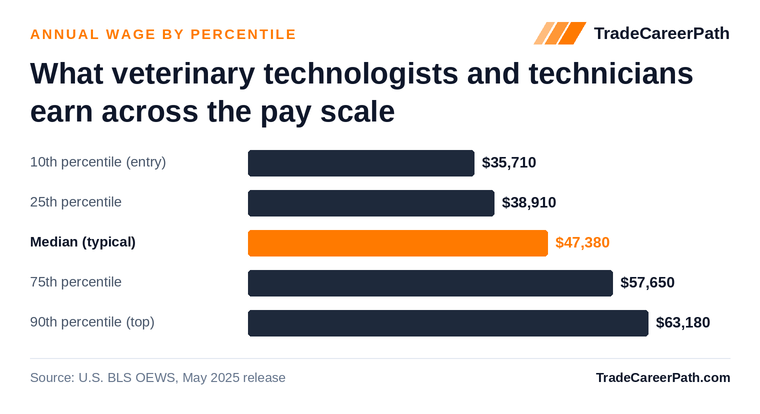
The median annual salary for veterinary technologists is $47,380 according to the Bureau of Labor Statistics (May 2025). Entry-level workers earn around $35,710, while those in the 90th percentile earn over $63,180. Pay varies by state, experience, and specialization.
What is the job outlook for veterinary technologists?
The Bureau of Labor Statistics projects 9.1% employment growth for this occupation from 2024 to 2034, which is faster than average. Approximately 14,300 job openings are expected each year due to growth, retirements, and workers leaving the field.
Do you need a college degree to work as a veterinary technologist?
No. A college degree is not required to work as a veterinary technologist. Most people enter the field through a certificate or associate degree program. A high school diploma or GED is typically the only educational prerequisite.
Which states pay veterinary technologists the most?
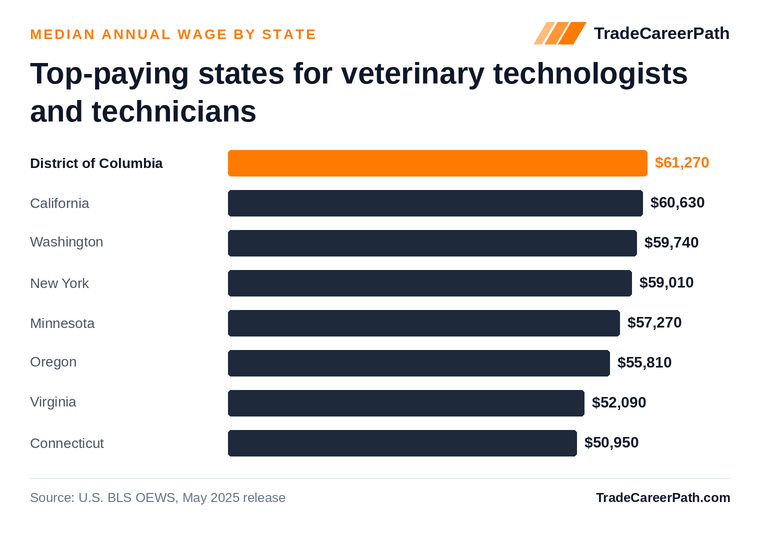
According to the U.S. Bureau of Labor Statistics (May 2025 OEWS), the highest-paying states for veterinary technologists are District of Columbia, California, and Washington. Median annual wages: District of Columbia ($61,270); California ($60,630); Washington ($59,740).
Which states employ the most veterinary technologists?
BLS reports the largest concentrations of veterinary technologists in Texas, Florida, and California. Employment levels: Texas (16,730 workers); Florida (11,380 workers); California (11,310 workers) (May 2025).
How much do experienced veterinary technologists earn?
The top 10% of veterinary technologists earn more than $63,180 per year, according to BLS Occupational Employment and Wage Statistics (May 2025). Experienced workers in this band typically hold senior credentials, supervisory roles, or specialty certifications.
What is entry-level pay for veterinary technologists?
BLS reports the bottom 10% of veterinary technologists earn under $35,710 per year. New workers often start near this level and see pay rise as they accumulate experience and credentials.
How many veterinary technologists work in the United States?
BLS reports approximately 129,140 veterinary technologists employed nationwide as of May 2025.
How many job openings are expected for veterinary technologists each year?
BLS projects approximately 14,300 openings per year for veterinary technologists from 2024 through 2034, including new positions, retirements, and workers transitioning out. The occupation is projected to grow 9.1% from 2024 to 2034, classified as much faster than average growth.
Is veterinary technologist a growing career?
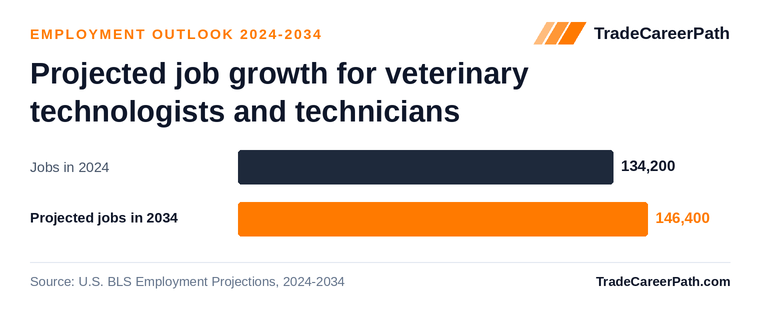
Yes. BLS projects 9.1% employment growth for veterinary technologists between 2024 and 2034, classified as much faster than average. Employment is projected to rise from approximately 134,200 jobs in 2024 to 146,400 in 2034.
How much do veterinary technologists make per hour?
The median hourly wage for veterinary technologists is $22.78, according to BLS (May 2025). Hourly pay ranges from about $17.17 (bottom 10%) to $30.38 (top 10%).
Sources
- U.S. Bureau of Labor Statistics, Occupational Employment and Wage Statistics (May 2025)
- U.S. Bureau of Labor Statistics, Employment Projections 2024-2034
- U.S. Bureau of Labor Statistics, Survey of Occupational Injuries and Illnesses (2023-2024, Table R98)
- U.S. Department of Labor, Wage and Hour Division, Davis-Bacon General Wage Determinations (2026)
Veterinary Technologist Salary by State
About this guide: Researched and written by the TradeCareerPath Editorial Team. Our editorial team researches and sources every trade school and career guide using federal labor and education data, including BLS OEWS and Employment Projections, DOL apprenticeship records, IPEDS, College Scorecard, and state licensing boards. We follow the editorial standards documented at /editorial-policy/.
Data sources
Figures on this page are sourced from the federal and state datasets below. Methodology: how we rank and source data.
| Data | Provider | Vintage |
|---|---|---|
| Occupational Employment and Wage Statistics (OEWS) | U.S. Bureau of Labor Statistics | May 2025 |
| Employment Projections | U.S. Bureau of Labor Statistics | 2024-2034 |
| Integrated Postsecondary Education Data System | National Center for Education Statistics (IPEDS) | 2024 |
| College Scorecard (school-level outcomes) | U.S. Department of Education | latest release |
| College Scorecard (field-of-study earnings) | U.S. Department of Education | latest release (updated 2026-06-12) |
| Occupational licensing requirements | CareerOneStop (U.S. Department of Labor) | latest release (updated 2026-02-22) |
| Registered apprenticeship programs | CareerOneStop / Apprenticeship.gov (U.S. Department of Labor) | latest release (updated 2025-10-25) |
| O*NET occupation profiles (skills, tasks, tools, job zones) | U.S. Department of Labor (O*NET / Employment & Training Admin.) | O*NET 29.1 (updated 2026-06-13) |