
How to Become a Web Designer (5 Steps)
Web designers build the visual and interactive experience of the internet.
They combine creativity, coding, and user experience design to make websites functional, fast, and engaging.
If you’re artistic, tech-savvy, and enjoy solving design challenges, a career in web design offers both flexibility and growth in a digital-first world.
Quick answers
Industry Organizations & Certifying Bodies
These are the recognized national organizations, unions, certifying bodies, and regulatory authorities that shape this trade. They issue the credentials, sponsor the apprenticeships, publish the codes, and represent workers and employers.
- International Web Association (IWA) Issues the Certified Web Professional (CWP) credentials.
- W3C Web Accessibility Initiative (WAI) Reference for web accessibility standards (WCAG).
Wage and Employment Charts
| Percentile | Annual wage |
|---|---|
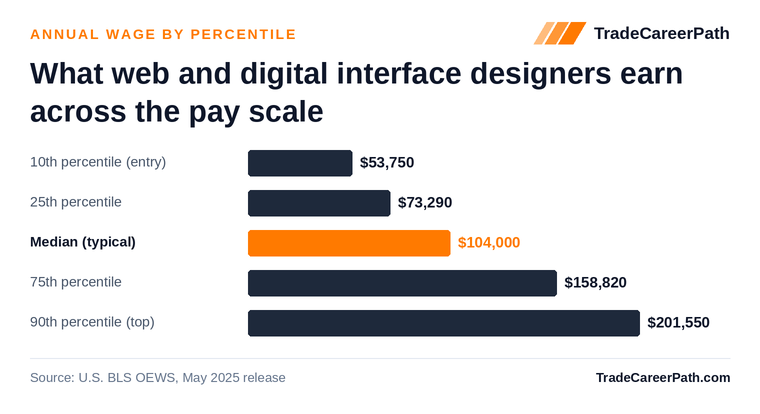
| 10th | $53,750 |
| 25th | $73,290 |
| 50th (median) | $104,000 |
| 75th | $158,820 |
| 90th | $201,550 |
| Year | Employment |
|---|---|
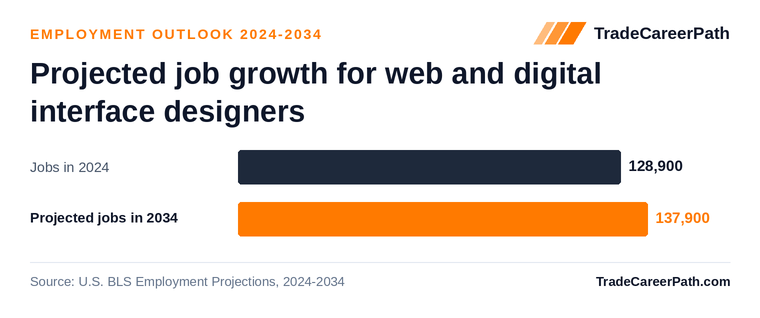
| 2024 | 128,900 |
| 2034 projected | 137,900 |
| Percent change | +7.0% |
Web Designer Salary and Requirements by State
Select your state for local wage data, training options, and requirements:
Alabama · Alaska · Arizona · Arkansas · California · Colorado · Connecticut · Delaware · District of Columbia · Florida · Georgia · Hawaii · Idaho · Illinois · Indiana · Iowa · Kansas · Kentucky · Louisiana · Maine · Maryland · Massachusetts · Michigan · Minnesota · Mississippi · Missouri · Montana · Nebraska · Nevada · New Hampshire · New Jersey · New Mexico · New York · North Carolina · North Dakota · Ohio · Oklahoma · Oregon · Pennsylvania · Rhode Island · South Carolina · South Dakota · Tennessee · Texas · Utah · Vermont · Virginia · Washington · West Virginia · Wisconsin · Wyoming
What does a web designer do?
Web designers create websites that balance functionality, visual appeal, and user experience. They use design tools and HTML and CSS to build responsive layouts.
Is coding part of web design?
Most web designers use HTML and CSS to build pages. Web designers also collaborate with developers and content teams to bring sites to life.
What training paths are common for web designers?
Common pathways include certificate programs (6-12 months), associate degrees (2 years), or bachelor’s degrees (4 years). Each path builds a mix of design and web development fundamentals.
What tools do web designers use?
Many web designers use Figma, Adobe XD, and Photoshop. Content management systems like WordPress or Webflow are also common.
Are certifications required to work as a web designer?
Certifications are optional. Credentials from Adobe, CIW, or Google can validate your skills.
Where do web designers work?
Web designers work in agencies, corporate web teams, and tech startups. Many also freelance or work remotely.
At a glance
- Typical training: certificate (6-12 months), associate degree (2 years), or bachelor’s degree (4 years)
- Program cost: varies by school, format and location plus optional certification fees ($95-$300)
- Core skills: HTML, CSS, responsive design, UX/UI principles, collaboration
- Common tools: Figma, Adobe XD, Photoshop, WordPress, Webflow
- Work settings: agency, corporate, freelance, remote
What Web Designers Do
Web designers create websites that balance functionality, visual appeal, and user experience. They use design tools and coding languages to build responsive layouts that work on all devices. Responsive design means a layout adapts to different screen sizes and devices.
Typical Responsibilities
- Design web layouts, color palettes, and typography
- Use HTML, CSS, and design software to build pages
- Ensure websites are responsive and accessible
- Collaborate with developers and content teams
- Optimize sites for performance and search engines
- Test websites for functionality across browsers
Web designers bring brands and ideas to life online, turning creative concepts into digital experiences.
Key Skills and Traits for Success
- Creativity and an eye for detail
- Understanding of UX/UI principles
- Knowledge of HTML, CSS, and responsive design
- Proficiency with design tools (Figma, Adobe XD, Photoshop)
- Problem-solving and collaboration skills
- Time management and client communication
Common Work Environments
Web designers work in:
- Design agencies or marketing firms
- Corporate web teams
- Freelance or remote settings
- Tech startups and small businesses
- Government and nonprofit organizations
How to Become a Web Designer (5 Steps)
1. Earn a High School Diploma or GED
Take courses in art, computer science, and communications to prepare for design and technical studies.
2. Complete a Web Design Program
Enroll in a trade school, community college, or online web design program. Courses typically cover design principles, coding, and accessibility standards.
3. Build a Design Portfolio
Create sample websites and design projects to showcase your skills to employers or clients.
4. Learn Industry Tools and Software
Gain proficiency in Adobe Creative Cloud, Figma, and content management systems like WordPress or Webflow.
5. Earn Certifications and Stay Current
Optional credentials from Adobe, CIW, or Google can validate your skills. Keep learning as design trends and web technologies evolve.
Education and Certification Options
| Pathway | Typical Duration | Outcome |
|---|---|---|
| Certificate Program | 6-12 months | Entry-level design and coding skills |
| Associate Degree | 2 years | Broad foundation in design and development |
| Bachelor’s Degree | 4 years | Comprehensive UX/UI, branding, and coding training |
Career Growth and Advancement
With experience, web designers can advance into:
- UX/UI Designer - focuses on usability and interface design
- Front-End Developer - blends design with advanced coding
- Web Project Manager - oversees creative and technical teams
- Creative Director - leads brand and digital strategy projects
Cost and Duration of Training
- Program Cost: varies by school, format and location depending on program type
- Duration: 6 months to 4 years
- Certification Fees: $95-$300 depending on provider
Many web designers start freelancing while still in training, building portfolios that attract clients and employers.
Pros and Cons
✅ Pros
- Creative and flexible career path
- Remote and freelance opportunities
- High demand for skilled designers
- Low barrier to entry with online training
⚠️ Cons
- Competitive job market
- Constantly evolving technology
- Client deadlines can be intense
Quick Facts: Web Designer Salary, Education, and Outlook
Frequently Asked Questions
How long does web designer training take?
It typically takes typically 6 months to 2 years of training. The most common entry path is through a certificate or associate degree program. A high school diploma or GED is generally required to get started.
Do you need a college degree to work as a web designer?
No. A college degree is not required to work as a web designer. Most people enter the field through a certificate or associate degree program. A high school diploma or GED is typically the only educational prerequisite.
Which states pay web designers the most?
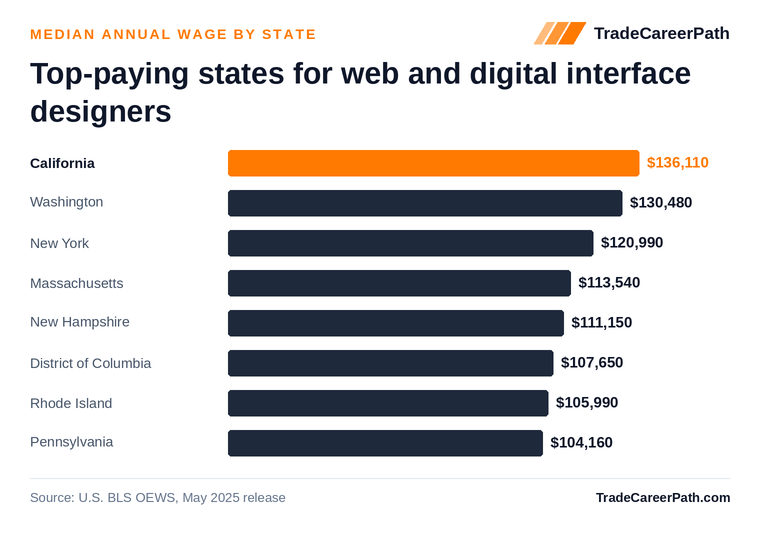
According to the U.S. Bureau of Labor Statistics (May 2025 OEWS), the highest-paying states for web designers are California, Washington, and New York. Median annual wages: California ($136,110); Washington ($130,480); New York ($120,990).
Which states employ the most web designers?
BLS reports the largest concentrations of web designers in California, New York, and Washington. Employment levels: California (27,090 workers); New York (16,560 workers); Washington (11,580 workers) (May 2025).
How much do experienced web designers earn?
The top 10% of web designers earn more than $201,550 per year, according to BLS Occupational Employment and Wage Statistics (May 2025). Experienced workers in this band typically hold senior credentials, supervisory roles, or specialty certifications.
What is entry-level pay for web designers?
BLS reports the bottom 10% of web designers earn under $53,750 per year. New workers often start near this level and see pay rise as they accumulate experience and credentials.
How many web designers work in the United States?
BLS reports approximately 113,330 web designers employed nationwide as of May 2025.
How many job openings are expected for web designers each year?
BLS projects approximately 9,100 openings per year for web designers from 2024 through 2034, including new positions, retirements, and workers transitioning out. The occupation is projected to grow 7.0% from 2024 to 2034, classified as faster than average growth.
Is web designer a growing career?
Yes. BLS projects 7.0% employment growth for web designers between 2024 and 2034, classified as faster than average. Employment is projected to rise from approximately 128,900 jobs in 2024 to 137,900 in 2034.
How much do web designers make per hour?
The median hourly wage for web designers is $50.00, according to BLS (May 2025). Hourly pay ranges from about $25.84 (bottom 10%) to $96.90 (top 10%).
Sources
- U.S. Bureau of Labor Statistics, Occupational Employment and Wage Statistics (May 2025)
- U.S. Bureau of Labor Statistics, Employment Projections 2024-2034
- U.S. Bureau of Labor Statistics, Survey of Occupational Injuries and Illnesses (2023-2024, Table R98)
- U.S. Department of Labor, Wage and Hour Division, Davis-Bacon General Wage Determinations (2026)
Web Designer Salary by State
About this guide: Researched and written by the TradeCareerPath Editorial Team. Our editorial team researches and sources every trade school and career guide using federal labor and education data, including BLS OEWS and Employment Projections, DOL apprenticeship records, IPEDS, College Scorecard, and state licensing boards. We follow the editorial standards documented at /editorial-policy/.
Data sources
Figures on this page are sourced from the federal and state datasets below. Methodology: how we rank and source data.
| Data | Provider | Vintage |
|---|---|---|
| Occupational Employment and Wage Statistics (OEWS) | U.S. Bureau of Labor Statistics | May 2025 |
| Employment Projections | U.S. Bureau of Labor Statistics | 2024-2034 |
| Integrated Postsecondary Education Data System | National Center for Education Statistics (IPEDS) | 2024 |
| College Scorecard (school-level outcomes) | U.S. Department of Education | latest release |
| College Scorecard (field-of-study earnings) | U.S. Department of Education | latest release (updated 2026-06-12) |
| Occupational licensing requirements | CareerOneStop (U.S. Department of Labor) | latest release (updated 2026-02-22) |
| Registered apprenticeship programs | CareerOneStop / Apprenticeship.gov (U.S. Department of Labor) | latest release (updated 2025-10-25) |
| O*NET occupation profiles (skills, tasks, tools, job zones) | U.S. Department of Labor (O*NET / Employment & Training Admin.) | O*NET 29.1 (updated 2026-06-13) |