
Welder to Welding Engineer: The Degree Path Off the Floor (2026)
Quick answer: Yes. A welder becomes a welding engineer by earning the accredited bachelor’s degree, usually part-time over five to six years while working, less with transfer credit. The national median moves from $53,750 (welder) to $112,860 (welding engineer), per BLS OEWS, May 2025, and your field experience is an asset the whole way.
The Numbers
| Role | National median pay | Source |
|---|---|---|
| Welder | $53,750 | BLS OEWS, May 2025 |
| Welding Engineer | $112,860 | BLS OEWS, May 2025 |
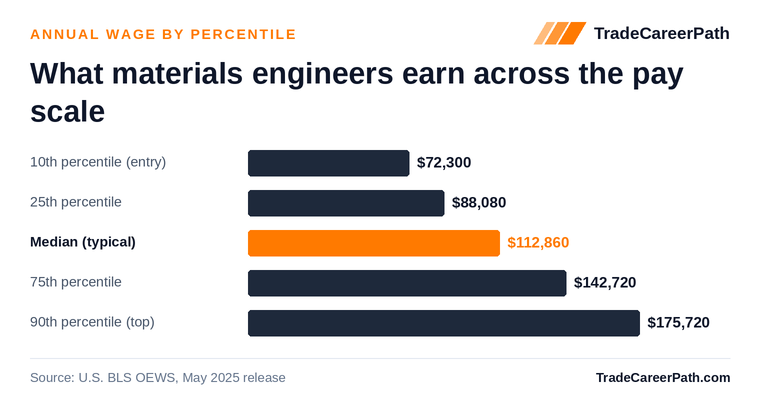
BLS tracks welding engineers under materials engineers (SOC 17-2131), a small occupation - 22,770 people nationwide - which is part of why the pay holds up: there are far fewer people qualified to write a welding procedure than to run one. Even the 10th percentile for the degree role, $72,300, sits well above the welder median. Full career details, percentiles, and state-by-state pay: Welding Engineer career guide.
What Your Experience Is Worth
Process knowledge no classroom teaches: what a good bead looks like, why a procedure fails in position, how fit-up really goes. Welding engineers who cannot weld write procedures nobody can run; you will not have that problem.
This is not a consolation prize - it is a hiring differentiator. A large share of welding engineering is diagnosing why production welds are failing, and the engineer who has actually chased porosity on a humid day or fought distortion on a thin-wall assembly gets to the answer faster than one who has only seen the defect catalog in a textbook. Employers know it, and former welders routinely come in above the bottom of the pay band because of it.
What the Work Is Like on the Other Side
The short version: you stop making the weld and start owning it. The welding engineer decides which process, filler, joint design, preheat, and heat treatment a job gets, writes the WPS, qualifies it, and signs the paperwork that says the weld will hold.
Day to day, that splits roughly three ways. There is desk work: writing and revising procedures, running or reviewing calculations on heat input and joint strength, reading code (ASME IX, AWS D1.1, API standards depending on the industry), and producing the documentation trail that fabrication codes demand. There is lab and floor work: witnessing procedure qualification tests, sectioning and examining test coupons, standing behind a welder during a mock-up, troubleshooting a production line that suddenly started rejecting parts. And there is people work: training and qualifying welders, arguing with designers about joints that look fine in CAD and are unweldable in real life, and defending your procedure to a customer’s inspector.
Physically, it is a different life. Most days are climate-controlled, and nobody’s shoulder wears out at 50. You will still put on a hood - good welding engineers stay close to the arc - but by choice, not for eight hours in a boiler. The trade-off is that the stress moves from your body to your signature: when a procedure you stamped cracks in service, that is your problem to explain.
Welding Engineer Salary: The Full Band
The welder-to-engineer jump is not just a one-time raise; the ceiling moves too. The 90th percentile for the destination role is $175,720 - a number essentially no hourly welding job reaches without brutal overtime or offshore rotations - and the mean of $120,250 runs above the median because the top of the field pulls hard (BLS OEWS, May 2025).
Career Ladder: Titles and Realistic Pay
The BLS wage percentiles map onto how the career actually progresses. Use this as a sanity check on offers, not a guarantee:
| Stage | Typical titles | Years in | Realistic pay (BLS OEWS, May 2025) |
|---|---|---|---|
| Entry level | Welding engineer I, associate process engineer | 0-3 | ~$72,300-$88,080 (10th-25th pct) |
| Mid-career | Welding engineer II/III, process owner | 3-10 | ~$112,860 (median) |
| Senior | Senior welding engineer, technical lead | 10-15 | ~$142,720 (75th pct) |
| Principal / leadership | Principal engineer, corporate welding authority, engineering manager | 15+ | $175,720+ (90th pct) |
For a career changer, the entry band deserves a note: a former welder with a CWI and real code experience is a very different hire from a 22-year-old graduate, and offers reflect that. Many land above the 10th-percentile floor on day one - which means the degree can pay for itself faster than the raw entry numbers suggest.
Where Welding Engineers Get Paid Most
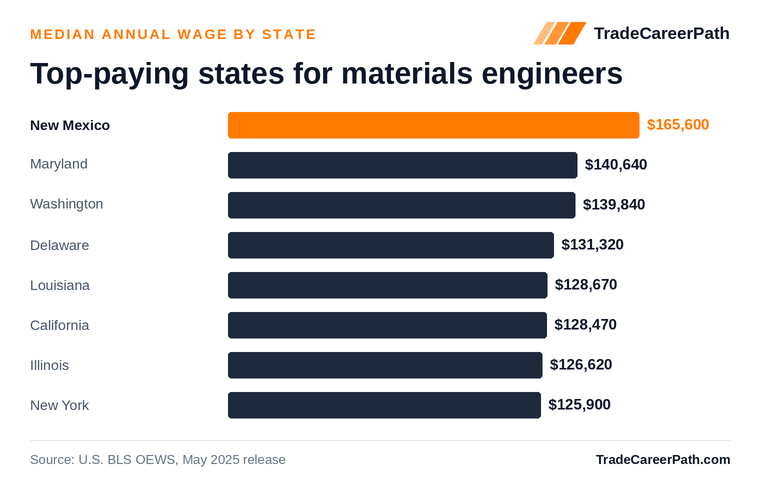
Pay for the degree role concentrates around energy, defense, and national-lab work. New Mexico tops the table on the strength of its national laboratories - welding engineers are more than three times as concentrated there as in the average state labor market.
| State | Median annual wage | Employment |
|---|---|---|
| New Mexico | $165,600 | 450 |
| Maryland | $140,640 | 740 |
| Washington | $139,840 | 1,000 |
| Delaware | $131,320 | 40 |
| Louisiana | $128,670 | 90 |
If you would rather not move, the jobs themselves cluster where heavy manufacturing does: California leads with 3,020 positions at a $128,470 median, Ohio has 1,790 at $106,510, and Texas 1,440 at $117,700 (BLS OEWS, May 2025). Ohio is worth a hard look for anyone already welding in the Midwest - the concentration of welding engineering work there is more than twice the national average, which means depth of employers, not just count of jobs.
What Transfers
AWS certifications and CWI experience carry direct weight with employers, and welding-technology associate credits commonly transfer into welding engineering technology bachelor’s programs.
Ask every program for a written transfer-credit evaluation before enrolling; it is free, and the difference between schools can be a full year of your life.
Two more levers worth pulling. Military welding and NDT training often converts to credit at transfer-friendly schools, so dig out the paperwork even if it is a decade old. And if your employer fabricates to code, ask about tuition assistance before you assume it does not exist - shops that employ welding engineers understand exactly what they are buying by funding one, and a welder who is halfway through the degree is the most cost-effective engineering hire they will ever make.
The Path, Step by Step
- Close the math gap first. Most working tradespeople start with algebra-to-calculus refreshers at a community college; cheap, online, and it de-risks the whole plan.
- Pick an accredited program built for working adults. ABET accreditation if you may ever want the PE license; evening, online, or hybrid formats.
- Submit everything for transfer credit. Apprenticeship records, certifications, military training, and old college credits.
- Keep working your trade. Your income funds the degree, and your daily work keeps compounding into exactly the experience employers want attached to the diploma.
- Move sideways before you graduate. Design-adjacent roles (drafting, field engineering, QA) often open to students partway through and convert to engineering titles at graduation.
Do You Need a PE License?
Mostly no. Welding engineers overwhelmingly work for manufacturers and fabricators, where the industrial exemption applies - the company holds design responsibility, so the individual engineer is not required to be licensed. Plenty of senior welding engineers never sit for the PE.
If you want it anyway - it helps for consulting, expert-witness work, and anything touching public infrastructure - the path is standard: ABET-accredited degree, pass the Fundamentals of Engineering (FE) exam (you can take it as a senior), four years of qualifying experience, then the PE exam per your state board’s rules. Your years under the hood do not count toward the experience requirement, but they make the metallurgy and process content of the exams noticeably easier.
The credentials that matter more day to day in this field come from AWS, not the state board. The CWI you may already hold keeps its value on the engineering side, and AWS also offers engineer-level certifications that some employers treat as a meaningful differentiator. If you are unsure whether to invest exam effort in the PE or the AWS ladder, look at the job postings in your target industry - shipyards, pipeline, and structural work lean AWS; consulting leans PE.
Job Outlook for 2026 and Beyond
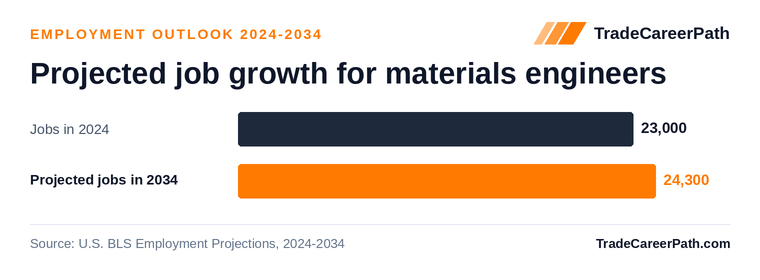
BLS projects employment of materials engineers - the category that includes welding engineers - to grow +7.5% from 2025 to 2035, from 23,800 to 25,600 jobs, with about 1,300 openings per year once retirements and occupation changes are counted (BLS Employment Projections, 2025-35). Pay is moving the right direction too: the 2024 median of $108,310 rose to $112,860 in the May 2025 OEWS data.
For a career changer, the openings number matters more than the growth rate. In an occupation of 22,770 people, 1,500 seats a year is steady turnover - and a large share of the outgoing cohort is retirement-age engineers taking decades of code knowledge with them. Employers replacing that experience are exactly the ones who value a candidate whose resume shows years of production welding underneath the degree.
If This Path Is Not Quite Right
Related jumps from the same starting point:
Or browse all trade careers that require a 4-year degree.
Frequently Asked Questions
Can a welder really work as a welding engineer?
Yes. The requirement is the accredited bachelor's degree; nothing about starting in the trade blocks the path, and employers consistently treat field experience as an advantage rather than a detour.
How long does it take while working full-time?
Typically five to six years part-time for the bachelor's, less with transfer credit. AWS certifications and CWI experience carry direct weight with employers, and welding-technology associate credits commonly transfer into welding engineering technology bachelor's programs.
What is the pay difference?
The national median is $53,750 for welders versus $112,860 for the degree role (BLS OEWS, May 2025), a difference of about $59,110 per year at the median.
Is the welding engineering degree hard?
It is math- and science-heavy: calculus, physics, metallurgy, and materials science are unavoidable. Working welders usually find the process and lab courses easier than fresh high-school graduates do, because the arc physics and distortion behavior describe things you have already watched happen under the hood. The math refresher up front is the real hurdle.
Should I get a welding engineering degree or a materials/mechanical engineering degree?
A dedicated welding engineering or welding engineering technology degree is the most direct route, but accredited programs are scarce. Materials or mechanical engineering with welding-focused coursework is a common alternative with far more program options - BLS classifies welding engineers under materials engineers (SOC 17-2131), and employers hire from both paths.
Can you train as a welding engineer without a degree?
Not with the engineer title at most employers - the accredited bachelor's is the screen. Without it, the realistic ceiling is CWI, welding supervisor, or QA/QC lead. Those are solid roles, and the certifications shorten the degree, but they do not replace it.
Do welding engineers need a PE license?
Usually no. Most welding engineers work for manufacturers under the industrial exemption, so the PE is optional. It matters for consulting and public-works sign-off; the path is the FE exam, four years of qualifying experience, then the PE exam. In this field, AWS credentials like the CWI often carry more day-to-day weight than the PE.
What is the job outlook for welding engineers?
BLS projects employment of materials engineers - the category that includes welding engineers - to grow +7.5% from 2025 to 2035, from 23,800 to 25,600 jobs, with about 1,300 openings per year on average (BLS Employment Projections, 2025-35).
Degree and Program Guides
- Which Engineering Degree Fits Your Trade - welding, materials and mechanical compared
Sources
- U.S. Bureau of Labor Statistics, Occupational Employment and Wage Statistics (OEWS), May 2025 - Materials Engineers (SOC 17-2131) and Welders, Cutters, Solderers, and Brazers
- U.S. Bureau of Labor Statistics, Employment Projections, 2025-35
- U.S. Bureau of Labor Statistics, Occupational Outlook Handbook - education and licensing requirements
Welder to Welding Engineer Salary by State
About this guide: Researched and written by the TradeCareerPath Editorial Team. Our editorial team researches and sources every trade school and career guide using federal labor and education data, including BLS OEWS and Employment Projections, DOL apprenticeship records, IPEDS, College Scorecard, and state licensing boards. We follow the editorial standards documented at /editorial-policy/.
Data sources
Figures on this page are sourced from the federal and state datasets below. Methodology: how we rank and source data.
| Data | Provider | Vintage |
|---|---|---|
| Occupational Employment and Wage Statistics (OEWS) | U.S. Bureau of Labor Statistics | May 2025 |
| Employment Projections | U.S. Bureau of Labor Statistics | 2025-2035 |
| Integrated Postsecondary Education Data System | National Center for Education Statistics (IPEDS) | 2024 |
| College Scorecard (school-level outcomes) | U.S. Department of Education | latest release |
| College Scorecard (field-of-study earnings) | U.S. Department of Education | latest release (updated 2026-06-12) |
| Occupational licensing requirements | CareerOneStop (U.S. Department of Labor) | latest release (updated 2026-02-22) |
| Registered apprenticeship programs | CareerOneStop / Apprenticeship.gov (U.S. Department of Labor) | latest release (updated 2025-10-25) |
| O*NET occupation profiles (skills, tasks, tools, job zones) | U.S. Department of Labor (O*NET / Employment & Training Admin.) | O*NET 31.0 (updated 2026-10-14) |