
How to Become a Welder in 2026
Is Welder Right for You?
The U.S. Department of Labor's O*NET profile for Welders, Cutters, Solderers, and Brazers (SOC 51-4121) describes the work this way: Use hand-welding, flame-cutting, hand-soldering, or brazing equipment to weld or join metal components or to fill holes, indentations, or seams of fabricated metal products.
What the work involves
- Operate safety equipment and use safe work habits.
- Examine workpieces for defects and measure workpieces with straightedges or templates to ensure conformance with specifications.
- Weld components in flat, vertical, or overhead positions.
- Detect faulty operation of equipment or defective materials and notify supervisors.
- Recognize, set up, and operate hand and power tools common to the welding trade, such as shielded metal arc and gas metal arc welding equipment.
Skills and knowledge that matter
Skills: Quality Control Analysis, Monitoring, Judgment and Decision Making, Critical Thinking, Time Management, Operations Monitoring.
Knowledge: Production and Processing, Mechanical, Mathematics, English Language.
Tools and technology you may use
Tools: Adjustable widemouth pliers, Adjustable wrenches, Air chisels, Air drills, Air scalers, Angle finders.
Technology: Enterprise resource planning ERP software, Computer aided design CAD software, Analytical or scientific software, Microsoft Excel, Microsoft Office software, Microsoft Outlook.
Typical preparation
O*NET Job Zone Two (Some Preparation Needed). These occupations usually require a high school diploma. Employees in these occupations need anywhere from a few months to one year of working with experienced employees. A recognized apprenticeship program may be associated with these occupations.
Interest fit
O*NET interest profile: Realistic, Conventional, Investigative. People who enjoy hands-on, practical work with tools, machines, plants, or materials often find this occupation a good fit.
Source: O*NET 29.1 (updated 2026-06-13)
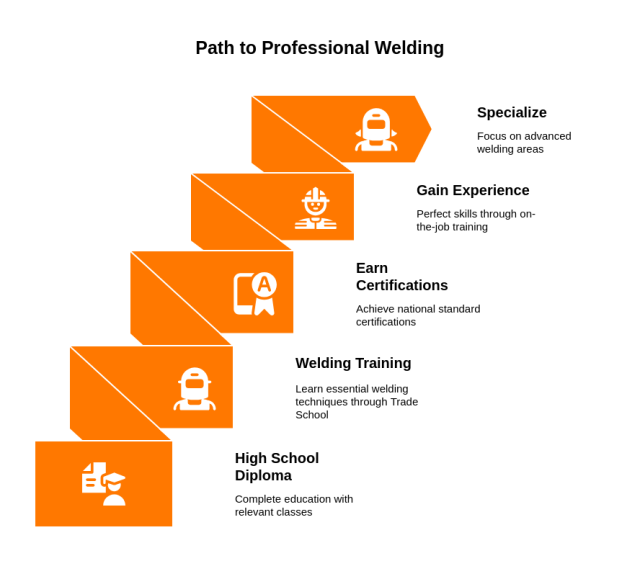
Quick answer: Training as a welder takes about 7 months to 2 years, depending on whether you choose a certificate, diploma, or apprenticeship. Training costs vary by program and school. There is no single national welding license, but employers usually want you to pass a hands-on certification test such as the AWS Certified Welder or NCCER Welding credential. Welders earn a median of $53,750 per year ($25.84/hour) (BLS, May 2025), with about 45,600 openings nationwide each year through 2034.
Welders use heat and electricity to join and shape the metal that holds bridges, ships, pipelines, and buildings together. If you like hands-on, precise work, it is a skilled trade you can enter without a four-year degree.
How to Become a Welder
Training as a welder generally takes 7 months to 2 years, depending on your path and how much you specialize.
1. Finish High School or Earn a GED
A high school diploma or GED is the standard starting point for welding programs and apprenticeships. Focus on classes that carry over directly to the trade: math for measurements and angles, shop for tool handling, and mechanical drawing for reading prints. Physics and chemistry help you understand how metals behave under heat. If your school has a welding or metalworking elective, take it, since even basic torch time gives you a feel for the work before you commit to a full program. Strong reading skills matter too, because welders constantly interpret blueprints, weld symbols, and written procedures. Use this stage to confirm that you enjoy working with your hands and do not mind heat, sparks, and protective gear, since those conditions are part of the job every day.
2. Complete a Welding Training Program
Enroll in a certificate, diploma, or associate program at a trade school or community college. These programs mix classroom theory with supervised lab time so you build real welding skill, not just knowledge. Expect to practice the main processes: MIG (gas metal arc), TIG (gas tungsten arc), Stick (shielded metal arc), and Flux-core. You will also learn blueprint and weld-symbol reading, metallurgy basics, joint design, and shop safety, including how to protect your eyes, lungs, and skin. NCCER builds standardized welding curricula many schools follow, so ask whether a program aligns with NCCER or AWS standards. Hands-on lab hours are the most valuable part, so look for programs with enough booth time and a low student-to-instructor ratio. A certificate or diploma signals to employers that you have covered the fundamentals and are ready for entry-level work.
3. Build Hands-On Experience
Welding rewards repetition, so the goal after training is to log real hours on real parts. Many welders start as apprentices, helpers, or entry-level production welders, working under experienced welders who can correct technique before bad habits set in. Apprenticeships are especially valuable because they pay you while you learn and often combine on-the-job work with classroom instruction. On the floor you will refine consistency, speed, and the ability to weld in different positions, flat, horizontal, vertical, and overhead, which is exactly what certification tests measure. Keep a record of the processes, materials, and positions you have worked with, since employers and inspectors care about that range. Treat every assignment as practice for the certifications you will pursue next, and ask experienced welders for feedback on your weld quality and cleanup.
4. Earn Welding Certifications
Certifications prove to employers that you can produce sound welds on specific processes and positions. The American Welding Society (AWS) issues the Certified Welder (CW) credential through performance tests, plus the Certified Welding Inspector (CWI) for those who move into inspection. NCCER offers a nationally recognized Welding certification tied to its curriculum. For code work, the American Society of Mechanical Engineers (ASME) publishes the Boiler and Pressure Vessel Code that governs welding qualifications, and the American Petroleum Institute (API) certifies welders for pipeline and refinery work through API 1104. There is no single national license; the credentials you need depend on your employer, the project, and the state. Many tests are job-specific and may need to be renewed or re-qualified, so confirm exactly what your target employers require before you sit for an exam.
5. Find a Job and Specialize
With training and at least one certification in hand, apply to fabrication shops, construction firms, manufacturers, shipyards, and pipeline contractors. A short portfolio of clean weld samples and a clear list of the processes and positions you can certify on will help you stand out. Once you are working, specialization is how you raise your pay and job security. Welders commonly move into pipe welding, structural work, aerospace or high-precision fabrication, or quality and inspection roles. Some pursue the AWS Certified Welding Inspector path, take on supervisory and training positions, or eventually run their own shop. Keep stacking certifications that match where you want to go, since each new qualified process or code opens up higher-skill, better-paying work.
What Welders Do
Welders use heat and electricity to fuse metal parts together. Their work is essential in manufacturing, construction, and repair settings where precision and safety are critical.
Common Duties
- Read blueprints and technical drawings
- Set up and maintain welding tools and materials
- Operate MIG, TIG, Stick, or Flux-core welding systems
- Inspect welds for quality standards
- Work safely around high temperatures and equipment
Welding is both a craft and a science. It requires focus, control, and dedication to quality.
Core Skills for Welding Success
- Steady hand and strong attention to detail
- Mechanical aptitude and spatial awareness
- Ability to follow blueprints and procedures
- Physical stamina and safety awareness
- Comfort working in varied environments
Typical Work Environments
Welders work in diverse industries and locations, including:
- Construction and infrastructure projects
- Manufacturing and fabrication facilities
- Automotive and aerospace production
- Shipyards and marine repair
- Energy and utility systems
State Welding Requirements
Each state has its own approach to welding qualifications. Some rely on employer-based performance tests, while others reference national standards.
| State | Guide |
|---|---|
| Texas | Welding in Texas |
| Florida | Welding in Florida |
| California | Welding in California |
Explore welding requirements by state
Education and Certification Options
| Pathway | Typical Duration | Outcome |
|---|---|---|
| Certificate or Diploma | 6-18 months | Entry-level readiness |
| Associate Degree | 2 years | Broader technical understanding |
| Apprenticeship | 3-4 years | Paid hands-on training |
| Advanced Certification | Varies | Specialized credentials |
Career Development and Growth
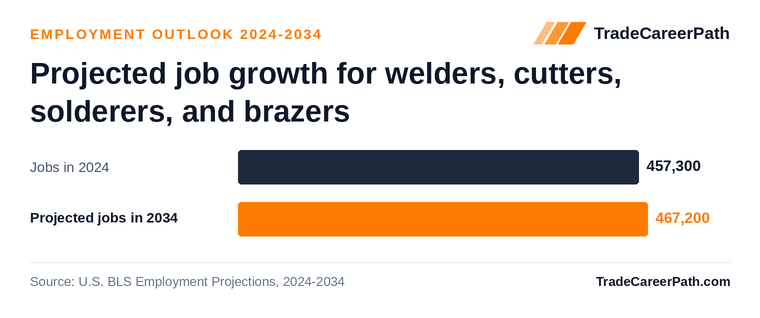
Welding offers long-term potential for growth as your technical skill increases. With experience, welders may qualify for:
- Quality Assurance or Inspection roles
- Fabrication Supervision or Training positions
- Specialized Welding in high-precision industries
The welding trade evolves constantly with technology. Continuous learning helps you stay competitive.
Training Duration and Cost Overview
- Training Timeframe: typically 6 months to 2 years
- Program Type: certificate, diploma, or associate degree
- Additional Credentials: AWS or NCCER certifications
Costs and schedules vary by school and program type. Check each provider for details about available formats and requirements.
Pros and Considerations
Highlights
- Hands-on, results-driven work
- Training available in as little as a year
- Strong demand across multiple industries
- Clear technical skill progression
Considerations
- Physically active and detail-focused work
- Requires adherence to safety standards
- Work environments can vary by project
- Ongoing certification renewals may apply
Quick Facts: Welding Training, Skills, and Industry Outlook
Industry Organizations & Certifying Bodies
These are the recognized national organizations, unions, certifying bodies, and regulatory authorities that shape this trade. They issue the credentials, sponsor the apprenticeships, publish the codes, and represent workers and employers.
- American Welding Society (AWS) Issues Certified Welder (CW), Certified Welding Inspector (CWI), and other industry-standard credentials.
- NCCER (National Center for Construction Education and Research) Develops welding curricula and the NCCER Welding certification.
- American Society of Mechanical Engineers (ASME) Publishes the Boiler and Pressure Vessel Code that governs welding qualifications for code work.
- American Petroleum Institute (API) Certifies welders for pipeline and refinery work (API 1104).
Wage and Employment Charts
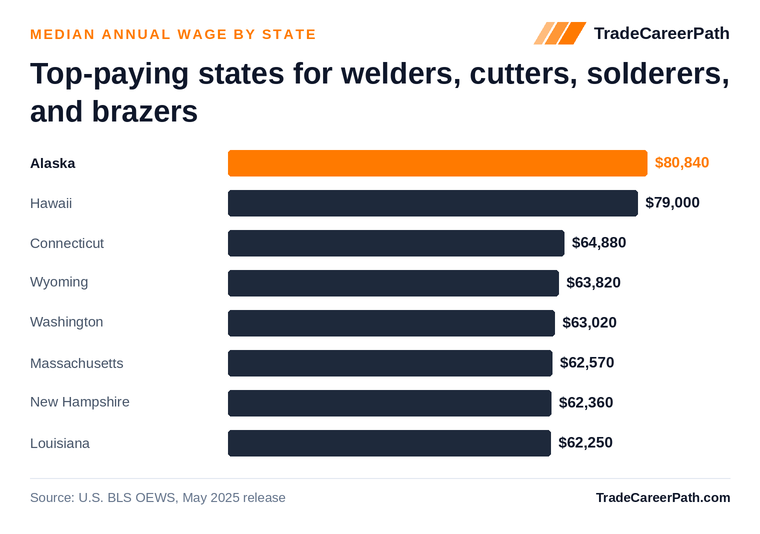
Welder Salary and Requirements by State
Select your state for local wage data, training options, and requirements:
Alabama · Alaska · Arizona · Arkansas · California · Colorado · Connecticut · Delaware · District of Columbia · Florida · Georgia · Hawaii · Idaho · Illinois · Indiana · Iowa · Kansas · Kentucky · Louisiana · Maine · Maryland · Massachusetts · Michigan · Minnesota · Mississippi · Missouri · Montana · Nebraska · Nevada · New Hampshire · New Jersey · New Mexico · New York · North Carolina · North Dakota · Ohio · Oklahoma · Oregon · Pennsylvania · Rhode Island · South Carolina · South Dakota · Tennessee · Texas · Utah · Vermont · Virginia · Washington · West Virginia · Wisconsin · Wyoming
Find Welding Training Near You
Workplace Safety Snapshot
BLS Survey of Occupational Injuries and Illnesses data (2023-2024) report approximately 69.9 days-away, restricted, or transfer cases per 10,000 full-time-equivalent workers in welders, cutters, solderers, and brazers (about 0.70 per 100 FTE). Source: BLS Survey of Occupational Injuries and Illnesses, Table R98.
Frequently Asked Questions
How long does welder training take?
Most people are job-ready in 7 months to 2 years. A certificate or diploma program at a trade school or community college can take 7 months to about 18 months, while an apprenticeship runs longer because it combines paid work with classroom hours. A high school diploma or GED is the usual starting point.
Do you need a college degree to work as a welder?
No. A college degree is not required. Most welders enter the field through a certificate or diploma program at a trade school or community college, or through an apprenticeship. A high school diploma or GED is typically the only educational prerequisite.
How much does welding training cost?
Costs vary widely by program type, school, and location. Certificate programs, associate degrees, and apprenticeships all carry different price tags, and apprenticeships often pay you while you learn. Check directly with each school for current tuition and fees.
Do welders need to be certified or licensed?
There is no single national welding license. Many employers ask welders to pass a hands-on certification test tied to the work they do, such as the American Welding Society (AWS) Certified Welder, NCCER Welding, ASME code qualifications, or API 1104 for pipeline work. Requirements depend on the employer, the project, and the state.
Is welding hard to learn?
Welding takes a steady hand, good attention to detail, and a lot of practice to do well, but the basics are learnable in a structured program. Most of the difficulty comes from building speed, consistency, and the ability to pass certification tests on specific processes and positions.
How much do welders make?
Welders earn a median of $53,750 per year, or about $25.84 per hour (BLS, May 2025). The lowest 10 percent earn around $39,240 and the highest 10 percent earn around $77,530. Pay varies by specialty, certifications, industry, and location.
Can you train as a welder online?
Welding is a hands-on skill, so you cannot fully learn it online. Some programs offer online coursework for theory, blueprint reading, and safety, but you still need in-person lab time and supervised practice to build and certify your welding skills.
How Welder Pay Compares to Similar Trades
Side-by-side comparison of Welding and the closest related careers, based on U.S. Bureau of Labor Statistics data (May 2025 OEWS + 2024-2034 Employment Projections).
| Career | Median Pay | 10-Year Growth | Annual Openings |
|---|---|---|---|
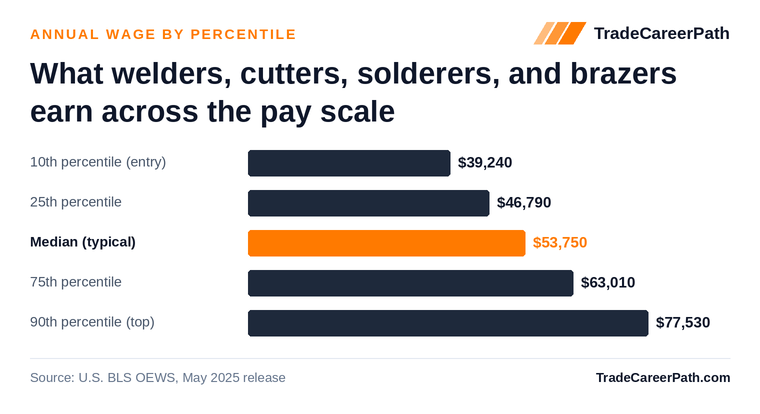
| Welding this guide | $53,750 | +2.2% | 45,600 |
| CNC Machinist | $58,750 | - | 29,500 |
| Gunsmith / Firearms Technician | $68,990 | +2.0% | 1,000 |
| Construction Worker | $47,120 | +7.3% | 129,400 |
| Heavy Equipment Operator | $59,850 | +3.6% | 41,900 |
Source: BLS Occupational Employment and Wage Statistics + BLS Employment Projections.
Advance Your Career with a Degree
Experienced Welder professionals often step up into degree-track careers where field experience is a hiring advantage:
- Health and Safety Engineer - median pay $115,160 (BLS OEWS, May 2025); requires a 4-year degree
- Industrial Engineer - median pay $102,440 (BLS OEWS, May 2025); requires a 4-year degree
- Welding Engineer - median pay $112,860 (BLS OEWS, May 2025); requires a 4-year degree
- Industrial Production Manager - median pay $126,060 (BLS OEWS, May 2025); requires a 4-year degree
- Marine Engineer - median pay $112,230 (BLS OEWS, May 2025); requires a 4-year degree
- Petroleum Engineer - median pay $144,910 (BLS OEWS, May 2025); requires a 4-year degree
- Agricultural Engineer - median pay $98,590 (BLS OEWS, May 2025); requires a 4-year degree
- CTE Teacher (Shop Teacher) - median pay $66,270 (BLS OEWS, May 2025); requires a 4-year degree
- Chemical Engineer - median pay $125,040 (BLS OEWS, May 2025); requires a 4-year degree
- Geoscientist - median pay $101,920 (BLS OEWS, May 2025); requires a 4-year degree
- Nuclear Engineer - median pay $133,970 (BLS OEWS, May 2025); requires a 4-year degree
- Mining Engineer - median pay $106,220 (BLS OEWS, May 2025); requires a 4-year degree
- Merchant Marine Officer - median pay $92,460 (BLS OEWS, May 2025); requires a 4-year degree
- Welder to welding engineer - what your hood time is worth
See all trade careers that require a 4-year degree.
Degree and Program Guides
- Which Engineering Degree Fits Your Trade - where welding experience leads with a degree
Sources
- U.S. Bureau of Labor Statistics, Occupational Employment and Wage Statistics (May 2025)
- U.S. Bureau of Labor Statistics, Employment Projections 2024-2034
- U.S. Bureau of Labor Statistics, Survey of Occupational Injuries and Illnesses (2023-2024, Table R98)
- U.S. Department of Labor, Wage and Hour Division, Davis-Bacon General Wage Determinations (2026)
Welder Salary by State
About this guide: Researched and written by the TradeCareerPath Editorial Team. Our editorial team researches and sources every trade school and career guide using federal labor and education data, including BLS OEWS and Employment Projections, DOL apprenticeship records, IPEDS, College Scorecard, and state licensing boards. We follow the editorial standards documented at /editorial-policy/.
Data sources
Figures on this page are sourced from the federal and state datasets below. Methodology: how we rank and source data.
| Data | Provider | Vintage |
|---|---|---|
| Occupational Employment and Wage Statistics (OEWS) | U.S. Bureau of Labor Statistics | May 2025 |
| Employment Projections | U.S. Bureau of Labor Statistics | 2024-2034 |
| Integrated Postsecondary Education Data System | National Center for Education Statistics (IPEDS) | 2024 |
| College Scorecard (school-level outcomes) | U.S. Department of Education | latest release |
| College Scorecard (field-of-study earnings) | U.S. Department of Education | latest release (updated 2026-06-12) |
| Occupational licensing requirements | CareerOneStop (U.S. Department of Labor) | latest release (updated 2026-02-22) |
| Registered apprenticeship programs | CareerOneStop / Apprenticeship.gov (U.S. Department of Labor) | latest release (updated 2025-10-25) |
| O*NET occupation profiles (skills, tasks, tools, job zones) | U.S. Department of Labor (O*NET / Employment & Training Admin.) | O*NET 29.1 (updated 2026-06-13) |