
How to Become a Welding Engineer in 2026
Is Welding Engineer Right for You?
The U.S. Department of Labor's O*NET profile for Materials Engineers (SOC 17-2131) describes the work this way: Evaluate materials and develop machinery and processes to manufacture materials for use in products that must meet specialized design and performance specifications. Develop new uses for known materials. Includes those engineers working with composite materials or specializing in one type of material, such as graphite, metal and metal alloys, ceramics and glass, plastics and polymers, and naturally occurring materials. Includes metallurgists and metallurgical engineers, ceramic engineers, and welding engineers.
What the work involves
- Conduct or supervise tests on raw materials or finished products to ensure their quality.
- Review new product plans, and make recommendations for material selection, based on design objectives such as strength, weight, heat resistance, electrical conductivity, and cost.
- Evaluate technical specifications and economic factors relating to process or product design objectives.
- Solve problems in a number of engineering fields, such as mechanical, chemical, electrical, civil, nuclear, and aerospace.
- Plan and implement laboratory operations to develop material and fabrication procedures that meet cost, product specification, and performance standards.
Skills and knowledge that matter
Skills: Reading Comprehension, Active Listening, Writing, Speaking, Mathematics, Science.
Knowledge: Engineering and Technology, Mathematics, Production and Processing, Physics.
Tools and technology you may use
Technology: Analytical or scientific software, Computer aided design CAD software, Object or component oriented development software, Autodesk AutoCAD, C++, Dassault Systemes SolidWorks.
Typical preparation
O*NET Job Zone Four (Considerable Preparation Needed). Most of these occupations require a four-year bachelor's degree, but some do not. Employees in these occupations usually need several years of work-related experience, on-the-job training, and/or vocational training.
Interest fit
O*NET interest profile: Realistic, Investigative, Conventional. People who enjoy hands-on, practical work with tools, machines, plants, or materials often find this occupation a good fit.
Source: O*NET 31.0 (updated 2026-10-14)
Quick answer: Training as a welding engineer requires a 4-year degree - typically a Bachelor’s in welding engineering, materials science, or metallurgical engineering. The national median pay is $112,860 per year, and BLS projects +7.5% employment change from 2025 to 2035 (BLS OEWS, May 2025; BLS Employment Projections, 2025-35).
Welding Engineer at a Glance
| Metric | Detail | Source |
|---|---|---|
| Median annual wage | $112,860 | BLS OEWS, May 2025 |
| Typical wage range | $72,300 (10th pct) - $175,720 (90th pct) | BLS OEWS, May 2025 |
| Employment | 22,770 nationwide | BLS OEWS, May 2025 |
| Projected growth (2025-35) | +7.5%, about 1,300 openings per year | BLS Employment Projections, 2025-35 |
| Typical education | Bachelor’s in welding engineering, materials science, or metallurgical engineering | BLS Occupational Outlook Handbook |
| License / certification | CWEng/CWI certifications (AWS) valued; PE for some roles | State licensing boards |
What Does a Welding Engineer Do?
Welding engineers own the engineering decisions behind every weld a shop or field crew makes: they specify processes and filler metals, write and qualify weld procedures (WPS/PQR), qualify the welders themselves, and solve the metallurgy problems that show up as cracking, distortion, and failed inspections. BLS classifies them under materials engineers (SOC 17-2131), and the wage data on this page is for that category - welding-specific roles cluster in energy, heavy fabrication, shipbuilding, and pressure-vessel work.
Day to day, the work splits by sub-specialty. A procedure engineer at a fabricator develops and qualifies WPSs against AWS D1.1 or ASME Section IX, runs mechanical tests on coupons, and dispositions the nonconformances QA sends up. A pipeline or pressure-vessel engineer selects preheat and interpass limits for high-strength or chrome-moly steels, reviews NDT results, and decides whether a repair procedure keeps the joint code-compliant. A manufacturing-side welding engineer works on automation and robotic cells - fixturing, parameters, and first-article qualification - while a failure analyst sections broken welds, reads the fracture surfaces, and writes the report that says why it cracked and what changes. Nearly all of it is documented, code-referenced, and traceable, because on pressure boundaries and structural steel a bad weld decision is a safety event.
If you are coming off the hood, the shortest way to say it: the welder executes the procedure; the welding engineer decides what the procedure must be and proves it works. The variables you already manage by feel - amperage, travel speed, joint fit-up, heat input - work as numbers you set, justify, and defend in a qualification package. That is exactly why hood time matters so much in this job: engineers who have never run a bead write procedures that fail in the field, and shops know it.
Skills That Make a Great Welding Engineer
- Weld metallurgy, heat treatment, and heat-input control
- WPS/PQR development and welder qualification
- NDT methods (VT, UT, RT, PT/MT) and acceptance criteria
- AWS D1.1 and ASME Section IX code fluency
- Failure analysis and fractography
- Robotic and automated welding process development
- Writing: procedures, qualification packages, and disposition reports carry the job
Welding Engineer Salary
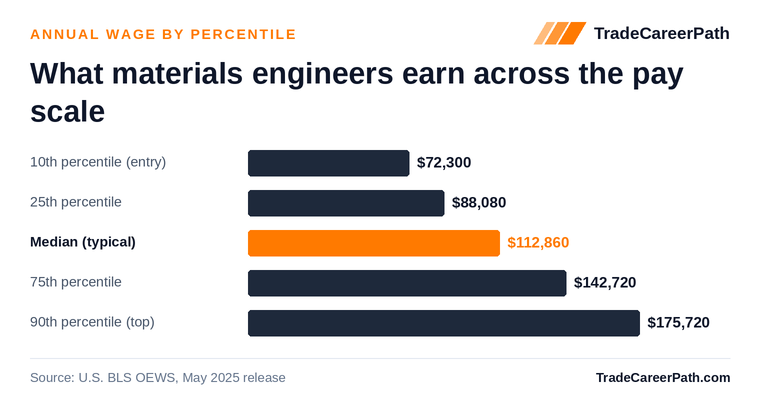
Welding engineering is one of the highest-paying destinations a welding career can lead to. The national median for materials engineers is $112,860 per year, and even the 10th percentile - roughly where new graduates start - is $72,300, comparable to what many experienced welders top out at. The 75th percentile is $142,720, and the 90th percentile reaches $175,720 (BLS OEWS, May 2025). Welding-specific roles in oil and gas, nuclear, and code-shop consulting frequently sit in that upper band.
Where the Jobs and the Money Are
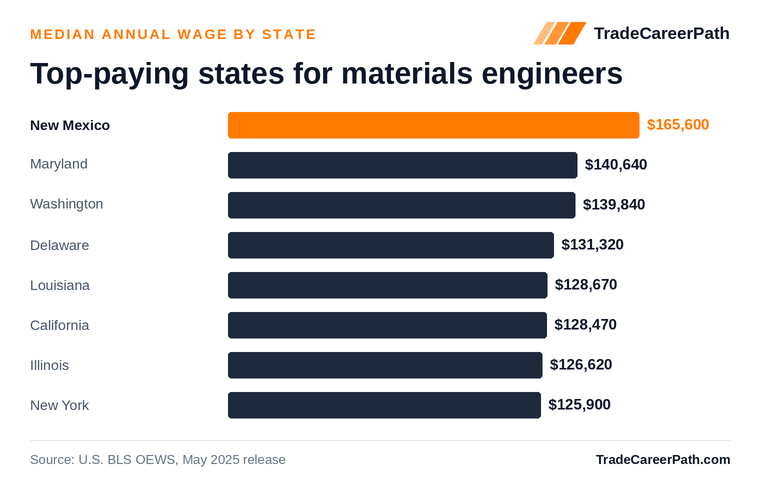
Materials engineering employment follows heavy industry and research: the largest single cluster - about 3,020 engineers - is in California, with Ohio (1,790) and Texas (1,440) next, tracking manufacturing, energy, and fabrication work (BLS OEWS, May 2025). The pay leaders are a different list:
| State | Median annual wage | Employment |
|---|---|---|
| New Mexico | $165,600 | 450 |
| Maryland | $140,640 | 740 |
| Washington | $139,840 | 1,000 |
| Delaware | $131,320 | 40 |
| Louisiana | $128,670 | 90 |
New Mexico’s eye-catching median rides on national-lab and defense research work - materials engineers are more than three times as concentrated there as in the average state labor market. Ohio is the opposite kind of hub: pay near the national median, but a concentration more than twice the national average, which means a deep manufacturing job market where you can change employers without moving. Washington and Maryland stand out on both counts, with concentrations nearly double the average state’s.
How to Become a Welding Engineer
1. Earn a bachelor’s degree
Welding engineering (a handful of dedicated programs exist), materials science, or metallurgical engineering. Because true welding engineering programs are scarce, most working welders take the materials science or welding engineering technology route - both are hired into welding engineer roles. Check ABET accreditation before enrolling: employers screen for it, and the FE/PE licensure path assumes it. For someone working full-time, welding engineering technology programs are often the most online-friendly option.
2. Keep your hood time
Field welding experience is what separates welding engineers who write workable procedures from those who don’t. Do not treat your welding years as something the degree replaces - treat them as the asset that makes you a better hire than the 22-year-old graduate. Keep welding while you study if you can: every process you have run, every code job you have passed, and every repair you have made becomes credibility when you are qualifying welders and defending procedures later.
3. Add AWS credentials
CWI (Certified Welding Inspector) and later CWEng formalize the expertise. The CWI is worth pursuing before or during the degree - it pays immediately as an inspector, it teaches code navigation cold, and a CWI-plus-degree resume is close to a guaranteed interview in fabrication and energy. The CWEng (Certified Welding Engineer) comes after the degree and cements the specialist title.
4. Start in procedure development or QA
Fabricators, energy companies, and shipyards hire at the bachelor’s level. Procedure development, weld QA, and liaison roles - the desk that dispositions shop nonconformances - are the classic entry points for former welders, because the job is judging real weldments rather than working purely from theory. Structural steel shops, pipeline contractors, pressure-vessel manufacturers, and defense shipyards all run these seats.
5. Advance
Senior welding engineer, QA manager, or consulting on code work (ASME, AWS D1.1). The fork comes with experience: deepen into a technical authority - the person a company or code committee calls on cracking problems - or take the management track toward QA or engineering leadership. Independent code consulting is a realistic endgame for welding engineers with a CWI/SCWI history and a network in energy or heavy fab.
Career Ladder: Titles and Realistic Pay
The BLS wage percentiles map cleanly onto how this career actually progresses. Use this as a sanity check on offers, not a guarantee:
| Stage | Typical titles | Years in | Realistic pay (BLS OEWS, May 2025) |
|---|---|---|---|
| Entry level | Associate welding engineer, weld QA engineer, procedure engineer | 0-3 | ~$72,300-$88,080 (10th-25th pct) |
| Mid-career | Welding engineer, materials/process engineer | 3-10 | ~$112,860 (median) |
| Senior | Senior welding engineer, principal metallurgist, QA manager | 10-15 | ~$142,720 (75th pct) |
| Principal / consulting | Chief welding engineer, SCWI/CWEng consultant, code specialist | 15+ | $175,720+ (90th pct) |
Two notes for career changers. First, hood time compresses this ladder: former welders with a CWI are routinely hired above the bottom of the entry band because they need no supervision around real weldments and can qualify welders on day one. Second, the top band understates what code consultants earn - independent SCWI/CWEng specialists billing on ASME and D1.1 work are paid by the day, and their income is not captured in salaried wage data.
Do You Need a PE License?
Mostly no. Welding engineers at fabricators, manufacturers, and energy companies work under the “industrial exemption” - the company, not the individual engineer, holds design responsibility, so most never license. In this field the credentials that actually gate pay and authority are AWS credentials:
- CWI / SCWI (Certified / Senior Certified Welding Inspector): the inspection credential the whole industry recognizes; the SCWI marks senior code authority.
- CWEng (Certified Welding Engineer): the AWS engineering credential that formalizes the specialist title.
If you want the PE anyway - it helps in consulting, structural work, and anything with public-infrastructure sign-off - the path is the standard one: ABET degree, pass the Fundamentals of Engineering (FE) exam (you can sit for it as a senior), four years of qualifying experience, then the PE exam, per your state board’s rules.
Why an Online Degree Works for This Career
This is the welder’s degree path, full stop. A certified welder with a welding engineering or materials science bachelor’s is one of the most employable combinations in heavy industry - and AWS CWI experience counts double alongside it. Online materials and welding engineering technology programs serve working welders specifically, and employer tuition assistance is common at fabricators, utilities, and energy companies - many welders finish the degree with most of the tuition covered, without giving up their book time or their seniority.
Job Outlook for 2026 and Beyond
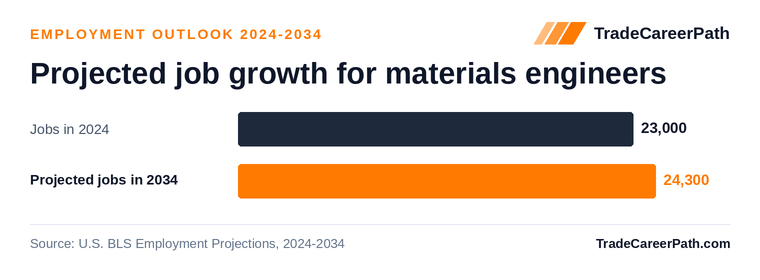
BLS projects materials engineering employment to grow +7.5% from 2025 to 2035 - from 23,800 to 25,600 jobs - with about 1,300 openings per year once retirements and occupation changes are counted (BLS Employment Projections, 2025-35). The latest wage data (OEWS, May 2025) puts the median at $112,860, up meaningfully from the 2024 figure of $108,310 - pay in this field is rising, not just holding.
For career changers, the openings figure is the number that matters: 1,300 seats a year in a 22,770-person occupation means steady, if not explosive, hiring - and the pool of candidates who can both do the metallurgy and read a weld is small. Energy transition work (pipelines, pressure vessels, nuclear), an aging inspector workforce, and reshored heavy fabrication all keep demand for weld-literate engineers firm.
Cost and Time to Complete the Degree
For welding engineers, the credential is: Bachelor’s in welding engineering, materials science, or metallurgical engineering. A bachelor’s degree is typically 120 credit hours: four years full-time, and commonly five to six years part-time while working. Transfer credit is the other lever: prior college, military training, apprenticeship coursework, and industry certifications can be worth meaningful credit at transfer-friendly schools, so get a written transfer evaluation before enrolling anywhere. Costs vary widely by school type; in-state public online programs are usually the value benchmark, and employer tuition assistance is common for working adults in this field.
Pros and Cons of Training as a Welding Engineer
Pros
- Median pay of $112,860 nationally (BLS OEWS, May 2025)
- BLS projects +7.5% employment growth through 2035
- Field experience from the trades is a genuine hiring advantage
- Accredited online and hybrid degree paths exist for working adults
Cons
- Requires a 4-year degree (typically 120 credit hours)
- Entry-level pay starts near $72,300 at the 10th percentile
- Licensing hurdle: CWEng/CWI certifications (AWS) valued; PE for some roles
Frequently Asked Questions
Is welding engineer a real degree path for welders?
Yes - it is the canonical trade-to-engineer jump. BLS groups welding engineers under materials engineers (SOC 17-2131); the median for that category is shown above, and welding-specific roles in energy and heavy fabrication frequently pay at the upper end.
How much do welding engineers make?
The national median annual wage for materials engineers is $112,860 (BLS OEWS, May 2025). The top 10% earn $175,720 or more, while entry-level pay starts around $72,300.
What is the job outlook for welding engineers?
BLS projects employment of materials engineers to change by +7.5% from 2025 to 2035 (BLS Employment Projections, 2025-35).
How long does welding engineer training take?
The bachelor's degree is typically 120 credit hours: four years full-time, commonly five to six years part-time while working. Transfer credit from prior college, military training, or apprenticeship coursework can meaningfully shorten it at transfer-friendly schools, and AWS certifications sometimes earn credit too.
Is welding engineering hard?
The degree is math- and chemistry-heavy - metallurgy, thermodynamics, and materials science are unavoidable. Working welders usually find the process and fabrication courses far easier than fresh high-school graduates do, because the theory maps directly onto arcs, distortion, and cracking you have already seen under the hood.
Should I get a welding engineering or materials science degree?
Dedicated welding engineering programs are rare, so most working welders choose materials science, metallurgical engineering, or a welding engineering technology bachelor's - all three are hired into welding engineer roles. Materials science keeps the widest doors open outside welding; a welding engineering technology degree is often the most online-friendly for someone working full-time.
Can you train as a welding engineer without a degree?
Not with the engineer title at most employers - the bachelor's is the requirement. Without it, the realistic ceiling is CWI (Certified Welding Inspector), welding technician, or QA supervisor. Field experience plus a CWI shortens and strengthens the degree path, but does not replace it.
Do welding engineers need a PE license?
Usually no - most work for manufacturers and fabricators under the industrial exemption, so the company holds design responsibility. AWS credentials (CWI, SCWI, CWEng) carry more weight in this field. The PE matters mainly for consulting and public-infrastructure sign-off; the path is the FE exam, four years of qualifying experience, then the PE exam.
Welding Engineer Salary and Requirements by State
Alabama · Alaska · Arizona · Arkansas · California · Colorado · Connecticut · Delaware · Florida · Georgia · Idaho · Illinois · Indiana · Iowa · Kansas · Kentucky · Louisiana · Maine · Maryland · Massachusetts · Michigan · Minnesota · Mississippi · Missouri · Montana · Nebraska · Nevada · New Hampshire · New Jersey · New Mexico · New York · North Carolina · Ohio · Oklahoma · Oregon · Pennsylvania · Rhode Island · South Carolina · Tennessee · Texas · Utah · Virginia · Washington · Wisconsin · Wyoming
Related Careers and Degree Paths
- Welder to Welding Engineer - the step-by-step bridge path from the hood to the title
- Welder - the feeder trade this page is built for
- Mechanical Engineer - the broader engineering degree that also covers fabrication and design work
- Industrial Engineer - the process-and-production side of the same shops
- Online Engineering Degrees for Tradespeople - how to pick an accredited program that fits a work schedule
Degree and Program Guides
- Which Engineering Degree Fits Your Trade - how welding maps to materials and mechanical programs
Sources
- U.S. Bureau of Labor Statistics, Occupational Employment and Wage Statistics (OEWS), May 2025 - Materials Engineers (SOC 17-2131)
- U.S. Bureau of Labor Statistics, Employment Projections, 2025-35
- U.S. Bureau of Labor Statistics, Occupational Outlook Handbook - education and licensing requirements
Welding Engineer Salary by State
About this guide: Researched and written by the TradeCareerPath Editorial Team. Our editorial team researches and sources every trade school and career guide using federal labor and education data, including BLS OEWS and Employment Projections, DOL apprenticeship records, IPEDS, College Scorecard, and state licensing boards. We follow the editorial standards documented at /editorial-policy/.
Data sources
Figures on this page are sourced from the federal and state datasets below. Methodology: how we rank and source data.
| Data | Provider | Vintage |
|---|---|---|
| Occupational Employment and Wage Statistics (OEWS) | U.S. Bureau of Labor Statistics | May 2025 |
| Employment Projections | U.S. Bureau of Labor Statistics | 2025-2035 |
| Integrated Postsecondary Education Data System | National Center for Education Statistics (IPEDS) | 2024 |
| College Scorecard (school-level outcomes) | U.S. Department of Education | latest release |
| College Scorecard (field-of-study earnings) | U.S. Department of Education | latest release (updated 2026-06-12) |
| Occupational licensing requirements | CareerOneStop (U.S. Department of Labor) | latest release (updated 2026-02-22) |
| Registered apprenticeship programs | CareerOneStop / Apprenticeship.gov (U.S. Department of Labor) | latest release (updated 2025-10-25) |
| O*NET occupation profiles (skills, tasks, tools, job zones) | U.S. Department of Labor (O*NET / Employment & Training Admin.) | O*NET 31.0 (updated 2026-10-14) |