
How to Become a Wind Turbine Technician in 2026
Is Wind Turbine Technician Right for You?
The U.S. Department of Labor's O*NET profile for Wind Turbine Service Technicians (SOC 49-9081) describes the work this way: Inspect, diagnose, adjust, or repair wind turbines. Perform maintenance on wind turbine equipment including resolving electrical, mechanical, and hydraulic malfunctions.
What the work involves
- Troubleshoot or repair mechanical, hydraulic, or electrical malfunctions related to variable pitch systems, variable speed control systems, converter systems, or related components.
- Perform routine maintenance on wind turbine equipment, underground transmission systems, wind fields substations, or fiber optic sensing and control systems.
- Diagnose problems involving wind turbine generators or control systems.
- Test electrical components of wind systems with devices, such as voltage testers, multimeters, oscilloscopes, infrared testers, or fiber optic equipment.
- Start or restart wind turbine generator systems to ensure proper operations.
Skills and knowledge that matter
Skills: Operations Monitoring, Equipment Maintenance, Troubleshooting, Repairing, Critical Thinking, Reading Comprehension.
Knowledge: Mechanical, Computers and Electronics, English Language, Public Safety and Security.
Tools and technology you may use
Technology: Analytical or scientific software, Facilities management software, Enterprise resource planning ERP software, Microsoft Access, Microsoft Excel, Microsoft Office software.
Typical preparation
O*NET Job Zone Three (Medium Preparation Needed). Most occupations in this zone require training in vocational schools, related on-the-job experience, or an associate's degree. Employees in these occupations usually need one or two years of training involving both on-the-job experience and informal training with experienced workers. A recognized apprenticeship program may be associated with these occupations.
Interest fit
O*NET interest profile: Realistic, Conventional, Investigative. People who enjoy hands-on, practical work with tools, machines, plants, or materials often find this occupation a good fit.
Source: O*NET 31.0 (updated 2026-10-14)
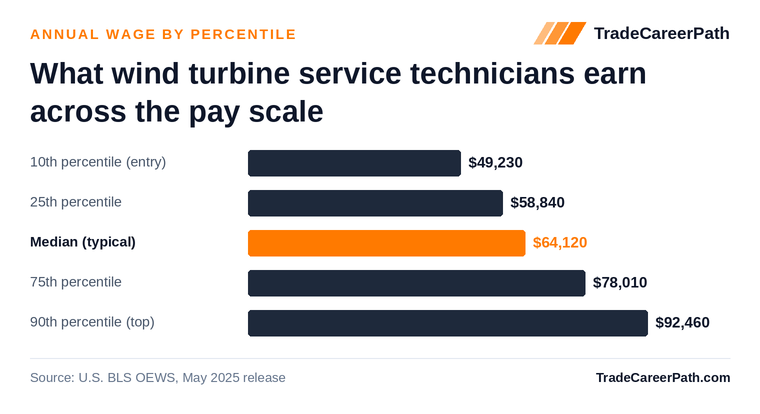
Quick answer: Training as a wind turbine technician usually takes 6 months to 2 years. You complete a certificate or associate degree in wind energy technology, earn safety credentials such as the Global Wind Organisation (GWO) Basic Safety Training, OSHA, and first aid or CPR, then build skills through paid on-the-job training. No four-year degree is required and there is no single national license. The median wind turbine technician salary is $64,120 per year ($30.83/hour), and employers post about 1,500 openings nationwide each year (BLS, May 2025).
Wind turbine technicians keep wind turbines running by inspecting, troubleshooting, and repairing their mechanical, electrical, and hydraulic systems. It is a hands-on, outdoor career in one of the fastest-growing fields in the country, and you can enter it without a four-year degree.
How to Become a Wind Turbine Technician
Most people enter the field in about six months to two years, depending on the program they choose. There is no single national license to pass. You build the career through training, safety certifications, and paid experience on the job.
1. Earn a high school diploma or GED
A high school diploma or GED is the minimum requirement for training programs and almost every entry-level wind job. Before you enroll, it helps to build the skills the work depends on. Math, especially basic algebra and trigonometry, comes up constantly when you measure tolerances and read schematics. Physics and any science class gives you a head start on how mechanical and electrical systems behave. Hands-on classes such as shop, welding, automotive, or electronics are valuable because the job is physical and tool-heavy. Comfort with computers matters too, since modern turbines are monitored through control software and diagnostic tools. If you are changing careers and already have a diploma or a degree, you can move straight to the next step. Many strong technicians come from the military, automotive repair, or other trades and bring transferable mechanical and electrical skills.
2. Complete a wind energy training program
This is the core credential, and you have a couple of formats to choose from. Certificate programs typically take about a year and focus tightly on turbine maintenance, getting you to work quickly. Associate degree programs take roughly two years and add general-education credits alongside the technical coursework, which can help with advancement later. Look for programs with real turbine labs, nacelle trainers, or partnerships with wind energy employers, because hands-on time is what makes you employable. Typical coursework covers electrical theory, hydraulics, mechanical power transmission, blade and gearbox systems, fiberglass and composite repair, and the control systems that monitor turbine performance. Some classroom theory can be done online or in a hybrid format, but the climbing, rescue, and equipment work has to happen in person. Costs vary by program and school, so contact schools directly for current tuition.
3. Earn safety and rescue certifications
Safety credentials are non-negotiable in this field because the work happens at height, often more than 200 feet up. The industry standard is the Global Wind Organisation (GWO) Basic Safety Training, which covers working at heights, manual handling, fire awareness, first aid, and sea survival for offshore roles. Most employers also expect OSHA safety training and current first aid and CPR certification, plus tower climbing and rescue training so you can evacuate a coworker in an emergency. Many training programs build these certifications into the curriculum, which saves you time and money. If your program does not, you can earn them through approved providers before you apply. Keeping these credentials current is part of the job, since they expire and must be renewed on a set schedule.
4. Gain hands-on experience
Coursework prepares you, but employers want to see you handle real equipment. Most employers provide paid on-the-job training, pairing new hires with experienced technicians for months before they work independently. During this period you learn the specific turbine models on your site, since manufacturers like the major turbine makers each have their own systems, torque specs, and software. This is also where you get manufacturer-specific training, often delivered by the equipment maker. Take every chance to work across mechanical, electrical, and hydraulic tasks so you work as versatile rather than narrow. Document the systems you have worked on and the certifications you hold, because that record is what moves you toward lead and specialist roles.
5. Apply for jobs and advance
Wind farm operators, turbine manufacturers, and independent service companies all hire technicians, and demand is strongest in wind-heavy states. Tailor your resume to highlight your safety certifications, hands-on lab hours, and any mechanical or electrical background. The U.S. Department of Energy WINDExchange and the American Clean Power Association (ACP) publish workforce resources and can help you understand where the jobs are. Be ready to relocate or travel, since sites are often in rural areas. Once you are established, on-the-job experience and extra certifications open the door to lead technician, site supervisor, and specialized electrical or SCADA control roles, which carry more responsibility and higher pay.
What Does a Wind Turbine Technician Do?
Wind turbine technicians keep turbines operating efficiently so they can reliably generate electricity. The role mixes mechanical, electrical, and hydraulic work, usually performed high inside the nacelle at the top of the tower.
Typical responsibilities
- Inspecting and maintaining systems: Check mechanical, electrical, and hydraulic components to prevent breakdowns.
- Diagnosing and repairing faults: Troubleshoot issues that disrupt turbine performance using diagnostic tools and control software.
- Performing safety checks: Conduct regular safety inspections and component upgrades to meet industry standards.
- Working in teams: Coordinate with coworkers to keep a wind farm running, often in challenging conditions.
Work environment
Technicians regularly climb turbines (often more than 200 feet) and work in a range of weather, so physical fitness and comfort with heights are essential.
Key Skills for Wind Turbine Technicians
- Comfort at heights: Ability to work confidently on tall turbines and in confined spaces.
- Technical aptitude: Strong troubleshooting across mechanical, electrical, and hydraulic systems.
- Physical stamina: Endurance for climbing and working in varied weather.
- Teamwork: Coordinating with a crew to keep turbines online.
- Problem-solving: Quick, careful thinking to diagnose and fix complex faults safely.
Where to Find Wind Turbine Training Programs
Quality programs are available across the U.S., and some offer online or hybrid coursework alongside required in-person labs. Prioritize programs that offer:
- Hands-on training: Access to turbine simulators, nacelle trainers, or real equipment.
- Safety certifications: Built-in GWO, OSHA, first aid or CPR, and tower rescue training.
- Industry connections: Partnerships with wind energy employers for internships or placement.
The U.S. Department of Energy WINDExchange maintains lists of training programs and workforce data that can help you compare options in your region.
Education and Certification
| Pathway | Typical Duration | Outcome |
|---|---|---|
| Certificate | About 1 year | Entry-level preparation |
| Associate degree | About 2 years | Common credential with room to advance |
| Employer on-the-job training | Months, paid | Manufacturer-specific turbine training |
Most employers expect the Global Wind Organisation (GWO) Basic Safety Training, OSHA safety training, and current first aid or CPR certification. Optional skills in electrical systems, hydraulics, or SCADA control can improve your marketability.
Career Growth and Advancement
With experience, wind turbine technicians can move into roles such as:
- Lead technician who guides a crew and handles complex repairs
- Site supervisor who manages a wind farm’s maintenance operations
- Specialized electrical or SCADA technician focused on control systems
- Trainer or safety coordinator supporting new hires and compliance
Cost and Duration of Training
- Program cost: varies by program and school; certificate programs generally cost less than associate degrees. Contact schools for current tuition.
- Time to complete: six months to two years, followed by paid on-the-job training.
- Safety certifications: GWO Basic Safety Training, OSHA, and first aid or CPR are often built into programs.
Some classroom coursework is available online or in a hybrid format, but hands-on climbing and turbine work must be completed in person.
Pros and Cons of Being a Wind Turbine Technician
Pros
- Strong, fast-growing demand for skilled technicians
- Solid pay without a four-year degree
- Hands-on, outdoor work in renewable energy
- Clear path to lead and supervisor roles
Cons
- Physically demanding, with frequent climbing and heavy lifting
- Work is often in remote or rural areas, requiring travel
- Exposure to harsh weather and heights
- Potential for irregular hours, including on-call shifts
Quick Facts: Wind Turbine Technician Salary, Education, and Outlook
Industry Organizations & Certifying Bodies
These are the recognized national organizations, unions, certifying bodies, and regulatory authorities that shape this trade. They issue the credentials, sponsor the apprenticeships, publish the codes, and represent workers and employers.
- American Clean Power Association (ACP) U.S. wind and renewable energy trade association.
- Global Wind Organisation (GWO) Industry-standard safety training certification (Basic Safety Training).
- U.S. Department of Energy WINDExchange Federal resource for wind workforce data and training programs.
Wage and Employment Charts
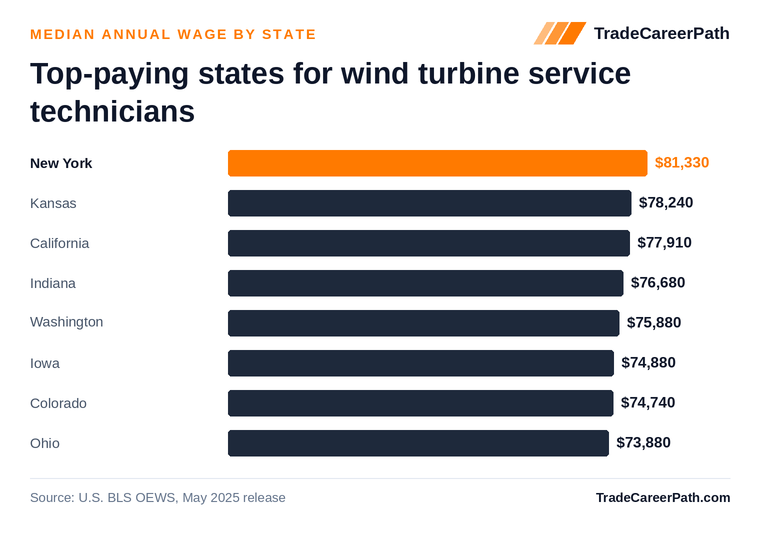
Wind Turbine Technician Salary and Requirements by State
Select your state for local wage data, training options, and requirements:
Alabama · Alaska · Arizona · Arkansas · California · Colorado · Connecticut · Delaware · District of Columbia · Florida · Georgia · Hawaii · Idaho · Illinois · Indiana · Iowa · Kansas · Kentucky · Louisiana · Maine · Maryland · Massachusetts · Michigan · Minnesota · Mississippi · Missouri · Montana · Nebraska · Nevada · New Hampshire · New Jersey · New Mexico · New York · North Carolina · North Dakota · Ohio · Oklahoma · Oregon · Pennsylvania · Rhode Island · South Carolina · South Dakota · Tennessee · Texas · Utah · Vermont · Virginia · Washington · West Virginia · Wisconsin · Wyoming
Workplace Safety Snapshot
BLS Survey of Occupational Injuries and Illnesses data (2023-2024) report approximately 164.2 days-away, restricted, or transfer cases per 10,000 full-time-equivalent workers in wind turbine service technicians (about 1.64 per 100 FTE). Source: BLS Survey of Occupational Injuries and Illnesses, Table R98.
Frequently Asked Questions
How long does wind turbine technician training take?
It typically takes 6 months to 2 years of training. The most common entry path is a certificate or associate degree program, after which employers add paid on-the-job training. A high school diploma or GED is generally required to get started.
Do you need a college degree to work as a wind turbine technician?
No. A four-year degree is not required. Most people enter the field through a certificate or associate degree program in wind energy technology. A high school diploma or GED is typically the only educational prerequisite.
How much does wind turbine technician training cost?
Costs vary by program and school. Certificate programs are usually less expensive than associate degrees, and some employers provide additional paid training on the job. Contact schools directly for current tuition.
Is certification required to work as a wind turbine technician?
No single national license is required, but most employers expect safety training such as the Global Wind Organisation (GWO) Basic Safety Training, plus OSHA and first aid or CPR credentials. Manufacturers often add their own equipment-specific training after you are hired.
Is it hard to train as a wind turbine technician?
Entry is accessible because no four-year degree is required and most people finish training in 6 months to 2 years. The work itself is physically demanding, with frequent climbing, heights, confined spaces, and outdoor weather, so physical fitness and comfort at heights matter.
Is wind turbine technician a growing career?
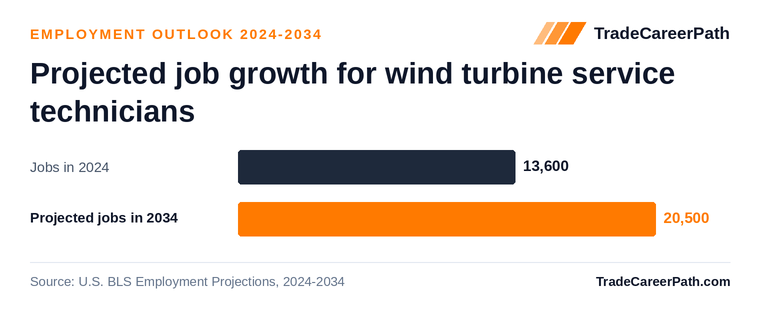
Yes. BLS projects 29.5% employment growth for wind turbine technicians between 2025 and 2035, much faster than average, with about 2,300 openings nationwide each year over that period.
Can you train to be a wind turbine technician online?
Classroom theory can often be completed online or in a hybrid format, but the hands-on climbing, rescue, and turbine-maintenance training must be done in person. Many programs combine online coursework with on-site labs.
How Wind Turbine Technician Pay Compares to Similar Trades
Side-by-side comparison of Wind Turbine Technician and the closest related careers, based on U.S. Bureau of Labor Statistics data (May 2025 OEWS + 2025-2035 Employment Projections).
| Career | Median Pay | 10-Year Growth | Annual Openings |
|---|---|---|---|
| Wind Turbine Technician this guide | $64,120 | +29.5% | 1,500 |
| Solar Installation Professional | $53,140 | +36.5% | 4,200 |
| Lineworker | $95,320 | +10.3% | 10,900 |
| Tower Technician Training | $63,890 | -3.3% | 11,300 |
| Electrician | $63,190 | +9.2% | 72,700 |
Source: BLS Occupational Employment and Wage Statistics + BLS Employment Projections.
Advance Your Career with a Degree
Experienced Wind Turbine Technician professionals often step up into degree-track careers where field experience is a hiring advantage:
- Electrical Engineer - median pay $120,630 (BLS OEWS, May 2025); requires a 4-year degree
See all trade careers that require a 4-year degree.
Sources
- U.S. Bureau of Labor Statistics, Occupational Employment and Wage Statistics (May 2025)
- U.S. Bureau of Labor Statistics, Employment Projections 2025-2035
- U.S. Bureau of Labor Statistics, Survey of Occupational Injuries and Illnesses (2023-2024, Table R98)
- U.S. Department of Labor, Wage and Hour Division, Davis-Bacon General Wage Determinations (2026)
Wind Turbine Technician Salary by State
About this guide: Researched and written by the TradeCareerPath Editorial Team. Our editorial team researches and sources every trade school and career guide using federal labor and education data, including BLS OEWS and Employment Projections, DOL apprenticeship records, IPEDS, College Scorecard, and state licensing boards. We follow the editorial standards documented at /editorial-policy/.
Data sources
Figures on this page are sourced from the federal and state datasets below. Methodology: how we rank and source data.
| Data | Provider | Vintage |
|---|---|---|
| Occupational Employment and Wage Statistics (OEWS) | U.S. Bureau of Labor Statistics | May 2025 |
| Employment Projections | U.S. Bureau of Labor Statistics | 2025-2035 |
| Integrated Postsecondary Education Data System | National Center for Education Statistics (IPEDS) | 2024 |
| College Scorecard (school-level outcomes) | U.S. Department of Education | latest release |
| College Scorecard (field-of-study earnings) | U.S. Department of Education | latest release (updated 2026-06-12) |
| Occupational licensing requirements | CareerOneStop (U.S. Department of Labor) | latest release (updated 2026-02-22) |
| Registered apprenticeship programs | CareerOneStop / Apprenticeship.gov (U.S. Department of Labor) | latest release (updated 2025-10-25) |
| O*NET occupation profiles (skills, tasks, tools, job zones) | U.S. Department of Labor (O*NET / Employment & Training Admin.) | O*NET 31.0 (updated 2026-10-14) |