
Programs Near You
Select a program of interest and we’ll connect you with trade schools that match your goals.
Top Paying Skilled Trades Without a Degree in 2026
Many skilled trades do not require a four-year degree, but pay and training time vary widely by trade, location, and experience. This guide uses U.S. Bureau of Labor Statistics (BLS) data to compare roles that often have higher earning potential, along with common training routes.
Many people choose trades because training can be shorter than a bachelor's degree and some fields offer paid apprenticeships. Outcomes, costs, and timelines vary by trade, school, and state, so it's worth comparing local options before committing.
Note on pay: the “median” is the midpoint of workers in that occupation. The “top 10%” typically reflects experienced workers, specialty roles, and higher-paying regions (and may include overtime); actual pay varies.
Why Skilled Trades Are In Demand
"The construction industry alone needs 439,000 additional workers in 2026 just to meet labor demand."[^abc]
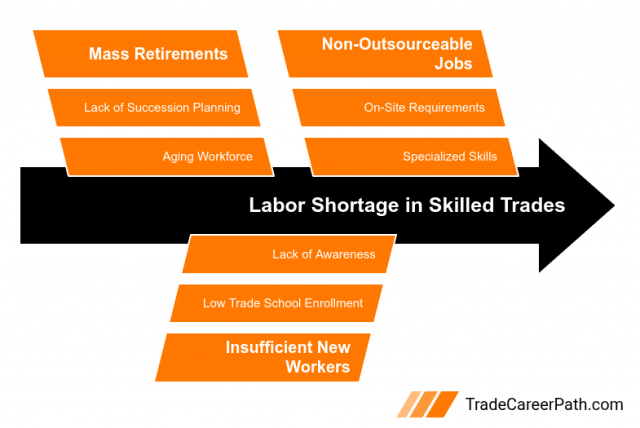
Some common factors include:
- Mass retirements - Nearly 40% of tradespeople are over 45[^peopleready]
- Too few new workers - Trade school enrollment hasn't kept up
- In-person work - Many roles require on-site work and hands-on skills
Many trades don't require a four-year degree. Common routes include apprenticeships, certificates, diplomas, and associate degrees, depending on the occupation and state requirements.
Top Skilled Trades That Pay (No Degree Required)
All of these are classified as skilled trades by the U.S. Bureau of Labor Statistics (BLS)[^bls-ooh]. Pay and training timelines vary by state, specialty, and employer.
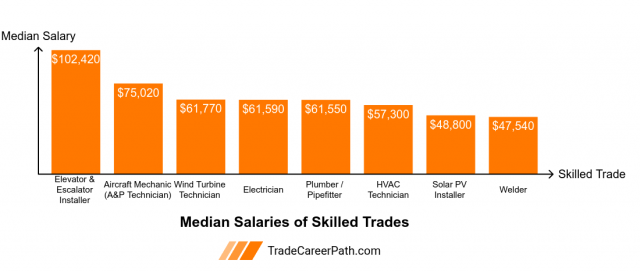
| Trade | Median Salary | Top 10% Earn | Training Time |
|---|---|---|---|
| Elevator & Escalator Installer | $102,420 | $138,910+ | 4-year Apprenticeship |
| Lineworker (Electrical Utility) | $82,770 | $107,000+ | 3-4 years (Apprenticeship + OJT) |
| Aircraft Mechanic (A&P Technician) | $75,020 | $114,750+ | 18-24 months (FAA program) |
| Boilermaker | $67,290 | $100,000+ | 3-4 years (Apprenticeship) |
| Wind Turbine Technician | $61,770 | $90,300 | ~2 years |
| Electrician | $61,590 | $80,260+ | 4-5 years (Apprenticeship) |
| Plumber / Pipefitter | $61,550 | $80,410+ | 2-5 years (Apprenticeship) |
| Millwright / Industrial Mechanic | $61,240 | $90,000+ | 2-4 years (Apprenticeship) |
| Crane Operator | $60,900 | $98,000+ | 6-12 months + certification |
| HVAC Technician | $57,300 | $79,000 | 6-18 months |
| Sheet Metal Worker | $56,450 | $90,000+ | 4-year Apprenticeship |
| Sprinkler Fitter / Fire Protection Installer | $55,000+ | $85,000+ | 3-5 years (Apprenticeship) |
| Heavy Equipment Operator | $55,060 | $85,000+ | 6-12 months |
| Truck Driver (CDL-A) | $53,090 | $80,000+ | 3-6 weeks (CDL school) |
| Diesel Mechanic | $51,800 | $78,000+ | 1-2 years |
| Masonry Worker | $51,240 | $78,000+ | Apprenticeship or on-the-job |
| Solar PV Installer | $48,800 | $72,000+ | 6-12 months |
| Welder | $47,540 | $72,970 | 6-18 months |
Career Growth & Pay Progression
Pay often increases with experience, licensing, and specialization. The examples below are illustrative and can vary widely by region, employer, and overtime.
| Trade | Entry-Level | Median | Top 10% |
|---|---|---|---|
| Elevator Installer | ~$45,000 | ~$102,420 | $138,910+ |
| Lineworker (Utility) | ~$50,000 | ~$82,770 | $107,000+ |
| Aircraft Mechanic | ~$45,000 | ~$75,020 | $114,750+ |
| Boilermaker | ~$45,000 | ~$67,290 | $100,000+ |
| Wind Turbine Technician | ~$45,000 | ~$61,770 | $90,300 |
| Electrician | ~$38,000 | ~$61,590 | $80,260+ |
| Plumber | ~$40,000 | ~$61,550 | $80,410+ |
| Millwright / Industrial Mechanic | ~$42,000 | ~$61,240 | $90,000+ |
| Crane Operator | ~$45,000 | ~$60,900 | $98,000+ |
| HVAC Tech | ~$36,000 | ~$57,300 | $79,000 |
| Sheet Metal Worker | ~$40,000 | ~$56,450 | $90,000+ |
| Sprinkler Fitter | ~$42,000 | ~$55,000+ | $85,000+ |
| Heavy Equipment Operator | ~$40,000 | ~$55,060 | $85,000+ |
| Truck Driver (CDL-A) | ~$40,000 | ~$53,090 | $80,000+ |
| Diesel Mechanic | ~$36,000 | ~$51,800 | $78,000+ |
| Masonry Worker | ~$38,000 | ~$51,240 | $78,000+ |
| Solar PV Installer | ~$38,000 | ~$48,800 | $72,000+ |
| Welder | ~$35,000 | ~$47,540 | $72,970 |
Union scale, overtime, commercial projects, and specialty licenses (e.g., Master Electrician, NCCCO for crane ops, or CDL-A endorsements) can increase pay in some markets; results vary.
How to Start Without a Degree
| Path | Description | Cost |
|---|---|---|
| Union Apprenticeship | Paid training with classroom + on-the-job learning | Costs and fees vary |
| Trade School | Focused hands-on training (program length varies) | Costs vary by program and credential |
| Community College | Certificates and associate-level trade programs | Often lower-cost; varies by state and district |
| On-the-Job Training | Start entry-level and learn on the job | Entry wages vary |
Use the Apprenticeship Finder[^dol] and check your state's license requirements to begin.
Which Trade Fits You?
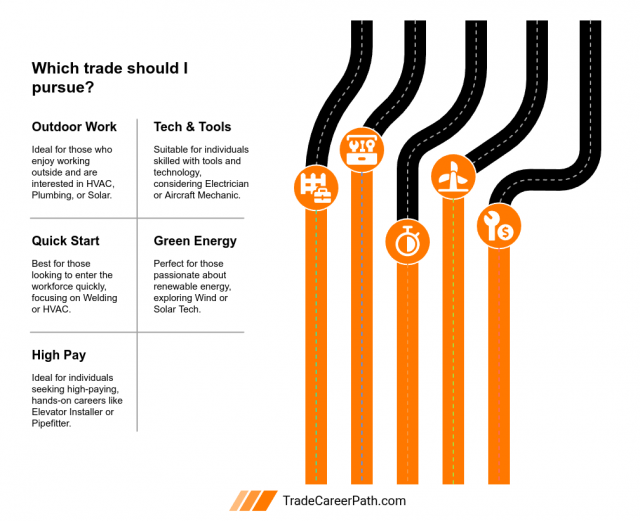
Prefer outdoor work? HVAC, Plumbing, Solar Installer, Lineworker, Heavy Equipment Operator
Like tools and troubleshooting? Electrician, Aircraft Mechanic, Millwright, Diesel Mechanic
Looking for a shorter initial training path? Welding, HVAC, Truck Driving (CDL), Solar Installation
Interested in energy work? Wind Turbine Tech, Solar Installer, Sheet Metal Worker (HVAC ducting)
Focused on higher earning potential in some markets? Elevator Installer, Crane Operator, Boilermaker, Plumber
Want to work with large equipment? Heavy Equipment Operator, Crane Operator, Diesel Mechanic
Interested in apprenticeships (when available)? Electrician, Plumber, Elevator, Sheet Metal, Sprinkler Fitter
Prefer building and fabrication work? Masonry Worker, Welder, Sheet Metal Worker, Carpenter
Still not sure? Start by browsing our Skilled Trade Guides.
Common Questions About Pay and Training
Do trades pay well?
Pay varies by trade, region, licensing, and overtime. Some roles have higher median wages than others, and pay can increase with experience and specialization.
Is it all manual labor?
Many trades involve physical work, but most also require troubleshooting, math, code compliance, safety procedures, and customer communication.
Do I need college?
Many roles do not require a bachelor's degree, but some paths (especially management roles) may require additional education or experience.
How long does training take?
It depends. Some certificates can take months, while apprenticeships often take several years and include paid on-the-job learning.
Is there room to advance?
Many workers move into lead roles, foreman positions, estimating, inspection, instruction, or business ownership over time.
Next Steps
- Explore our Skilled Trade Guides
- Learn your State Licensing Requirements
- Find an Apprenticeship Program[^dol]
- Bookmark this page for 2026 salary updates
Sources [^bls-ooh]: U.S. Bureau of Labor Statistics - Occupational Outlook Handbook [^abc]: Associated Builders and Contractors - Construction Labor Forecast 2025 [^peopleready]: PeopleReady - Skilled Trades Labor Gap Report [^dol]: U.S. Department of Labor - Apprenticeship Finder [^nccer]: National Center for Construction Education & Research (NCCER) - nccer.org