
How to Become a Plumber in 2026
Is Plumber Right for You?
The U.S. Department of Labor's O*NET profile for Plumbers, Pipefitters, and Steamfitters (SOC 47-2152) describes the work this way: Assemble, install, alter, and repair pipelines or pipe systems that carry water, steam, air, or other liquids or gases. May install heating and cooling equipment and mechanical control systems. Includes sprinkler fitters.
What the work involves
- Shut off steam, water, or other gases or liquids from pipe sections, using valve keys or wrenches.
- Install underground storm, sanitary, or water piping systems, extending piping as needed to connect fixtures and plumbing.
- Assemble pipe sections, tubing, or fittings, using couplings, clamps, screws, bolts, cement, plastic solvent, caulking, or soldering, brazing, or welding equipment.
- Locate and mark the position of pipe installations, connections, passage holes, or fixtures in structures, using measuring instruments such as rulers or levels.
- Cut, thread, or hammer pipes to specifications, using tools such as saws, cutting torches, pipe threaders, or pipe benders.
Skills and knowledge that matter
Skills: Critical Thinking, Troubleshooting, Repairing, Judgment and Decision Making, Monitoring, Time Management.
Knowledge: Building and Construction, Mechanical, Design, Mathematics.
Tools and technology you may use
Tools: Acetylene torches, Adjustable slip lock nut wrenches, Adjustable wrenches, Air compressors, Air operated grinders, Air pressure gauges.
Technology: Computer aided design CAD software, Word processing software, Analytical or scientific software, Intuit QuickBooks, Microsoft Active Server Pages ASP, Microsoft Excel.
Typical preparation
O*NET Job Zone Three (Medium Preparation Needed). Most occupations in this zone require training in vocational schools, related on-the-job experience, or an associate's degree. Employees in these occupations usually need one or two years of training involving both on-the-job experience and informal training with experienced workers. A recognized apprenticeship program may be associated with these occupations.
Interest fit
O*NET interest profile: Realistic, Conventional, Investigative. People who enjoy hands-on, practical work with tools, machines, plants, or materials often find this occupation a good fit.
Source: O*NET 29.1 (updated 2026-06-13)
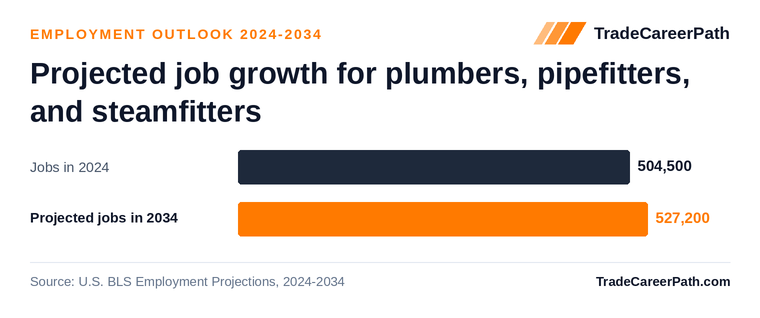
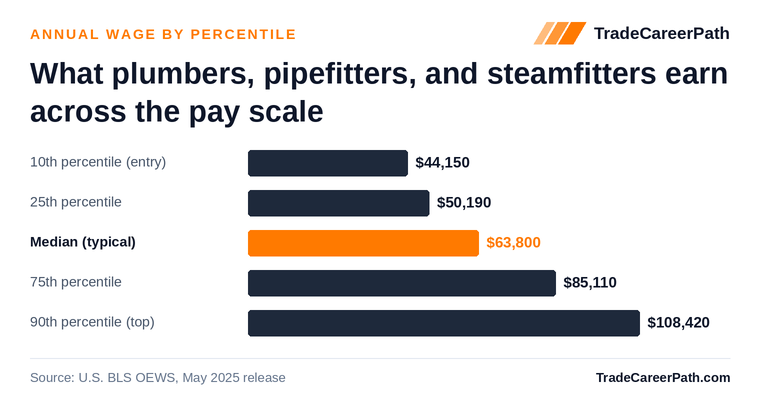
Quick answer: Training as a plumber usually takes about 4 to 5 years through a registered apprenticeship that pays you while you learn. You complete supervised on-the-job hours plus classroom instruction, then earn a state license (required in most states) by passing a codes and safety exam. No college degree is needed. The median plumber salary is $63,800 per year ($30.67/hour), and the field is expected to have about 44,000 openings nationwide each year (BLS, May 2025).
Plumbers install, maintain, and repair the piping systems that carry water, gas, and waste through homes, hospitals, schools, and factories. If you are mechanically inclined and like solving problems with your hands, plumbing offers steady, skilled work with a clear path to licensing and self-employment.
How to Become a Plumber
Most plumbers reach journeyman status in about four to five years. There is no single shortcut: you build the career through education, paid apprenticeship hours, and a state license. Here is how the path works.
1. Earn a High School Diploma or GED
A high school diploma or GED is the baseline requirement for nearly every apprenticeship and trade program. Before you apply, focus on the subjects the work depends on. Algebra and geometry come up constantly when you size pipe, calculate slope for drainage, and figure pressure and flow. Basic physics and chemistry help you understand how water, gas, and heat behave in a system. Any shop, drafting, or technical-drawing class is good preparation for reading blueprints and isometric diagrams. Comfort with simple computer tools helps too, since modern shops use estimating software and digital code references. If you are changing careers and already hold a diploma, you can move straight to the next step. Trades welcome people from other backgrounds, and skills like reliability, customer service, and basic mechanical work transfer well into plumbing.
2. Apply for an Apprenticeship or Trade Program
The most common route into plumbing is a registered apprenticeship. The United Association (UA) of Plumbers and Pipefitters is the primary union and sponsors registered apprenticeships, while the Plumbing-Heating-Cooling Contractors Association (PHCC) runs programs through its educational foundation. Non-union contractors and local joint apprenticeship committees also hire apprentices directly. These programs pay you a wage that rises as you gain skill, so you earn while you learn instead of paying full tuition. If you cannot land an apprenticeship right away, a trade school certificate or pre-apprenticeship program teaches safety, tools, and basic code, which can make you a stronger applicant. Apply to several programs, since competition for paid apprenticeship slots can be high, and ask each about start dates, wage progression, and how classroom hours are scheduled.
3. Complete Your On-the-Job and Classroom Hours
A plumbing apprenticeship typically runs four to five years and blends supervised field work with classroom instruction. On the job, you work alongside licensed plumbers measuring, cutting, joining, and testing pipe, installing fixtures and water heaters, and roughing in new systems. In the classroom, you study the plumbing code, blueprint and isometric reading, math for the trade, water supply and drainage design, gas piping, and job-site safety. Much of the code instruction is built on standards from bodies like the International Association of Plumbing and Mechanical Officials (IAPMO), which publishes the Uniform Plumbing Code, and the International Code Council (ICC), which publishes the International Plumbing Code. Keep careful records of your hours, because your state licensing board will require proof of supervised experience when you apply to test.
4. Earn Your State Plumbing License
Most states require plumbers to hold a license before working on their own. The first credential is usually a journeyman license, which lets you do plumbing work independently. To qualify, you generally document your apprenticeship hours and pass an exam covering plumbing codes, safety procedures, system design, and practical skills. Requirements and exam content vary by state and sometimes by city or county, so check with your state board early and study the exact code edition your jurisdiction adopts. Some plumbers also add national certifications that licensing and employers value, such as a backflow prevention assembly tester or medical gas installer credential. The American Society of Sanitary Engineering (ASSE) develops plumbing standards and offers several of these professional certifications.
5. Specialize or Advance Your License
Once you are a licensed journeyman, you can keep building. Many plumbers work toward a master plumber license, which usually requires additional years of experience and a more advanced exam. A master license lets you pull permits, design systems, run jobs, and supervise other plumbers, and it is often a prerequisite for owning a plumbing business. You can also specialize in higher-paying niches such as pipefitting and steamfitting, gas systems, medical gas, backflow testing, or green and high-efficiency plumbing. To find work, use apprenticeship and union connections, contractor associations, trade-school placement help, and local job boards. As you gain a reputation for clean, code-compliant work, referrals and repeat customers work as a steady source of jobs.
What Plumbers Do
Plumbers install, maintain, and repair piping systems that move water, gas, and waste. They read blueprints, interpret plumbing codes, and make sure each system runs safely and efficiently in homes, businesses, and industrial sites.
Common Responsibilities
- Measure, cut, and assemble pipes and fittings
- Install and test water heaters, sinks, and drainage lines
- Connect gas lines to stoves and furnaces
- Inspect systems for leaks and performance issues
- Follow local and national plumbing codes
- Maintain tools, safety gear, and documentation
Plumbing combines precision, safety, and problem-solving. No two job sites are exactly alike.
Key Skills for Plumbing Success
- Mechanical and troubleshooting aptitude
- Basic math and spatial reasoning
- Understanding of codes and technical diagrams
- Physical stamina and attention to safety
- Clear communication with clients and team members
Typical Work Settings
Plumbers work across many industries and settings:
- Residential and commercial construction
- Maintenance and facility operations
- Industrial and manufacturing sites
- Municipal and water systems
- Specialized gas or medical pipeline systems
Journeyman vs. Master Plumber
People often ask how a journeyman plumber differs from a master plumber. The distinction matters for both pay and what work you are allowed to do.
- Journeyman plumber: has finished an apprenticeship and passed a licensing exam. A journeyman can perform plumbing work independently, usually under a master’s permit on larger jobs.
- Master plumber: holds a higher license earned with additional experience and a more advanced exam. A master can pull permits, design systems, supervise other plumbers, and is typically required to own and run a plumbing business.
Exact rules vary by state, so confirm the requirements with your state or local licensing board before planning your path.
Training and Education Options
| Pathway | Typical Duration | Description |
|---|---|---|
| Pre-Apprenticeship Program | 6 to 12 months | Introduces safety, codes, and basic tools |
| Apprenticeship | 4 to 5 years | Combines classroom learning with paid on-the-job training |
| Trade School Certificate | 1 to 2 years | Classroom-based technical training |
| Continuing Education | Ongoing | Updates on plumbing codes and technologies |
Specialty Certifications
Beyond a state license, plumbers can earn advanced or niche credentials, including:
- Backflow Prevention Assembly Tester
- Medical Gas Installer
- Green or High-Efficiency Plumbing Certification
- Pipefitting or Fire Suppression Systems Endorsement
Continuing education and specialty training help maintain licensure and open higher-paying work.
Career Growth and Opportunities
With experience and licensing, plumbers can advance into:
- Journeyman or Master Plumber Roles
- Project Supervisor or Estimator
- Business Owner or Contractor
- Specialty Systems Installer (Gas, Water, or Fire Protection)
Plumbing offers steady, technical work with room to advance and the option to run your own business.
Training Duration and Cost Overview
- Time to train: about 4 to 5 years, including apprenticeship
- Structure: a combination of classroom instruction and supervised field experience
- Program costs: vary by state, union, or training provider; many apprenticeships are paid
Always verify costs and requirements directly with your chosen school, union, or licensing board.
Pros and Considerations
Highlights
- Hands-on, practical trade
- Paid apprenticeship instead of tuition debt
- Strong, steady industry demand
- Clear path to independent contracting
Considerations
- Training and licensing take several years
- Work can involve confined or outdoor environments
- Requires physical stamina and a safety focus
- License rules vary by state
Plumbing Licensing by State
Licensing rules vary widely across the country. Most states issue separate credentials for journeyman and master plumbers, while some also regulate gas fitting and pipefitting.
| State | Guide |
|---|---|
| Texas | Plumbing in Texas |
| Florida | Plumbing in Florida |
| California | Plumbing in California |
View All State Plumbing Requirements >
Find Plumbing Training Near You
Quick Facts: Plumbing Salary, Licensing, and Outlook
Industry Organizations & Certifying Bodies
These are the recognized national organizations, unions, certifying bodies, and regulatory authorities that shape this trade. They issue the credentials, sponsor the apprenticeships, publish the codes, and represent workers and employers.
- United Association (UA) of Plumbers and Pipefitters Primary plumbing union; sponsors 5-year registered apprenticeships.
- Plumbing-Heating-Cooling Contractors Association (PHCC) National contractor association with PHCC Educational Foundation apprenticeship programs.
- American Society of Sanitary Engineering (ASSE) Develops plumbing standards and offers professional certifications (backflow, medical gas, etc.).
- International Association of Plumbing and Mechanical Officials (IAPMO) Publishes the Uniform Plumbing Code (UPC) used in many states.
- International Code Council (ICC) Publishes the International Plumbing Code (IPC) used in many states.
Federal Prevailing Wages by State
The U.S. Department of Labor sets Davis-Bacon prevailing wages that contractors must pay on federally funded construction projects. These are minimum hourly rates, not averages - actual market pay can be higher. Across 48 states with active 2026 determinations, the average total compensation (base + fringe) for plumbers is $55.88/hour. New Jersey pays the highest rate ($107.06/hr total), while Florida reports the lowest active determination ($15.60/hr total).
| State | Base Hourly | Fringe Hourly | Total Hourly | Annualized* |
|---|---|---|---|---|
| New Jersey | $56.30 | $50.76 | $107.06 | $222,685 |
| Massachusetts | $69.84 | $36.43 | $106.27 | $221,042 |
| Oregon | $60.77 | $34.72 | $95.49 | $198,619 |
| Nevada | $65.79 | $26.55 | $92.34 | $192,067 |
| Wisconsin | $60.05 | $27.90 | $87.95 | $182,936 |
| Hawaii | $53.83 | $33.19 | $87.02 | $181,002 |
| Missouri | $52.60 | $29.93 | $82.53 | $171,662 |
| Minnesota | $48.06 | $30.33 | $78.39 | $163,051 |
| Michigan | $51.30 | $25.87 | $77.17 | $160,514 |
| District of Columbia | $53.30 | $23.71 | $77.01 | $160,181 |
| Washington | $47.15 | $27.20 | $74.35 | $154,648 |
| Pennsylvania | $48.65 | $25.47 | $74.12 | $154,170 |
| Illinois | $42.70 | $30.98 | $73.68 | $153,254 |
| Idaho | $44.57 | $26.58 | $71.15 | $147,992 |
| Maryland | $46.21 | $24.90 | $71.11 | $147,909 |
| California | $44.75 | $26.20 | $70.95 | $147,576 |
| New York | $42.68 | $27.88 | $70.56 | $146,765 |
| Alaska | $41.50 | $27.62 | $69.12 | $143,770 |
| Indiana | $44.93 | $23.23 | $68.16 | $141,773 |
| Montana | $46.45 | $19.92 | $66.37 | $138,050 |
| Kentucky | $41.00 | $21.66 | $62.66 | $130,333 |
| Delaware | $45.40 | $16.23 | $61.63 | $128,190 |
| Nebraska | $44.26 | $16.90 | $61.16 | $127,213 |
| West Virginia | $36.58 | $24.58 | $61.16 | $127,213 |
| North Dakota | $40.53 | $20.60 | $61.13 | $127,150 |
| New Mexico | $43.07 | $16.60 | $59.67 | $124,114 |
| Colorado | $41.32 | $16.01 | $57.33 | $119,246 |
| Texas | $37.15 | $16.92 | $54.07 | $112,466 |
| Alabama | $32.50 | $19.33 | $51.83 | $107,806 |
| Georgia | $30.00 | $16.66 | $46.66 | $97,053 |
| Ohio | $27.79 | $14.49 | $42.28 | $87,942 |
| Mississippi | $30.41 | $11.47 | $41.88 | $87,110 |
| Louisiana | $26.50 | $13.39 | $39.89 | $82,971 |
| Kansas | $27.79 | $10.85 | $38.64 | $80,371 |
| Iowa | $23.94 | $10.84 | $34.78 | $72,342 |
| New Hampshire | $25.24 | $8.60 | $33.84 | $70,387 |
| Vermont | $24.04 | $8.25 | $32.29 | $67,163 |
| Utah | $24.00 | $4.62 | $28.62 | $59,530 |
| Virginia | $21.74 | $5.45 | $27.19 | $56,555 |
| Maine | $20.35 | $5.09 | $25.44 | $52,915 |
| North Carolina | $23.11 | $0.00 | $23.11 | $48,069 |
| Arizona | $19.04 | $3.07 | $22.11 | $45,989 |
| Tennessee | $21.81 | $0.00 | $21.81 | $45,365 |
| Oklahoma | $18.00 | $3.23 | $21.23 | $44,158 |
| Arkansas | $17.73 | $2.84 | $20.57 | $42,786 |
| South Carolina | $16.99 | $2.17 | $19.16 | $39,853 |
| South Dakota | $14.02 | $1.90 | $15.92 | $33,114 |
| Florida | $12.27 | $3.33 | $15.60 | $32,448 |
* Annualized total = total hourly × 2,080 hours (40-hour week, 52 weeks). Actual annual pay varies with overtime, project length, and benefits utilization.
Source: U.S. Department of Labor, Wage and Hour Division - Davis-Bacon General Wage Determinations, 2026. Rates reflect the lowest base rate within each statewide determination for plumber classifications.
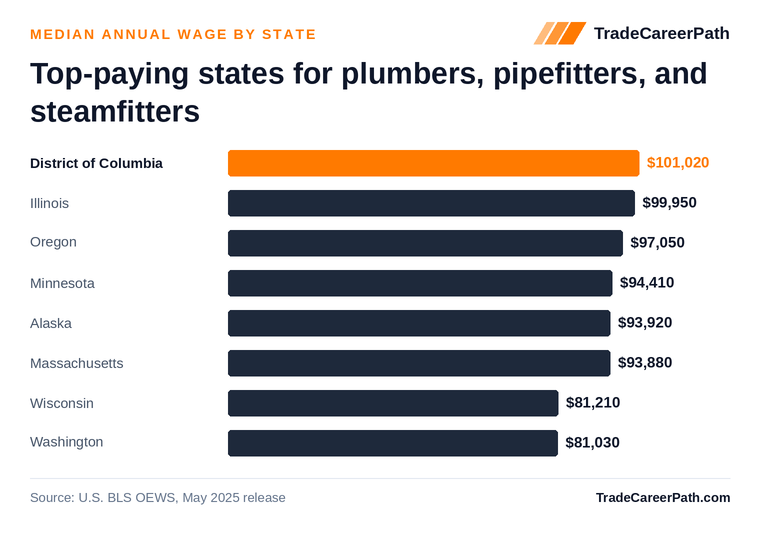
Wage and Employment Charts
Plumber Salary and Requirements by State
Select your state for local wage data, training options, and requirements:
Alabama · Alaska · Arizona · Arkansas · California · Colorado · Connecticut · Delaware · District of Columbia · Florida · Georgia · Hawaii · Idaho · Illinois · Indiana · Iowa · Kansas · Kentucky · Louisiana · Maine · Maryland · Massachusetts · Michigan · Minnesota · Mississippi · Missouri · Montana · Nebraska · Nevada · New Hampshire · New Jersey · New Mexico · New York · North Carolina · North Dakota · Ohio · Oklahoma · Oregon · Pennsylvania · Rhode Island · South Carolina · South Dakota · Tennessee · Texas · Utah · Vermont · Virginia · Washington · West Virginia · Wisconsin · Wyoming
Workplace Safety Snapshot
BLS Survey of Occupational Injuries and Illnesses data (2023-2024) report approximately 211.7 days-away, restricted, or transfer cases per 10,000 full-time-equivalent workers in plumbers, pipefitters, and steamfitters (about 2.12 per 100 FTE). Source: BLS Survey of Occupational Injuries and Illnesses, Table R98.
Frequently Asked Questions
How long does plumber training take?
Most plumbers reach journeyman status in about 4 to 5 years through a registered apprenticeship, which combines paid on-the-job hours with classroom instruction. A high school diploma or GED is generally required to start.
Do you need a college degree to work as a plumber?
No. A college degree is not required to work as a plumber. Most people enter through an apprenticeship or a trade school plus on-the-job training. A high school diploma or GED is typically the only educational prerequisite.
How much does plumbing training cost?
Costs vary widely by program, school, and state. Registered apprenticeships through groups like the United Association or PHCC are often paid, so apprentices earn while they learn, while standalone trade school certificates charge tuition. Check directly with the program or licensing board for current figures.
Do you need a license to work as a plumber?
In most states, yes. Plumbers usually need a state or local license to work independently, and many states issue separate journeyman and master plumber credentials. Licensing typically requires documented work hours and a passing score on an exam covering plumbing codes and safety.
Is plumbing hard to get into?
Entry is accessible because no college degree is required and apprenticeships pay while you train. The work is physically demanding, involves confined spaces and code knowledge, and the licensing path takes several years before you can work on your own.
Can you train to be a plumber online?
Some classroom theory, such as code study and blueprint reading, can be taken online, but plumbing requires extensive supervised, hands-on hours that must be completed in person through an apprenticeship or shop. A fully online path is not enough on its own to earn a license.
What is the difference between a journeyman and a master plumber?
A journeyman plumber has completed an apprenticeship and passed a licensing exam, allowing them to work independently. A master plumber holds a higher license, typically earned with additional experience and another exam, and can pull permits, design systems, and supervise other plumbers.
How Plumber Pay Compares to Similar Trades
Side-by-side comparison of Plumbing and the closest related careers, based on U.S. Bureau of Labor Statistics data (May 2025 OEWS + 2024-2034 Employment Projections).
| Career | Median Pay | 10-Year Growth | Annual Openings |
|---|---|---|---|
| Plumbing this guide | $63,800 | +4.5% | 44,000 |
| HVAC Technician | $61,010 | +8.1% | 40,100 |
| Electrician | $63,190 | +9.5% | 81,000 |
| Construction Worker | $47,120 | +7.3% | 129,400 |
| Home Inspector | $74,690 | -0.8% | 14,800 |
Source: BLS Occupational Employment and Wage Statistics + BLS Employment Projections.
Advance Your Career with a Degree
Experienced Plumber professionals often step up into degree-track careers where field experience is a hiring advantage:
- Environmental Engineer - median pay $107,110 (BLS OEWS, May 2025); requires a 4-year degree
- Construction Cost Estimator - median pay $78,740 (BLS OEWS, May 2025); requires a 4-year degree
- Facilities Manager - median pay $106,660 (BLS OEWS, May 2025); requires a 4-year degree
- Construction Project Manager - median pay $102,320 (BLS OEWS, May 2025); requires a 4-year degree
See all trade careers that require a 4-year degree.
Sources
- U.S. Bureau of Labor Statistics, Occupational Employment and Wage Statistics (May 2025)
- U.S. Bureau of Labor Statistics, Employment Projections 2024-2034
- U.S. Bureau of Labor Statistics, Survey of Occupational Injuries and Illnesses (2023-2024, Table R98)
- U.S. Department of Labor, Wage and Hour Division, Davis-Bacon General Wage Determinations (2026)
Plumber Salary by State
About this guide: Researched and written by the TradeCareerPath Editorial Team. Our editorial team researches and sources every trade school and career guide using federal labor and education data, including BLS OEWS and Employment Projections, DOL apprenticeship records, IPEDS, College Scorecard, and state licensing boards. We follow the editorial standards documented at /editorial-policy/.
Data sources
Figures on this page are sourced from the federal and state datasets below. Methodology: how we rank and source data.
| Data | Provider | Vintage |
|---|---|---|
| Occupational Employment and Wage Statistics (OEWS) | U.S. Bureau of Labor Statistics | May 2025 |
| Employment Projections | U.S. Bureau of Labor Statistics | 2024-2034 |
| Integrated Postsecondary Education Data System | National Center for Education Statistics (IPEDS) | 2024 |
| College Scorecard (school-level outcomes) | U.S. Department of Education | latest release |
| College Scorecard (field-of-study earnings) | U.S. Department of Education | latest release (updated 2026-06-12) |
| Occupational licensing requirements | CareerOneStop (U.S. Department of Labor) | latest release (updated 2026-02-22) |
| Registered apprenticeship programs | CareerOneStop / Apprenticeship.gov (U.S. Department of Labor) | latest release (updated 2025-10-25) |
| O*NET occupation profiles (skills, tasks, tools, job zones) | U.S. Department of Labor (O*NET / Employment & Training Admin.) | O*NET 29.1 (updated 2026-06-13) |